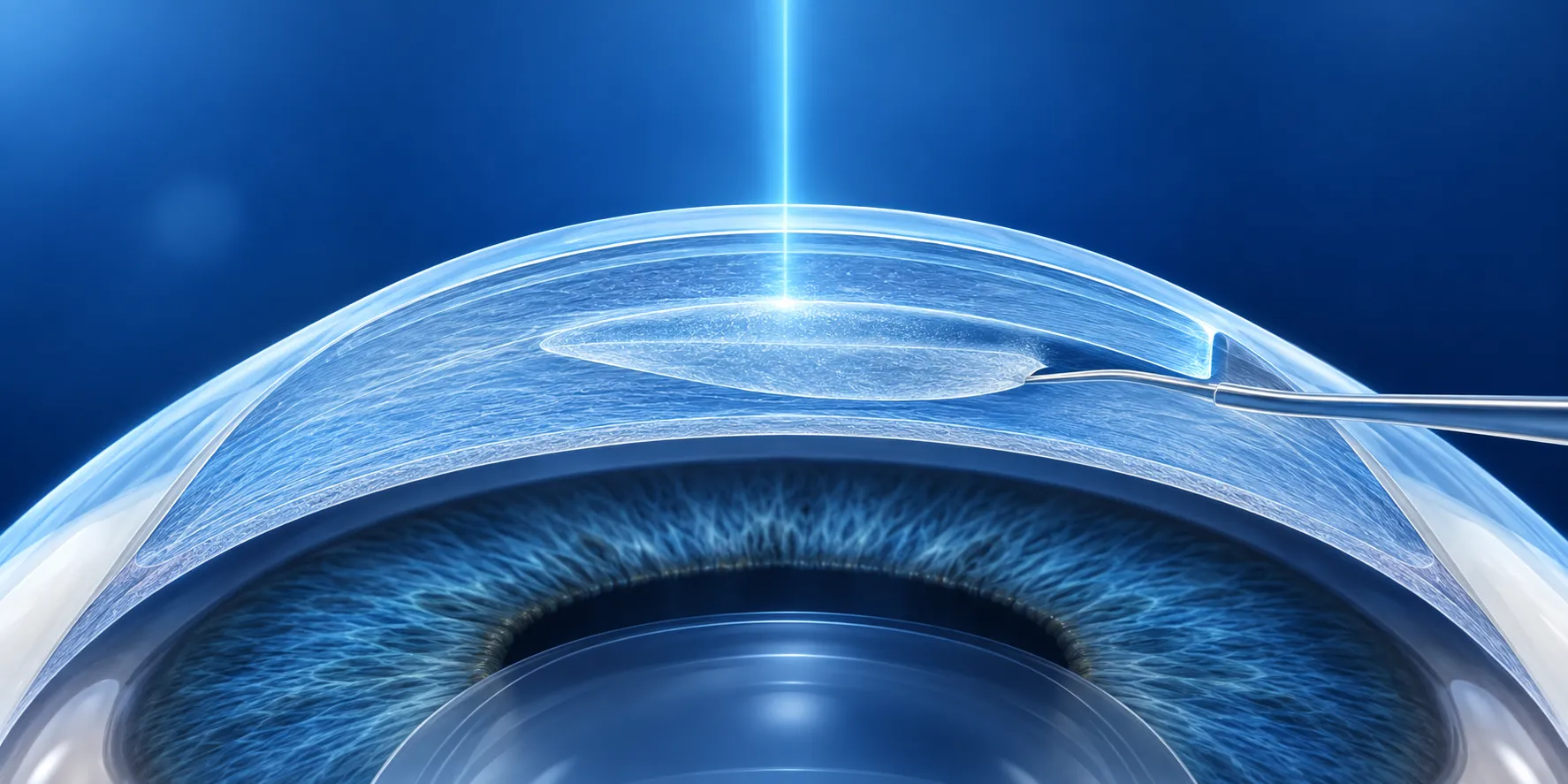

SMILE laser eye surgery is a form of corneal refractive surgery used to reduce myopia, with or without certain levels of astigmatism, in eligible adults. A femtosecond laser creates a thin disc of tissue, called a lenticule, inside the cornea. The surgeon removes that lenticule through a small incision, changing corneal shape so light focuses more accurately on the retina.
Because SMILE does not create a LASIK-style flap, it is often described as “flapless.” That word should not be mistaken for “risk-free” or “suitable for everyone.” Candidacy still depends on a stable prescription, corneal measurements, eye health, tear-film status and realistic expectations. Glasses and contact lenses remain valid alternatives.
How the SMILE procedure changes focus
In myopia, the eye’s optical system focuses distant light in front of the retina. During SMILE, the laser creates two precise planes within the corneal stroma that define the lenticule. A small access incision is then made, and the surgeon separates and removes the tissue. Removing the lenticule alters corneal curvature and focusing power.
The laser step and lenticule removal are both important. Accurate imaging, centration, energy settings and surgical technique influence the result. The procedure is performed with numbing drops, and a device gently stabilises the eye while the laser works. Patients may notice pressure, dimming or changing light during part of the process.
A detailed SMILE procedure review should explain the device, the approved treatment range and the surgeon’s plan. Marketing shorthand cannot replace device-specific patient information and informed consent.
Who may be considered for SMILE
Eligibility varies by device approval and country, but several principles are consistent. The prescription should be stable, the cornea should have an appropriate shape and thickness, and there should be no active eye disease that makes elective treatment unsafe. The planned correction must fall within the supported range of the system being used.
Preoperative testing usually includes refraction, corneal topography or tomography, pachymetry, pupil assessment, tear-film evaluation and a dilated retinal examination. Contact lenses can distort corneal measurements temporarily, so the clinic may ask a wearer to stop them for a specified period before final scans.
Pregnancy, breastfeeding, uncontrolled systemic disease, autoimmune conditions, severe dry eye, keratoconus or suspicious corneal maps may alter timing or rule out surgery. A large prescription alone does not determine candidacy. Residual tissue, optical zone and long-term corneal stability must be considered together.
SMILE, LASIK and PRK are different pathways
LASIK creates a hinged corneal flap, then uses an excimer laser to reshape the stroma beneath it. PRK removes the surface epithelium before excimer-laser treatment and allows that layer to regrow. SMILE creates and removes a stromal lenticule through a small incision without an excimer ablation or large flap.
These differences affect early recovery, possible complications and enhancement choices. LASIK often provides rapid early clarity but introduces flap-related considerations. PRK avoids a flap but usually involves more surface discomfort and slower early visual recovery. SMILE avoids a flap and may disturb fewer anterior corneal nerves, yet it has its own learning curve and retreatment pathways.
Comparative studies generally find all three capable of effective correction in appropriately selected eyes, but averages do not predict an individual result. A refractive surgery consultation should compare the measured eye against each procedure rather than declare one universally superior.
What to expect on procedure day
The team rechecks the treatment plan, confirms consent and prepares the eye. Numbing drops are applied. The patient lies beneath the laser and focuses on a target light as instructed. A curved contact interface connects with the eye, creating temporary pressure or a sensation of firmness.
The laser forms the lenticule and incision. The surgeon then opens the incision, separates the lenticule from surrounding tissue and removes it. Timing varies, and the preparation, positioning and checks take longer than the laser delivery itself.
Vision may be misty immediately afterward. Transport home should be arranged, and driving should wait until the treating clinician confirms that visual standards are met. Drops, protective measures and follow-up timing should be provided in writing.
Recovery is usually quick, but not identical for everyone
Many people resume routine indoor activities within a few days, but clarity can fluctuate. Mild irritation, watering, light sensitivity, glare or halos may occur. The tear film and cornea continue to settle beyond the first apparently clear day.
Avoid rubbing the eyes. Use prescribed antibiotic, anti-inflammatory and lubricating drops exactly as directed. Advice about washing the face, eye makeup, swimming, dusty settings, exercise and contact sport differs by case, so follow the treating team’s schedule rather than a generic online timeline.
Severe or increasing pain, marked redness, discharge, a sudden fall in vision or new light flashes and floaters needs prompt assessment. Elective surgery follow-up is part of treatment, not an optional extra after the laser has finished.
Risks and limitations deserve plain language
Possible outcomes include undercorrection, overcorrection, residual astigmatism, regression, dry-eye symptoms, glare, halos, starbursts, fluctuating vision and reduced contrast. Infection and inflammation are uncommon but potentially serious. Difficult lenticule separation, retained tissue or irregular healing can affect vision and may require further care.
Refractive surgery cannot guarantee spectacle independence. Reading glasses may be needed as presbyopia develops. Myopia-related retinal risk does not disappear because the front of the eye has been reshaped. Regular eye examinations remain important, especially for people with high myopia.
Enhancement after SMILE is possible in selected cases but is not simply a repeat of the original procedure. Options can include surface ablation or conversion to a flap-based approach, depending on the eye, device and residual tissue. The enhancement policy should be discussed before the first surgery.
Dry eye and visual quality need individual discussion
Some comparative research reports less early disruption to corneal nerves and fewer dry-eye symptoms after SMILE than after flap-based LASIK on average. That does not mean dry eye cannot occur after SMILE. Baseline tear-film disease, screen use, eyelid conditions, medications and environment all influence symptoms.
Visual quality also includes more than the standard eye-chart line. Night driving, glare, contrast and work in dim conditions can matter greatly. Large pupils, higher-order aberrations and the pattern of astigmatism should be part of the evaluation where relevant.
Treating significant ocular-surface disease before measurements can improve comfort and the reliability of surgical planning. A clinic that rushes past dry-eye symptoms may be overlooking both a patient concern and a source of measurement error.
Questions to ask before choosing SMILE
Ask why SMILE is recommended over glasses, contact lenses, PRK or LASIK for the measured eye. Request the name of the laser system and the patient information provided for it. Clarify which prescription ranges and corneal findings the surgeon considers acceptable.
Additional questions include:
- How many similar cases has the surgeon performed with this system?
- What is the plan if suction is lost or the lenticule is difficult to remove?
- What early symptoms are expected, and which require urgent review?
- How are dry eye and night-vision concerns assessed?
- What follow-up visits are included?
- How would a residual prescription be managed after stability?
Reading a LASIK comparison page (https://www.maxivisioneyehospital.com/specialities/lasik-treatment/) can help prepare questions, but the final decision should rest on the examination and the person’s priorities.
A measured decision, not a procedure label
SMILE is a sophisticated method of reshaping the cornea through a small incision. Its flapless design may offer practical advantages for selected patients, but safe care still depends on diagnosis, imaging, device limits, surgical skill and accessible follow-up.
Take time to review alternatives and informed-consent material. A responsible recommendation describes likely benefits and possible limitations without promising a perfect or permanent result.
This educational article does not determine candidacy or recommend refractive surgery. Consult a qualified ophthalmologist for examination and an individual discussion of benefits, alternatives and risks.


























Sign in to leave a comment.