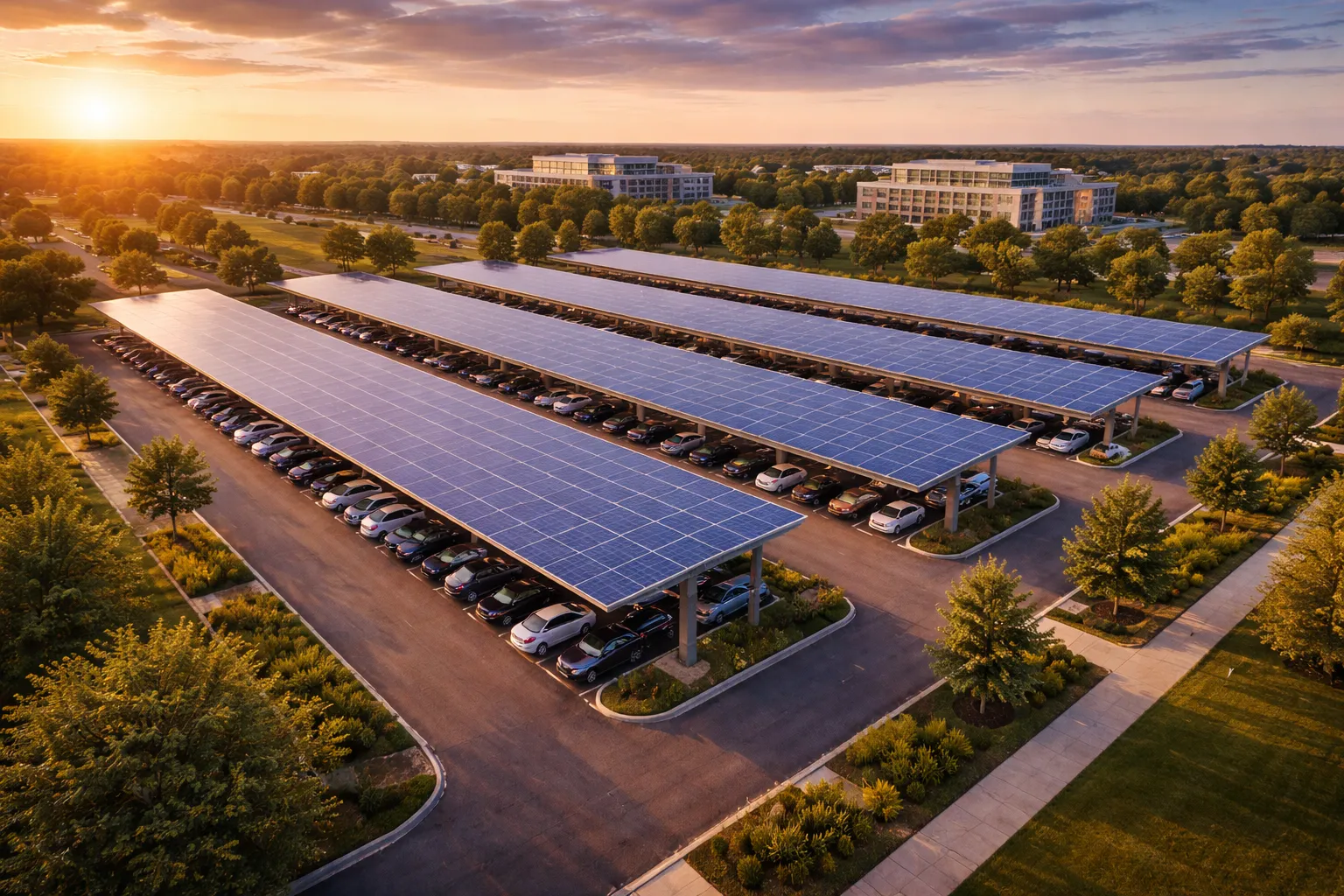

A factory or warehouse parking lot usually has one job: hold vehicles. But the space above it can do more. A solar carport places photovoltaic panels over parking bays, allowing the same footprint to provide shade and generate electricity for the facility.
For businesses with large parking areas and limited roof space, this can be a practical addition to an existing solar strategy. India already has operational solar carports across public and institutional sites, including installations in Chandigarh, Gujarat, Jharkhand and Ladakh, according to a 2026 Government of India document.For factories and warehouses, the attraction is straightforward. The business can use an area it already operates. The financial benefit may come primarily through reduced electricity purchases, while surplus power may have value depending on the project's electrical arrangement and applicable regulations.
Why Parking Areas Are Becoming Solar Assets
Industrial properties often have large parking zones for employees, visitors, delivery vehicles and fleet operations. These areas are already paved, connected to the main facility and kept clear for daily use.
A solar carport adds another layer of use without removing the parking function.
It is especially useful when the roof is already occupied or spare land is limited.
The basic model is simple: parking below, solar generation above and electricity used by the facility. One space performs two jobs.
How Solar Carports Can Improve the Business Case
The word revenue in the context of solar carports needs some qualification. A carport does not automatically create a new income stream. In many factory and warehouse projects, the immediate financial benefit comes from generating electricity on site and reducing the amount of power purchased from the grid.
A facility that consumes substantial electricity during daylight hours can use more solar generation directly, improving the project's usefulness.
A proper feasibility study should consider solar capacity, annual generation, electricity tariff, self-consumption, project cost, financing and applicable regulations rather than relying on a standard savings figure.
Factories and Warehouses Are Natural Candidates
Factories often have predictable daytime loads from machinery, lighting, ventilation, HVAC systems and other operations. Warehouses can have significant requirements for lighting, cooling, refrigeration, automation, security and material handling.
That daytime demand can align well with solar generation. The parking area becomes an additional generation surface when the main roof is not enough.
The Added Benefit: Covered Parking
Electricity is only part of the proposition.
A well-designed solar carport provides shade over vehicles. In India's climate, that can make a difference to cars, two-wheelers, and commercial vehicles parked for several hours.
The canopy can also provide protection from rain and direct sunlight, making the parking area more comfortable for employees and visitors.
For a warehouse or factory with many parking spaces, this turns a basic utility area into a more useful part of the site.
Solar Carports Can Work With EV Charging
The relationship between parking and electricity becomes even more relevant as businesses introduce electric vehicles.
A solar carport can be planned alongside EV charging points, allowing the parking area to become part of the site's energy infrastructure. The charging design depends on vehicle numbers, charging capacity and available electrical load.
This needs to be considered during design rather than added later.
For companies operating electric fleets, the combination can make the carport more useful than standard covered parking.
What Makes a Good Solar Carport Design?
A commercial solar carport is not simply a set of panels placed over cars. The structure has to work around the way the site is actually used.
Engineers need to consider vehicle dimensions, column positions, entry and exit routes, pedestrian movement, wind loads, foundations, drainage, panel orientation, cable routing and maintenance access.
The design also needs to account for the largest vehicle expected to use the area. A structure that works for employee cars may not work for trucks or other commercial vehicles.
Structural engineering is therefore as important as solar system design.
Choosing a Solar Carport Installation Company in India
Businesses should look beyond panel specifications when selecting a Solar Carport Installation Company in India.
The project combines structural engineering, civil work, solar generation and electrical integration. Experience across these areas helps a company assess the parking environment as one system.
Insteel's solar offering includes solar carports designed for industrial and commercial parking facilities. The company also works across structural fabrication, erection and solar in-roof solutions. Its website specifically describes its solar carports as suited to industrial and commercial parking applications.
That combination is relevant for projects where the supporting structure is just as important as the photovoltaic system.
Solar Carport or Rooftop Solar?
A carport does not necessarily replace rooftop solar. For many industrial properties, the two can complement each other.
Rooftop solar makes use of an existing building surface. A carport uses the parking footprint. If both areas are available and suitable, a business can evaluate them together based on generation potential, structural conditions, electrical demand and project economics.
Carports become particularly interesting when rooftop space is limited, unsuitable or already occupied.
A site assessment should determine the right mix.
What Should Be Checked Before Installation?
Before approving a solar carport project, a factory or warehouse owner should review the parking plan, electrical load, available area, structural requirements and future expansion plans.
It is also worth checking how the system will connect to the facility, how electricity will be consumed, what approvals may be required and how maintenance will be handled.
Future requirements matter too. If EV charging, additional parking or changes to vehicle movement are planned, the structure should account for them from the beginning.
Making the Parking Lot Work Harder
A parking area does not have to remain a passive part of a factory or warehouse.
With the right design, it can provide covered parking, generate solar electricity and support future EV infrastructure without giving up its original purpose. For businesses that have already explored rooftop solar and still have energy requirements to address, the parking lot can offer another route.
The strongest financial case is not about promising that every solar carport will create direct revenue. It is about using an existing commercial asset more efficiently and reducing avoidable electricity expenditure.
For businesses evaluating this approach, an experienced Solar Carport Installation Company in India can bring the structural and solar sides together. Insteel's focus on industrial structures and solar solutions makes the carport a natural extension of that approach.
The parking lot stays a parking lot. It does more work for the business.



























Sign in to leave a comment.