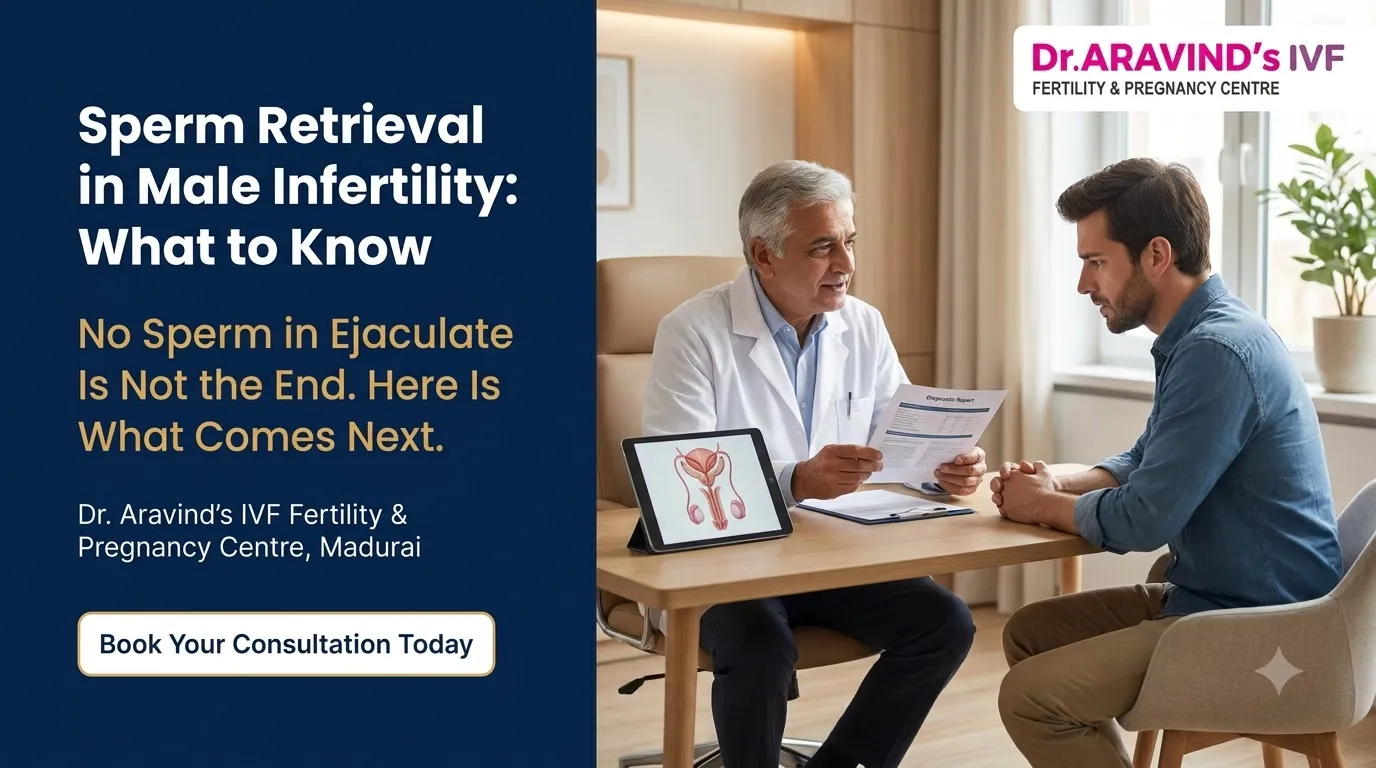
A semen analysis showing no sperm is not the end of the conversation — it is the beginning of a different one.
Sperm retrieval has transformed what is possible for men with azoospermia and severe male infertility. Techniques that were considered experimental three decades ago are now standard clinical procedures at specialist centres — giving biological fatherhood to men who were once told it was not possible. The best IVF centre in Madurai performs sperm retrieval as part of a complete male infertility pathway — because the right evaluation determines everything that comes next.
Why Sperm Retrieval Is Needed
Sperm retrieval is indicated when no sperm — or insufficient sperm — appear in the ejaculate.
The most common reason is azoospermia — the complete absence of sperm in semen. This affects approximately 1 percent of all men and 10 to 15 percent of men presenting at fertility clinics. Azoospermia sperm retrieval is possible because even when no sperm appear in ejaculate, viable sperm often exist within the testicular tissue or epididymis — accessible through minimally invasive surgical techniques.
Sperm retrieval is also indicated when:
- Sperm count is present but severely insufficient for natural conception or standard IVF
- Ejaculatory dysfunction prevents semen sample collection
- Sperm quality in ejaculate is too poor for successful fertilisation
- Sperm banking before cancer treatment was not completed
The Three Main Sperm Retrieval Techniques
Three distinct surgical approaches are used — each suited to a different clinical situation.
TESA — Testicular Sperm Aspiration
A fine needle is inserted through the scrotal skin directly into testicular tissue. Sperm cells are aspirated under suction. Performed under local anaesthesia. Day procedure with rapid recovery. Most effective for obstructive azoospermia — where sperm production is normal but passage is blocked.
PESA — Percutaneous Epididymal Sperm Aspiration
Sperm is retrieved from the epididymis — the coiled tube adjacent to the testicle where sperm mature. Most appropriate for blockage-related azoospermia — vasectomy, congenital absence of vas deferens, or epididymal scarring. Yields highly motile sperm in successful cases.
Micro-TESE — Microsurgical Testicular Sperm Extraction
The most advanced technique. Performed under general anaesthesia using an operating microscope — allowing the surgeon to identify and sample specific sperm-producing tubules within the testis. Most effective for non-obstructive azoospermia — where testicular sperm production is impaired rather than blocked. Micro-TESE achieves retrieval success in 40 to 60 percent of non-obstructive cases where standard TESA would yield nothing.
What Happens to Retrieved Sperm
Every retrieved sperm cell goes directly to the embryology laboratory.
The embryology team isolates viable sperm from the retrieved tissue — identifying cells with the best morphology and motility under high-powered magnification. Retrieved sperm is then used in one of two ways:
- Fresh use — injected directly into mature eggs during an ICSI cycle on the same day as retrieval
- Cryopreservation — frozen for future ICSI cycles. This allows multiple treatment attempts from a single retrieval procedure — important when retrieval yields more than one cycle's requirement
Surgical sperm retrieval ICSI combination is what makes the entire pathway viable — because ICSI requires only one viable sperm per egg, the minimum quantity needed for success is dramatically lower than any other fertilisation method.
Who Is a Candidate for Sperm Retrieval
Sperm retrieval candidacy is determined by the type and cause of azoospermia — not just its presence.
The best fertility centre in Madurai evaluates every candidate through:
- Hormone panel — FSH, LH, testosterone, and prolactin levels distinguish obstructive from non-obstructive azoospermia
- Genetic screening — Y-chromosome microdeletion analysis and karyotyping identify causes that affect retrieval probability
- Testicular volume assessment — smaller testes suggest more severe non-obstructive impairment
- Testicular biopsy histology — confirms whether sperm-producing cells are present before committing to Micro-TESE
This evaluation is not optional — it is the clinical foundation that determines which technique gives the best realistic chance of retrieving viable sperm.
What to Expect Before, During and After
Understanding the process removes a significant amount of the anxiety around it.
Before:
Complete diagnostic evaluation — hormone panel, genetic testing, ultrasound — establishes candidacy and technique selection. The female partner undergoes simultaneous ovarian stimulation, so egg retrieval and sperm retrieval are coordinated.
During:
TESA and PESA take 20 to 30 minutes under local anaesthesia. Micro-TESE takes one to two hours under general anaesthesia. Both are day procedures in most cases.
After:
TESA and PESA — minimal discomfort for one to two days. Normal activity resumed within two to three days. Micro-TESE — mild scrotal discomfort for three to five days. Full recovery within one to two weeks. Results from the embryology laboratory — whether sperm were found — are communicated the same day.
Sperm Retrieval Success Rates — What the Evidence Shows
Success rates depend on the technique used and the underlying cause of azoospermia.
| Technique | Condition | Retrieval Success Rate |
|---|---|---|
| TESA | Obstructive azoospermia | 80 to 90 percent |
| PESA | Epididymal obstruction | 80 to 95 percent |
| Micro-TESE | Non-obstructive azoospermia | 40 to 60 percent |
| Conventional TESE | Non-obstructive | 20 to 35 percent |
Micro-TESE consistently outperforms conventional TESE for non-obstructive cases — because the operating microscope identifies productive tubules that standard needle techniques miss. Surgeon experience and embryology laboratory quality both directly affect where within these ranges an individual result falls.
Where to Access Expert Sperm Retrieval in Madurai
Sperm retrieval outcomes depend as much on who performs the procedure as on the technique itself.
At Dr. Aravind's IVF Fertility & Pregnancy Centre — the best IVF centre in Madurai and one of the best IVF centres in India — TESA, PESA, and Micro-TESE are performed by specialists with dedicated microsurgical training in male infertility procedures. Every retrieval is supported by an advanced embryology team processing samples with the same precision applied to every ICSI cycle. With branches across Madurai, Chennai, Coimbatore, Trichy, Salem, and Tamil Nadu — expert sperm retrieval care is always within reach.
Sperm retrieval does not just retrieve cells — it retrieves possibility from a diagnosis that once felt final. That shift — from biological impossibility to clinical pathway — is what specialist care at the best IVF centre in Madurai delivers for every man who walks in believing his options are closed. At Dr. Aravind's IVF Fertility & Pregnancy Centre, every case of azoospermia is a clinical starting point — never an endpoint.
Frequently Asked Questions
What Is Sperm Retrieval and Who Needs It?
Sperm retrieval is a surgical procedure that accesses viable sperm directly from testicular or epididymal tissue when no sperm — or insufficient sperm — appear in ejaculate. Men with azoospermia, ejaculatory dysfunction, or severely poor ejaculated sperm quality are candidates. The best IVF centre in Madurai evaluates candidacy through a hormone panel, genetic screening, and testicular assessment before recommending any retrieval technique.
What Is the Difference Between TESA, PESA and Micro-TESE?
TESA aspirates sperm from testicular tissue — most effective for obstructive azoospermia. PESA retrieves sperm from the epididymis — best for blockage-related cases. Micro-TESE uses an operating microscope to identify sperm-producing tubules — the most effective technique for non-obstructive azoospermia. Men across Chennai, Coimbatore, and Tamil Nadu can get a complete evaluation at the best fertility centre in Madurai to determine the right technique for their specific diagnosis.
Is Sperm Retrieval Painful?
TESA and PESA cause minimal discomfort under local anaesthesia — most men report mild soreness for one to two days. Micro-TESE is performed under general anaesthesia with three to five days of mild recovery. All three procedures are well tolerated with appropriate anaesthetic and post-procedure care at Dr. Aravind's IVF Fertility & Pregnancy Centre across Madurai and Tamil Nadu.
What Happens if No Sperm Is Found During Retrieval?
If no viable sperm is found during TESA or PESA — Micro-TESE is usually the recommended next step, as it samples a larger testicular area with greater precision. If Micro-TESE also yields no sperm — donor sperm or adoption are discussed honestly. The best IVF centre in India, Dr. Aravind's IVF Fertility & Pregnancy Centre, manages every outcome — successful or not — with complete transparency and compassionate clinical guidance.
Can Retrieved Sperm Be Frozen for Future Use?
Yes. Sperm retrieved through TESA, PESA, or Micro-TESE can be cryopreserved — frozen — for use in future ICSI cycles. This allows multiple treatment attempts from a single retrieval procedure. Cryopreservation is particularly valuable when retrieval yields more than one cycle's requirement. Men across Madurai, Chennai, Coimbatore, and Tamil Nadu can access comprehensive sperm banking alongside retrieval at Dr. Aravind's IVF Fertility & Pregnancy Centre.





















Sign in to leave a comment.