A site engineer once told me about a canopy structure near the coast that started showing rust streaks down its facade within eighteen months of installation. The anchors holding the steel brackets in place had been specced as standard carbon steel the kind that works fine inland but has no business near salt air. By the time anyone noticed, the fasteners were already pitting and the whole bracket assembly needed to come down and go back up with something built for the environment it was actually in, that kind of failure is quiet at first, mostly unnotices, it shows up as a stain, then a wobble, then a call to a structural engineer nobody wanted to make it is also becoming more common as coastal development industrial expansion and stricter durability expectations push projects into conditions where ordinary fasteners simply do not last, and in such situations most structure engineers preffer stainless steel wedge anchors, not as an upgrade for its own sake but as the right tool for a specific kind of risk.
Why the Metal Underneath the Bolt Matters More Than People Think
Most people choosing an anchor look at diameter and length first, which makes sense since those numbers are easy to compare. What gets skipped over is the metallurgy and that is usually the part that decides whether the anchor is still doing its job in ten years, a stainless steel wedge anchor made from 304 grade, sometimes labelled A2, handles general outdoor exposure well. It resists rain, humidity, and normal atmospheric wear without much trouble. But once chlorides enter the picture, from seawater, deicing salt or industrial chemical splash, 304 starts to pit and that pitting spreads quietly beneath the surface long before it becomes visible from outside.
This is where 316, also known as A4 grade, changes the outcome. A4 316 wedge anchors carry an added 2% to 3% molybdenum in the alloy and that small addition meaningfully improves resistance to chloride attack. It is not a marketing distinction, it is why A4 has historically been the material of choice in food processing and shipbuilding, industries where corrosion failure has real consequences and no room for guesswork. A processing plant cannot afford a fastener that quietly degrades behind a wall panel and neither can a structure sitting a few hundred meters from open water.
Here is where procurement teams sometimes get caught out. A fastener stamped simply "316" tells you about the chemistry not the strength. The designation "A4-70" under ISO 3506-1 is the one that actually guarantees mechanical performance, specifying a minimum tensile strength of 700 MPa and a yield strength of at least 450 MPa alongside the 316 type composition, without that property class marking, you know the alloy resists corrosion, but you do not actually know its load behaviour and that gap matters more on a structural drawing than it does in a hardware catalogue. For anyone specifying stainless concrete fasteners that distinction is worth writing into the purchase order rather than assuming it is implied.
So the choice of grade should follow the environment, not the habit of always ordering the same part number. Inland, dry, low corrosion settings rarely justify the cost premium of A4. Coastal structures, wastewater plants and chemical processing facilities almost always do. Getting this right at the specification stage avoids the coastal canopy problem entirely and it is a far cheaper decision to make on paper than to correct on scaffolding eighteen months later.
What Is Actually Happening Inside the Concrete When the Nut Turns
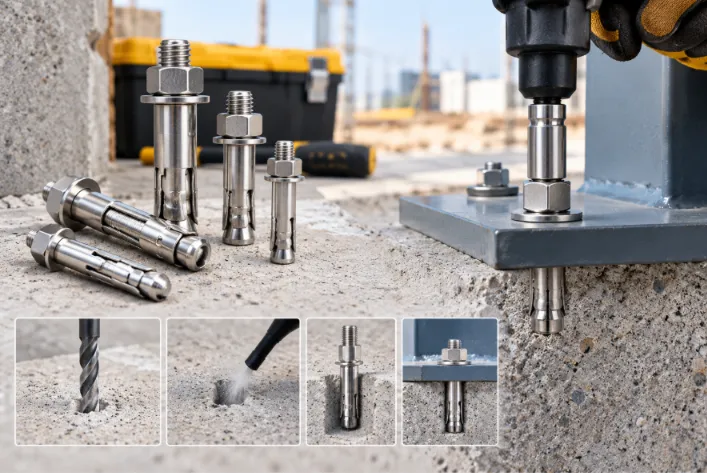
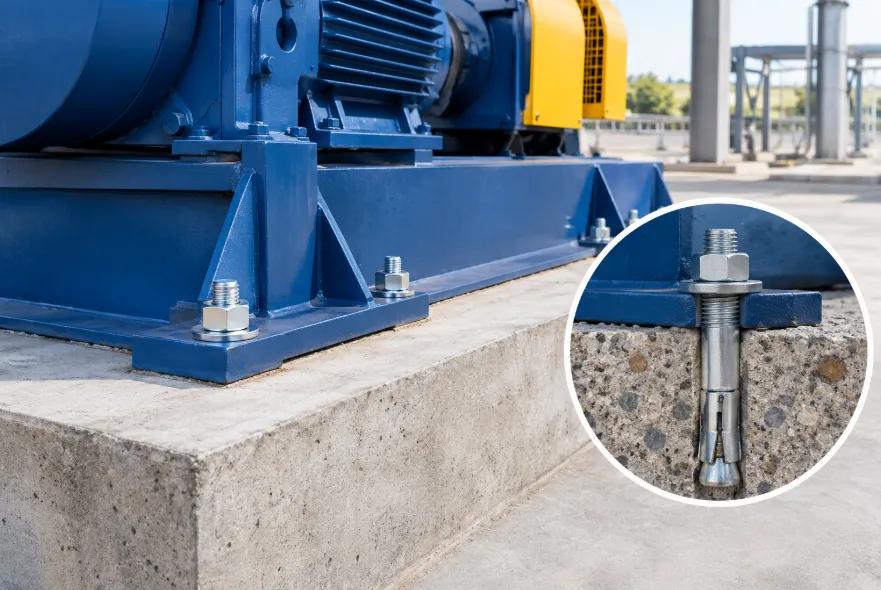
Once the material question is settled, the next thing worth understanding is how a wedge anchor physically works, because it explains why installation quality matters just as much as material quality. A wedge anchor is a non bottom bearing expansion fastener. That means it does not rely on sitting at the bottom of a drilled hole for its grip. Instead, a clip near the tip expands outward against the sides of the hole as the nut is tightened and that clip design means holding capacity actually increases as tension is applied, right up to the anchor's rated limit. It is a simple mechanism on paper, almost elegant in how little it relies on, but it depends entirely on the hole being the correct diameter and depth and on the base material being sound concrete rather than a patched or honeycombed section hiding voids underneath.
This is also where property class comes back into the conversation. A property class 70 fastener, the most commonly supplied version, comes from cold drawn bar stock, while property class 80 is made from more heavily cold worked material and generally carries a higher rated strength. The practical takeaway for a project manager is that not all heavy duty expansion bolts performing similarly on paper are interchangeable once you look at documented load ratings. Two anchors of the same diameter can carry meaningfully different safe working loads depending on their property class, and that number should come from a manufacturer's technical data sheet not an assumption. Matching anchor size and class to the actual structural load, rather than defaulting to whatever is in stock is the difference between a fastener that meets code and one that merely looks like it does.
Where the Install Either Confirms the Spec or Undoes It
Rakesh had seen this exact gap play out on a project outside Pune, his team had specified the right grade of anchor for a rooftop equipment platform but the installation crew was drilling holes slightly oversized to make the anchors go in faster, it seemed like a minor shortcut at the time, the kind of thing nobody mentions because the anchor still slides in and the nut still tightens. Rohan brought it in to review the work before sign off, caught it during a routine spot check running a few test measurements against the manufacturer's stated hole tolerance.
An oversized hole means the expansion clip cannot bite properly against the concrete and no amount of correct alloy selection saves an anchor installed into a hole that gives it nothing to grip. The fix is not complicated, but it does require discipline on site. Drill to the specified diameter and embedment depth, clear the hole of dust before inserting the anchor, since leftover dust cushions the clip and weakens the grip and torque to the manufacturer's stated value rather than "until it feels tight." Skipping any one of these steps quietly reduces holding strength, and the anchor will look identical to a properly installed one right up until it is loaded. Rohan's walkthrough that day caught the issue before the platform went into service, which is really the best outcome anyone can hope for. Catching it after equipment is running is a different, more expensive conversation, and one that usually involves an unplanned shutdown.
Why the Right Anchor Shows Up in More Places Than You'd Expect
Once you start looking for them stainless steel wedge anchors turn up across a surprising range of settings. Coastal walkways, seawall fittings, wastewater treatment infrastructure and food processing lines all lean on corrosion resistant fixings because the alternative is a maintenance cycle nobody budgets for, even inland industrial sites with washdown areas or chemical exposure end up needing the same protection simply for different reasons than a coastal build.
The upfront cost of A4 over carbon steel or even 304 can look steep on a line item, but weighed against the cost of scaffolding, downtime and replacement labour a few years down the road, it tends to even out. Rakesh's team, after the rooftop platform correction, started specifying A4-70 by default for anything exposed to weather reasoning that the price difference was smaller than a single future callback. That kind of decision rarely gets celebrated on a budget sheet but it is usually the one that ages well.
The pattern holds across sectors. Where equipment stays in place for decades and access for repairs is difficult or costly, spending a little more on the right grade and installing it correctly the first time is simply the cheaper path, even if it does not feel that way at the moment of purchase.
The Anchor Nobody Notices Until It Fails
Concrete fixing is one of those parts of a structure that only gets attention when something goes wrong. Nobody walks past a canopy or a rooftop platform admiring the anchors holding it up and that is exactly why getting the choice right matters so much. Material grade determines whether corrosion becomes a problem in the first place and installation quality determines whether that material ever gets the chance to perform as designed. Neither one compensates for the other no matter how good the paperwork looks.
So it is worth asking, on the projects you are involved in right now, how many anchors were selected because they were correct for the environment, and how many were selected because they were what was already in the truck. The difference between those two answers might not show up for a year or two. But eventually, it always does.


























Sign in to leave a comment.