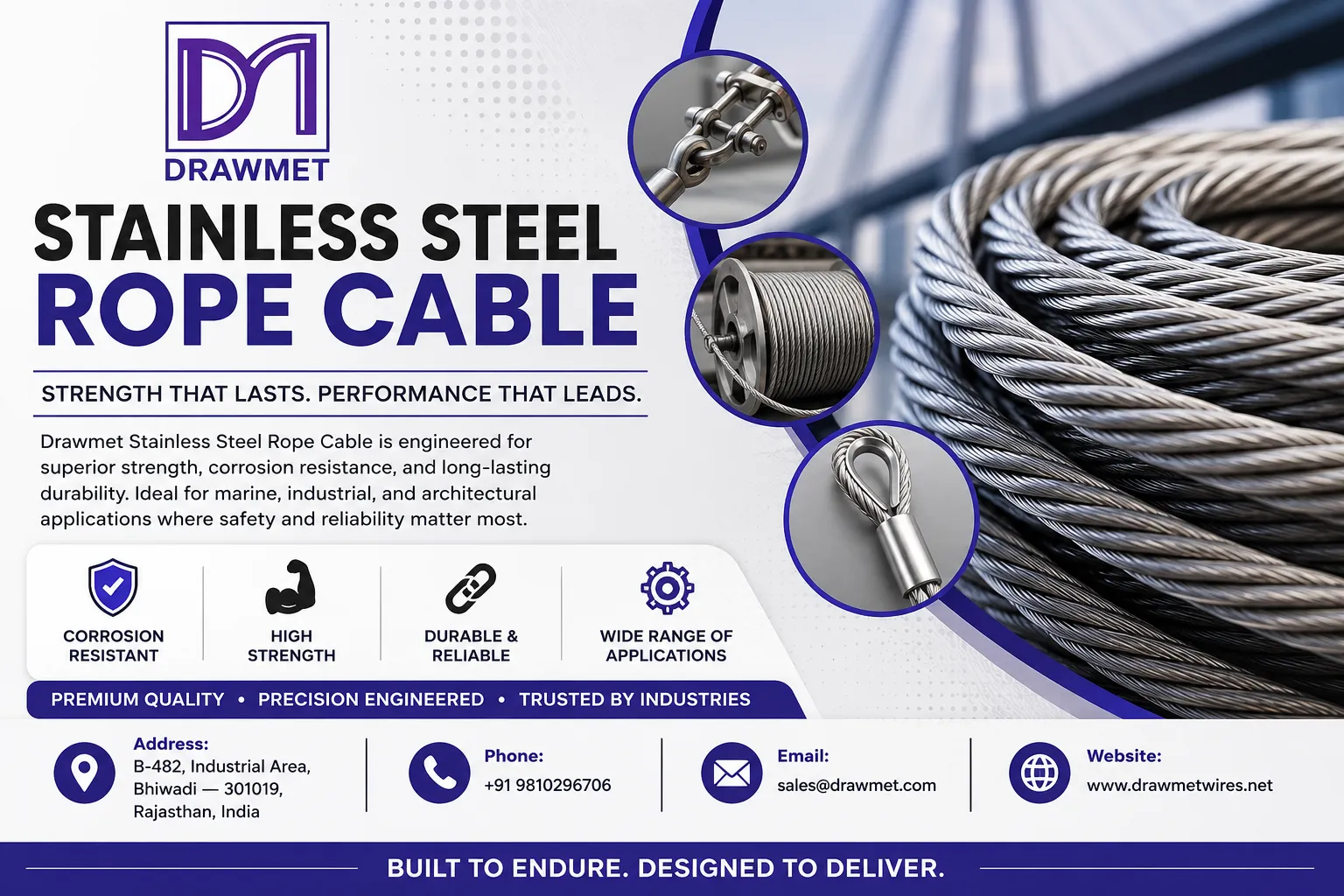

If you've ever compared quotes for a cable railing project, a boat's standing rigging, or a lifting sling and wondered why prices swing so widely between suppliers, the answer usually comes down to grade, construction, and who actually manufactures the rope. A stainless steel wire rope cable looks simple from the outside, just twisted wires around a core, but the specification behind it determines whether it lasts for decades or starts showing rust within a season.
This guide covers what stainless steel wire rope cable actually is, how SS304 and SS316 grades differ, which construction suits which job, how the rope is made and tested, and what to check before you place an order. Where relevant, we'll reference how Drawmet Wires Pvt. Ltd. approaches manufacturing and testing for its own stainless steel wire rope range.
What Is Stainless Steel Wire Rope Cable?
Stainless steel wire rope cable is a flexible steel rope made by twisting individual stainless steel wires into strands, then laying those strands around a central core to form the finished rope. It's used wherever a job needs the strength of steel cable combined with resistance to rust, staining, and chemical exposure, conditions where plain carbon steel or even galvanized wire rope would eventually corrode.
Drawmet Wires manufactures stainless steel wire rope cable in-house, from wire drawing through stranding and closing, then tests it against ASTM A492 and EN 12385 standards before dispatch. That in-house process matters because it means the rope that ships matches what's documented on the spec sheet, rather than being assembled from wire sourced elsewhere with no direct quality control.
SS304 vs SS316: Choosing the Right Grade
Grade selection is the single biggest factor in how long a stainless steel wire rope cable actually holds up in the field.
SS304 Wire Rope
- Suitable for general atmospheric and indoor applications
- Good baseline corrosion resistance for dry or occasionally damp environments
- A cost-effective choice when the rope won't face constant salt or chlorine exposure
SS316 / 316L Wire Rope
- Contains molybdenum, which gives it noticeably better resistance to pitting from chloride exposure
- The default choice for marine wire rope, dockside hardware, and coastal installations
- Recommended for swimming pool fencing and other chlorinated environments
If saltwater, pool chemicals, or coastal air are anywhere in the picture, SS316 is worth the price difference over SS304. It's the grade most marine surveyors expect to see on standing rigging and dock hardware.
Wire Rope Constructions Explained
The construction of a stainless steel wire rope cable determines how flexible it is, how much it stretches, and how well it holds tension over a long run.
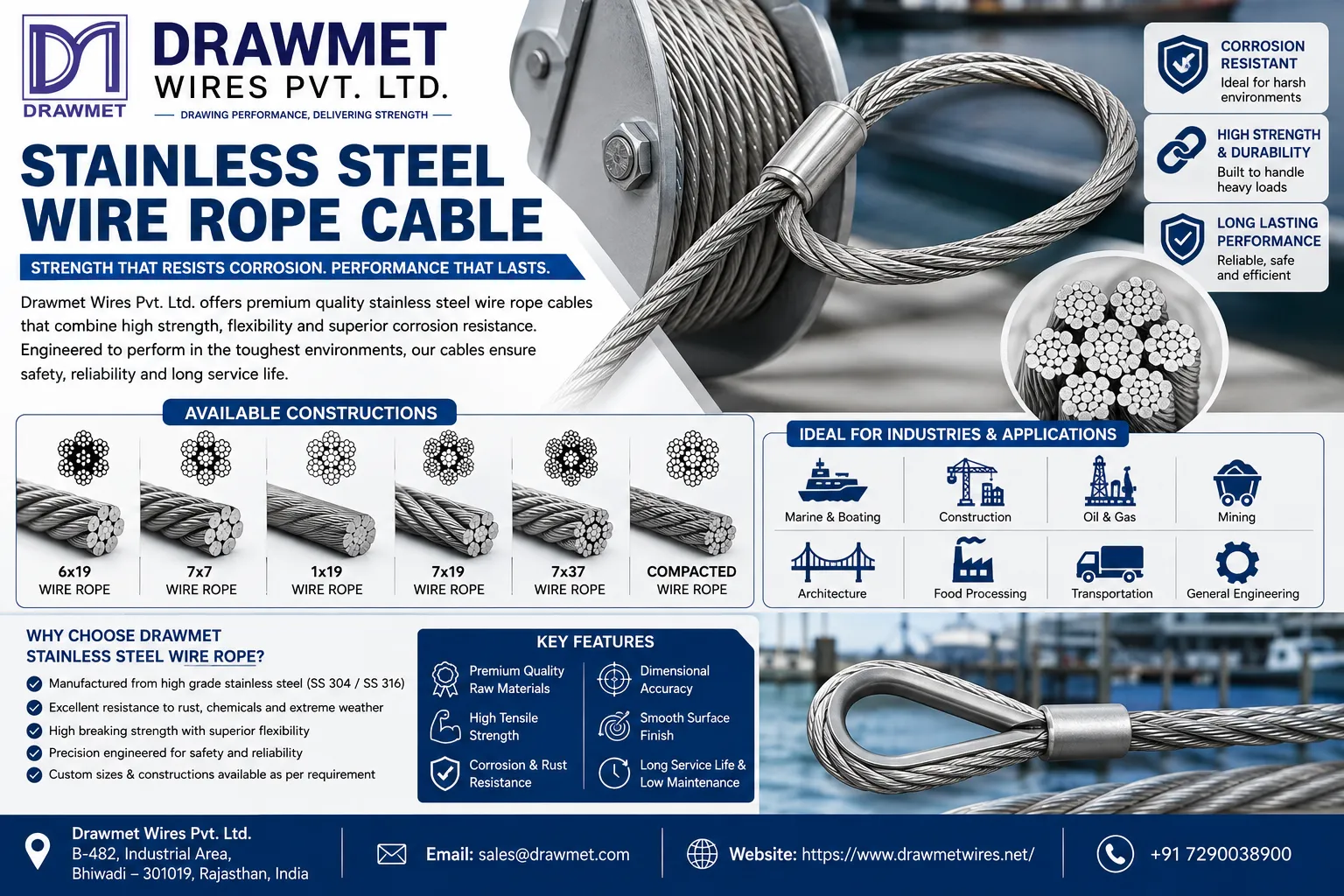
1x19 Construction
A single strand of 19 wires, with no separate core. This is a non-flexible construction, but it has the least stretch of the three, which is why it's the most common choice for cable railing and balustrade systems where a tight, consistent line matters more than flexibility.
7x7 Construction
Seven strands of seven wires each, giving semi-flexible performance. It's a middle-ground option where some flexibility is needed but a stiffer, more stable rope is still preferred over a fully flexible one.
7x19 Construction
Seven strands of nineteen wires each, making it the most flexible of the three. This construction threads through tight-radius sheaves and pulleys without work-hardening as quickly as stiffer constructions, making it suited to rigging, hoisting, and applications where the rope needs to bend repeatedly.
Applications of Stainless Steel Wire Rope Cable
Marine Applications
- Sailboat and yacht standing and running rigging
- Dock lines, guardrails, and safety netting supports
- Anchor and mooring cable assemblies
- Fishing and aquaculture cage cable
- Marine railing and lifeline cable for deck and walkway cable railing systems
Industrial and Architectural Applications
- Lifting slings and hoist cable for material handling
- Conveyor pull cable and emergency stop cable runs
- Machine guarding and safety barrier cable
- Architectural cable railing and stair balustrades
- Control cable and mechanical linkage assemblies
- Tensioned fencing and agricultural cable applications
The same rope construction that holds a deck rail steady also has to survive salt spray on a boat deck or repeated flexing on a factory floor, which is why matching grade and construction to the actual operating environment matters more than picking the cheapest option that fits the diameter.
How Stainless Steel Wire Rope Cable Is Manufactured
Understanding the process helps explain what separates a well-made rope from an inconsistent one.
1. Wire Drawing
Production starts with stainless steel rod, cold-drawn down through a series of dies to the target wire diameter. This step work-hardens the wire and builds tensile strength as the diameter is progressively reduced.
2. Stranding
Individual wires are stranded around a core on dedicated stranding equipment, following the pattern required for the specified construction (1x19, 7x7, or 7x19).
3. Closing
The strands are closed into the final rope construction on closing machines, forming the finished cable to the required diameter and lay.
4. Testing and Inspection
After closing, each production run goes through:
- Dimensional checks against the specified diameter
- Visual surface inspection for die marks or wire breaks
- Sample breaking-load tests, pulled to failure on a calibrated tensile rig
Finished rope is spooled, tagged with its heat number, and packed for dispatch, with a matching mill certificate accompanying every order. Traceability to a heat number and mill certificate matters when a structural engineer or marine surveyor requests documentation before sign-off.
Why Stainless Steel Resists Corrosion
Corrosion resistance in stainless steel wire rope comes from a passive chromium oxide layer on the surface. When that layer is scratched or nicked, it reforms on its own, which is why stainless outperforms galvanized wire rope in wet or chemically active environments over the long term.
SS316's added molybdenum content gives it meaningfully better resistance to pitting from chloride exposure than SS304. That said, even SS316 isn't fully immune to staining under constant salt spray. A light surface bloom is cosmetic rather than structural, and rinsing salt residue off periodically keeps both the finish and fatigue life closer to what the mill certificate promises.
Installing Stainless Steel Wire Rope Cable
If you're fitting cable railing or rigging yourself, a few steps make a real difference to how the finished installation performs:
- Measure the run length and add extra for terminations, thimbles, or turnbacks before cutting.
- Cut with a wire rope cutter rather than an angle grinder where possible, to avoid heat-affected zones that weaken the strands.
- Seize or tape both sides of the cut point before cutting to stop the strands unwinding.
- Fit swage terminals, thimbles, or mechanical fittings following the fitting manufacturer's rated crimp force and die size.
- Tension cable railing runs to the hardware manufacturer's spec, usually checked with a tension gauge rather than by feel.
- Inspect swaged terminations for full, even collar deformation before loading the assembly.
Maintaining Stainless Steel Wire Rope Cable
- Rinse salt, dust, or chemical residue off the cable on a regular schedule in coastal or industrial settings
- Check terminations and thimbles for movement or wear at each inspection interval
- Look along the rope length for broken wires, kinks, or flattened sections, especially near sheaves and terminations
- Re-tension cable railing periodically, since stainless rope has a small amount of constructional stretch when new
- Avoid dragging rope over abrasive surfaces or sharp edges that can nick individual wires
- Keep a spare length and matching fittings on hand for high-cycle rigging applications
How to Choose the Right Stainless Steel Wire Rope Cable
Matching the rope to the job comes down to a few practical questions:
- What's the environment? Coastal, chlorinated, or high-humidity settings point toward SS316. Indoor or general atmospheric use is usually fine with SS304.
- Does the run need to flex? Choose 1x19 for low-stretch, straight-line applications like cable railing. Choose 7x19 for flexibility around sheaves and pulleys.
- What's the load? Safe working load is typically calculated using a safety factor against the rope's rated breaking strength, though the actual rating for a given assembly should also account for the fitting and termination used. Always confirm the final safe working load with the fitting manufacturer and applicable lifting regulations.
- Do you need documentation? For structural, marine, or compliance sign-off, confirm the supplier provides mill test certificates referencing the coil's heat number.
Why Choose Drawmet Wires for Stainless Steel Wire Rope Cable
Drawmet Wires Pvt. Ltd. manufactures stainless steel wire rope cable in-house, running mill-certified stainless rod through its own drawing, stranding, and closing process, with sample breaking-load tests on every production batch. That gives specifiers documentation that holds up to a marine surveyor's or structural engineer's review, rather than a generic datasheet from a reseller.
The company ships standard coil lengths as well as custom cut-to-size and spooled orders, supports both retail and bulk project quantities, and works directly with fabricators, riggers, and OEMs. If a construction or grade outside the standard range is needed, discussing the load and environment directly with the technical team is the most reliable way to land on the right specification before ordering.
Conclusion
Stainless steel wire rope cable earns its place in marine rigging, cable railing, and industrial lifting precisely because it combines steel's strength with genuine corrosion resistance, provided the grade, construction, and manufacturing quality are right for the job. Getting SS304 versus SS316 wrong, or picking a construction that's too stiff or too stretchy for the application, tends to show up as premature wear, sagging railing, or unexpected staining well before the rope's rated life is used up.
Whether you're specifying cable for a coastal balustrade, a sailboat's standing rigging, or a factory lifting sling, working with a manufacturer who tests every batch and documents it with a mill certificate takes most of the guesswork out of the decision.
Frequently Asked Questions
1. What's the difference between SS304 and SS316 wire rope? SS316 contains molybdenum, which gives it stronger resistance to pitting and chloride corrosion than SS304. SS316 is the better choice for marine and coastal use, while SS304 is generally fine for indoor or general atmospheric applications.
2. What construction should I use for cable railing? 1x19 is the most common choice for cable railing because it has the least stretch and holds tension well over long spans. 7x19 is used where more flexibility is needed, such as around curves.
3. Does stainless steel wire rope rust? It resists rust far better than carbon steel or galvanized wire rope, but it isn't entirely immune to surface staining, especially SS304 in salt-heavy environments. SS316 holds up noticeably better in those conditions.
4. What is the safe working load of stainless steel wire rope? Safe working load is typically calculated using a safety factor against the rope's rated breaking strength, though the actual rating for a given assembly should also account for the fitting and termination used.
5. Can stainless steel wire rope be used for lifting applications? Yes, provided the rope, fittings, and rated capacity meet the relevant lifting standards and the assembly is inspected regularly. Always confirm compliance with local lifting regulations for the specific application.
6. What sizes of stainless steel wire rope cable are available? Standard stock generally runs from 1 mm to 12 mm diameter across 1x19, 7x7, and 7x19 constructions, with custom sizes and lengths available on request.
7. How do I terminate stainless steel wire rope? Common methods include swage terminals, mechanical fittings, thimbles with clamps, or hand splicing for larger diameters. The fitting manufacturer's rated crimp force and die size should always be followed.
8. Do suppliers provide mill certificates with wire rope orders? A reliable manufacturer should provide a mill test certificate referencing the coil's heat number with every order, which is often required for structural, marine, or compliance documentation. It's worth confirming this before placing an order.
Drawmet Wires Pvt. Ltd.
B-482, Industrial Area, Bhiwadi – 301019, Rajasthan, India
Email : [email protected]
Website : https://www.drawmetwires.net/
























Sign in to leave a comment.