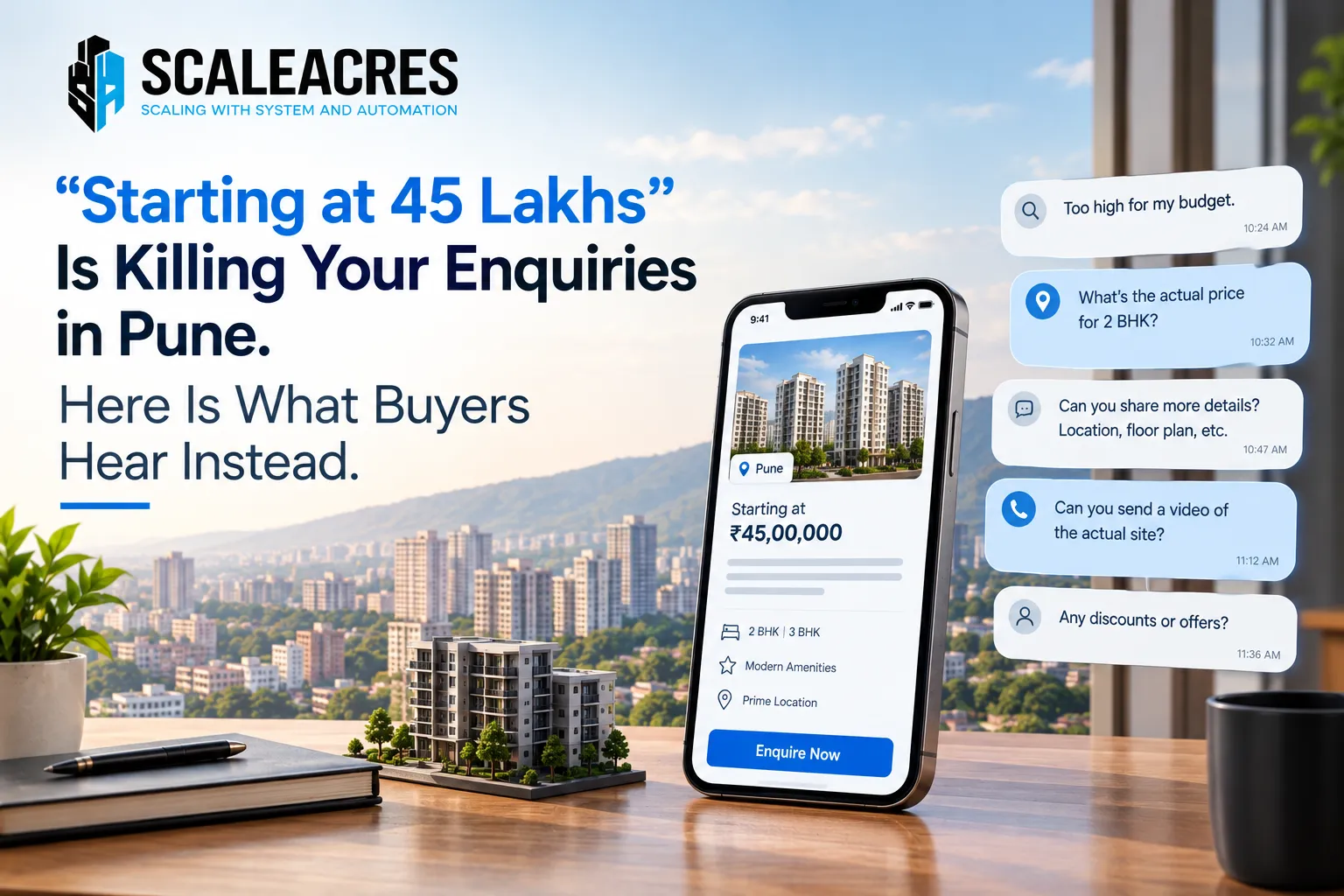

“Starting at 45 lakhs” looks like a smart line. It is short, it sounds affordable, and it gets clicks. But a Pune buyer reading it rarely thinks “great, I can afford this.” More often they think “that is the smallest unit, on the lowest floor, facing the wall, and the one I actually want will cost far more.” The enquiry may still come in, but the first call often goes badly, because the buyer is already waiting for the catch. This is where the best digital marketing company for real estate in Pune earns its fee: not only by getting the click, but by making sure the price message does not quietly damage trust before the conversation starts. You can see how ScaleAcres approaches pricing, landing pages and follow-up for developers in the city.
A note on the number: “45 lakhs” comes from the title and is used here only as an example. It is not a claim about real Pune prices or any real project.
Quick answer: “Starting at” prices often fail because buyers read them as the lowest, least attractive option, not the price they will actually pay. They then expect extra charges and a bigger number on the call. The fix is to show a realistic price range by configuration and an honest all-in picture, so the buyer’s first conversation starts with trust, not suspicion. This is based on common buyer behaviour, so test it against your own enquiry and call data.

Why developers use “starting at”
It is not a foolish habit. There are real reasons:
- It gives a low, attractive number in a small ad space.
- It filters for buyers with a lower budget and gets more clicks.
- It helps a project appear in budget-based searches on portals.
- It leaves room to adjust the final price later.
The trouble is that the same number that earns the click can cost you the conversation.
What the ad says and what the buyer hears
| What the ad says | What many buyers hear |
|---|---|
| “Starting at 45 lakhs” | “The cheapest unit, probably the smallest and least desirable” |
| “Starting at” with no unit size | “The price of something I would not actually buy” |
| “Starting at” with no mention of taxes and charges | “More charges will be added later” |
| “Starting at” and nothing else | “They are hiding the real price” |
| A very low number for a premium-looking project | “Too good to be true, so there is a catch” |
Buyers have seen this pattern many times. They respond not with excitement, but with caution.
What happens on the call
The pattern often looks like this:
- The buyer clicks the ad because the number fits their budget.
- The sales executive calls, and the buyer asks, “Is 45 lakhs for a 2 BHK?”
- The answer is “No, that is for the smaller unit. The 2 BHK is higher, plus other charges.”
- The buyer feels misled, even if no one meant to mislead them.
- They say “I’ll think about it” and stop replying.
The ad did its job and the enquiry arrived, but the first conversation began with a correction. In many cases it never recovers.
The hidden cost of a lower number
- Lower-quality enquiries. The headline price attracts buyers who may not be able to afford the units you actually want to sell.
- Wasted sales time. Teams spend calls explaining why the real price is higher.
- Lost trust. Buyers who feel the first number was bait doubt everything else.
- Weaker retargeting. Buyers who dropped off after price shock are harder to bring back.
- Misleading analytics. Cost per lead looks good while cost per site visit quietly grows.
What buyers actually want to know
A Pune buyer comparing projects is usually trying to answer a few practical questions:
- What does the unit I want actually cost, and what is the size in carpet area?
- Which floors, facings and views affect the price?
- What else will I pay beyond the base price, such as taxes, registration, parking, maintenance and other charges?
- What is the payment plan?
- How does this compare with other projects at a similar size and location?
Buyers increasingly compare on carpet area and total cost, not on a single headline number.
Better ways to show price
1. Show a range by configuration.
Instead of one “starting at” number, show a clear range for each unit type, with the carpet area.
| Configuration | Carpet area | Indicative price range |
|---|---|---|
| 1 BHK | [X sq ft] | [₹ range] |
| 2 BHK | [X sq ft] | [₹ range] |
| 3 BHK | [X sq ft] | [₹ range] |
(The table shows a format. Fill it only with your project’s real, approved figures.)
2. Be clear about what the price includes and excludes.
A short note such as “Base price. Taxes, registration and other charges extra. See full cost sheet” is far better than silence.
3. Offer an all-in cost sheet.
Share a simple, itemised breakdown on request or in the first message, so buyers can see the full picture early.
4. Explain what makes prices vary.
A line like “Prices vary by floor, facing and view” prepares the buyer for the range and makes it feel fair.
5. Match the ad to the unit.
If you show a particular layout in the creative, quote the price for that layout, not for a different one.
6. Keep it consistent.
The same prices should appear on your ad, landing page, brochure, portal listings and in what the sales team says.
Ad copy: before and after (illustrative format)
| Before | After |
|---|---|
| “2 and 3 BHK homes starting at 45 lakhs” | “2 BHK homes from [₹ range] for [X sq ft] carpet area. Full cost sheet available.” |
| “Luxury living starting at 45 lakhs” | “[Configuration] with [specific feature]. Indicative range: [₹ range]. Ask for the all-in price.” |
Use only real figures from your own price list, and make sure they are current.
How to handle the price conversation on a call
- Lead with clarity. “The 2 BHK ranges from [X] to [Y] depending on floor and facing. Would you like the full cost sheet on WhatsApp?”
- Confirm the unit type first. Ask which configuration and budget the buyer has in mind.
- Share the full picture early, including what is extra, and do not wait for the buyer to ask.
- Avoid pressure. Give the buyer time to review the numbers with family.
- Follow up in writing. Send the cost sheet and payment plan on WhatsApp for easy review.
What to measure
- Share of enquiries that raise the price in the first call
- Share of calls where the buyer’s budget does not match the unit
- Lead-to-visit rate for ads with a price range compared with “starting at”
- Cost per site visit and cost per booking by ad version
- Drop-off after the first price discussion
- Number of enquiries that ask for the cost sheet
Run a simple test
- Create two ad versions for the same project: one with “starting at” and one with a clear range by configuration.
- Keep everything else the same, including audience, budget and landing page.
- Run both for a few weeks and compare enquiries, call quality, visit rate and cost per visit.
- Ask the sales team which version produced calmer, more productive first calls.
- Keep the version that brings more site visits, not just more leads.
Common mistakes
- Using the price of a unit that is barely available
- Leaving out carpet area, so buyers cannot compare
- Hiding taxes and charges until late in the conversation
- Showing different prices on the ad, the portal and the brochure
- Quoting a price that does not match the unit shown in the creative
- Treating a low cost per lead as proof that the price message is working
Frequently asked questions
Is “starting at” pricing always bad?
Not always. It can work when it is clearly tied to a real, available unit and when the range and charges are easy to find. It fails when it stands alone and sets the wrong expectation.
Should I show the exact price in my ad?
A clear range by configuration, with carpet area, usually serves buyers better than one low number. The cost sheet can carry the full detail.
How do I explain extra charges without scaring buyers?
Be matter-of-fact. Show what is included, what is extra and the total picture early. Buyers are less alarmed by clear numbers than by surprises later.
Will a higher visible price reduce my enquiries?
It may reduce the number of enquiries, but the ones that remain are often better matched to your units. Compare enquiry quality and visits, not only volume.
How do I know which price message works for my project?
Test it. Run two versions, compare call quality, visit rate and cost per visit, and use your own data to decide.
Final thoughts
A price in an ad is not only a number. It is a promise about what the conversation will be like. “Starting at 45 lakhs” promises something the buyer suspects the next call will not deliver. A clear range, an honest note about what is included and a cost sheet ready to share make the first conversation easier for both sides. In a city where buyers compare many projects, being the one that is straight about price is often the quickest way to earn a second call.
If you want help turning pricing, landing pages and follow-up into something buyers trust from the first click, you can talk to ScaleAcres, which works with Pune developers as the best digital marketing company for real estate in Pune on lead generation, local SEO, WhatsApp and CRM follow-up and retargeting.























Sign in to leave a comment.