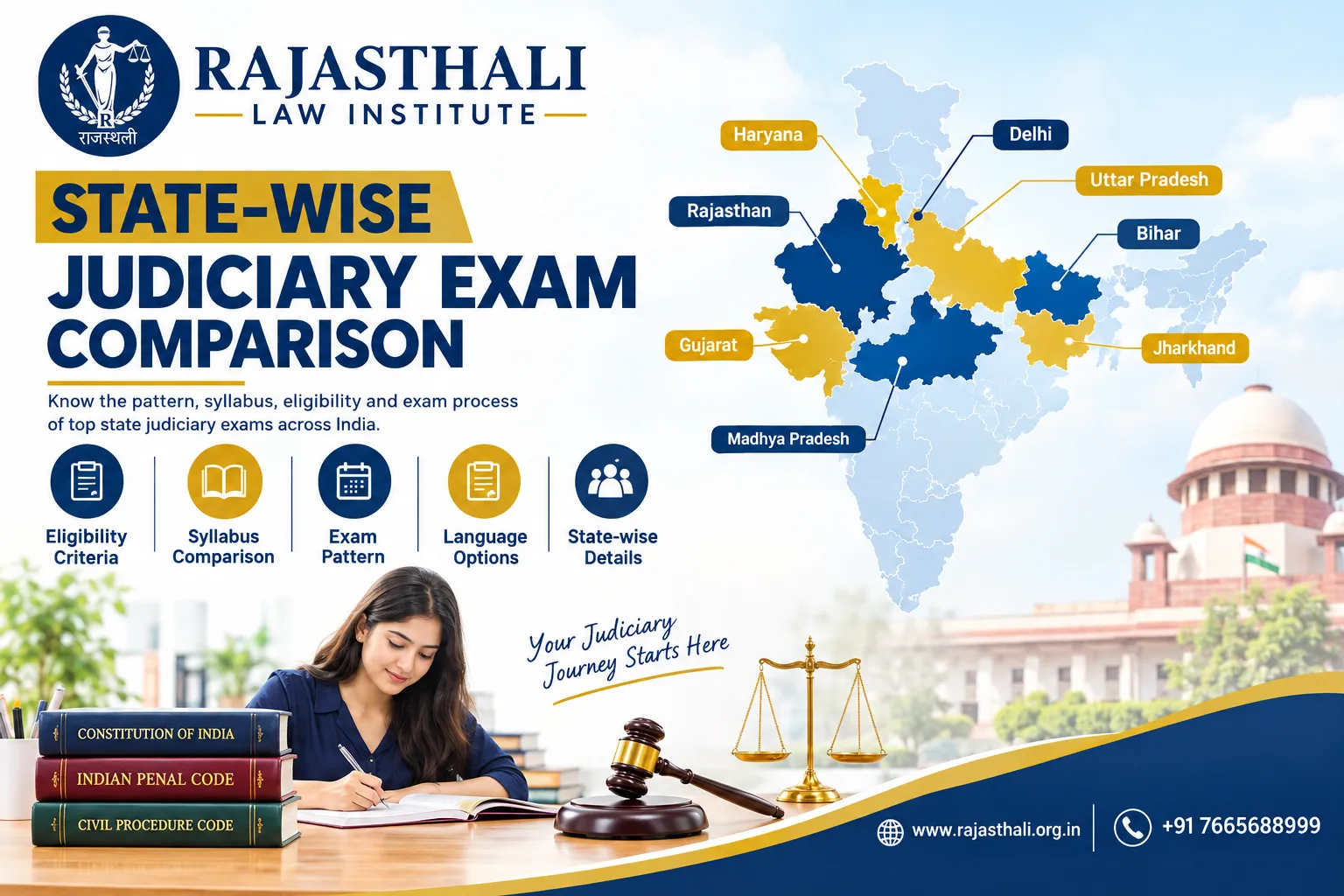


A state-wise judiciary exam comparison allows aspirants to understand the differences between various state judicial service examinations before beginning their preparation.
Judiciary examinations in India provide law graduates with an opportunity to begin a career in the judicial system. Every state has its own judicial service examination for recruiting civil judges and other judicial officers. While the fundamental objective of these examinations remains similar, the eligibility criteria, syllabus, examination pattern, language requirements, and selection process may differ significantly.
For law students and graduates planning to appear for a judiciary examination, understanding these differences is an important first step. A state-wise judiciary exam comparison helps candidates identify suitable examinations and prepare according to their specific requirements.
What Is a Judiciary Examination?
A judiciary examination is a competitive recruitment examination conducted by state judicial service authorities or high courts. Successful candidates are generally appointed to entry-level judicial positions, subject to the applicable recruitment rules.
The examination usually evaluates a candidate's knowledge of law, general awareness, language skills, analytical ability, and suitability for judicial responsibilities.
Most state judiciary examinations include three major stages:
- Preliminary Examination
- Main Examination
- Interview or Viva-Voce
However, the exact structure may vary depending on the state and recruitment notification.
Why State-Wise Judiciary Exam Comparison Is Important
India has several state judicial service examinations, and each state follows its own rules. Candidates who understand these differences can avoid confusion and develop a more focused preparation strategy.
The comparison is useful because:
- Eligibility requirements are not identical across all states.
- The syllabus may include state-specific laws.
- Local language knowledge may be required.
- The number of examination stages can differ.
- The weightage of law subjects and general studies may vary.
- The level of competition differs from state to state.
Instead of preparing randomly for multiple examinations, aspirants can compare the requirements and select examinations that match their qualifications and strengths.
Major Judiciary Exams in India
The following are some of the prominent state judiciary examinations conducted across India:
Before selecting a state-wise judiciary exam, candidates should compare the eligibility criteria, syllabus, examination pattern, and language requirements of different states.
| State | Judicial Service Examination | Key Preparation Areas |
| Rajasthan | Rajasthan Judicial Service (RJS) | Law Subjects, Hindi, English |
| Delhi | Delhi Judicial Service (DJS) | Civil Law, Criminal Law, General Knowledge |
| Uttar Pradesh | UP Civil Judge Examination | Law, General Studies, Language |
| Madhya Pradesh | MP Civil Judge Examination | Legal Knowledge, Hindi, English |
| Bihar | Bihar Civil Judge Examination | Law Subjects, General Studies |
| Haryana | Haryana Civil Judge Examination | Law, General Knowledge, Language |
| Gujarat | Gujarat Civil Judge Examination | Law and Gujarati Language |
| Jharkhand | Jharkhand Civil Judge Examination | Legal Subjects and General Studies |
| Chhattisgarh | Chhattisgarh Civil Judge Examination | Law, General Knowledge, Language |
The information provided in recruitment notifications may change from time to time. Therefore, candidates should always verify the latest official notification before applying.
Eligibility Criteria: How Requirements Differ
Eligibility is one of the most important aspects of a state-wise judiciary exam comparison.
Generally, candidates applying for judicial service examinations must possess a recognized law degree such as LLB or an equivalent qualification. However, additional requirements may differ depending on the state.
Some important eligibility factors include:
Educational Qualification
Most state judiciary examinations require candidates to hold an LLB degree from a recognized university or institution.
Candidates pursuing their final year may or may not be eligible depending on the specific notification.
Age Limit
Age limits vary among states. Some states provide relaxations for reserved categories according to government rules.
Aspirants should carefully check the minimum and maximum age requirements mentioned in the official notification.
Domicile Requirements
Certain examinations may have specific domicile or residency-related conditions. Others may allow candidates from across India to apply, subject to applicable rules.
This makes it important to review the recruitment notification before deciding to apply.
Preliminary Examination Comparison
The Preliminary Examination is generally the first stage of the judiciary recruitment process.
It is often objective in nature and tests candidates on:
- Constitutional Law
- Civil Procedure Code
- Criminal Procedure Code
- Indian Penal Code or applicable criminal laws
- Evidence Law
- Contract Law
- Transfer of Property Law
- Family Law
- General Knowledge
- Current Affairs
- State-specific laws
The number of questions, duration, marking scheme, and qualifying marks differ across states.
Some examinations may include negative marking, while others may not. Therefore, candidates should study the latest exam pattern carefully.
Main Examination Comparison
The Mains Examination is usually descriptive and requires a deeper understanding of legal subjects.
Unlike Prelims, where candidates select answers, Mains requires candidates to write structured and legally accurate responses.
Common subjects include:
- Civil Law
- Criminal Law
- Constitutional Law
- Contract Law
- Evidence Law
- Family Law
- Property Law
- Language Papers
- Essay Writing
- Judgment Writing
The importance of answer writing cannot be ignored. Candidates must learn how to present legal provisions, case laws, reasoning, and conclusions in a clear format.
Role of Language in State Judiciary Exams
Language is an important factor that differentiates judiciary examinations.
For example, some states may include Hindi as a compulsory or important language paper, while others may require knowledge of regional languages.
Candidates planning to appear for examinations in Rajasthan, Gujarat, Haryana, Bihar, or other states should understand the language-related requirements carefully.
Language preparation may include:
- Grammar
- Essay Writing
- Translation
- Precis Writing
- Comprehension
- Legal Terminology
Strong language skills can improve performance in both written examinations and interviews.
Interview and Viva-Voce
The interview stage evaluates a candidate's personality, confidence, communication skills, legal awareness, and understanding of judicial responsibilities.
Interview preparation may include:
- Current legal developments
- Constitutional knowledge
- Important judgments
- General awareness
- Personal introduction
- Situational and ethical questions
Candidates should focus not only on memorizing answers but also on developing logical thinking and balanced opinions.
State-Wise Preparation Strategy
Every state judiciary examination requires a slightly different preparation approach.
Rajasthan Judiciary Examination
Candidates preparing for the RJS examination should focus on core law subjects, Hindi and English language skills, Rajasthan-specific general knowledge where applicable, and regular mock tests.
Delhi Judiciary Examination
Preparation generally requires strong knowledge of civil and criminal law, constitutional provisions, and general awareness.
Uttar Pradesh Judiciary Examination
Candidates should pay attention to the prescribed legal syllabus, general studies, language papers, and the state's examination structure.
Madhya Pradesh Judiciary Examination
A balanced approach toward law subjects, language preparation, and answer writing is useful for candidates preparing for MP Judiciary.
The same principle applies to other states: understand the official syllabus first and then create a study plan.
How to Prepare for Multiple State Judiciary Exams?
Some aspirants prepare for more than one state judiciary examination. This can be beneficial because many core law subjects overlap.
A practical strategy includes:
1. Build Strong Legal Fundamentals
Study Bare Acts and understand important legal provisions. Focus on concepts instead of relying only on memorization.
2. Prepare State-Specific Subjects Separately
Maintain separate notes for state-specific laws, general knowledge, language, and local examination requirements.
3. Practice Previous Year Papers
Previous year question papers help identify repeated topics, question patterns, and difficulty levels.
4. Develop Answer Writing Skills
Regular descriptive writing practice is essential for Mains preparation.
5. Take Mock Tests
Mock tests improve time management, accuracy, and examination confidence.
Choosing the Right Judiciary Examination
There is no single judiciary examination that is best for every candidate. The right choice depends on several personal and academic factors.
Candidates should consider:
- Educational qualification
- Language proficiency
- Preferred state
- Eligibility requirements
- Syllabus overlap
- Preparation resources
- Career goals
A comparison-based approach helps candidates make informed decisions rather than selecting an examination without understanding its requirements.
Conclusion
State-wise judiciary exam comparison is an essential part of judicial service preparation. Although most examinations test similar legal knowledge, differences in eligibility, syllabus, language, and selection processes make each examination unique.
Law graduates should carefully study the official notification of their preferred state, understand the complete syllabus, and develop a preparation strategy accordingly. Consistent revision, Bare Act reading, mock tests, answer writing, and legal awareness can help candidates prepare more effectively.
For every aspirant, understanding the state-wise judiciary exam structure is an important step toward developing an effective preparation plan.
Read More: State-Wise Judiciary Exam Comparison – Rajasthali Law Institute


























Sign in to leave a comment.