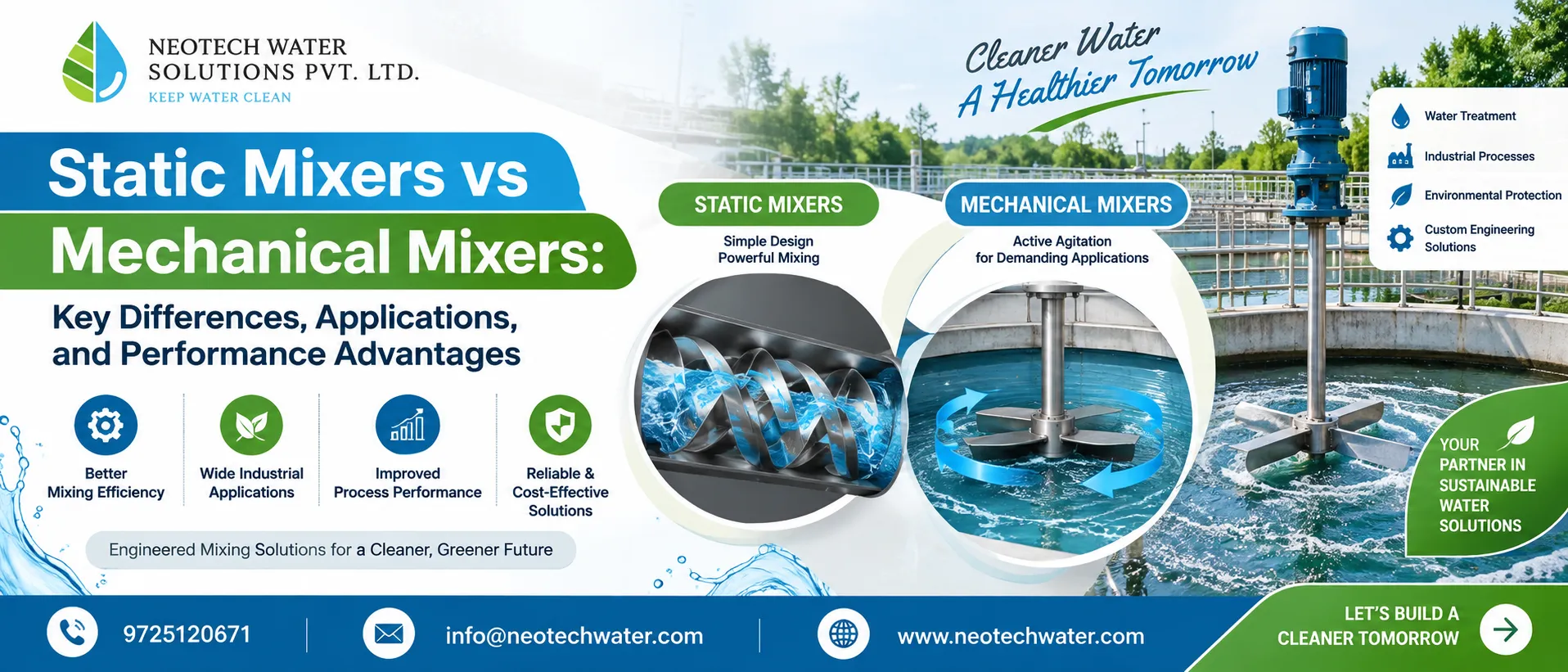

Mixing is an important process in water treatment, wastewater treatment, chemical processing, and many industrial applications. Depending on the process, liquids may need to be mixed with chemicals, additives, gases, or other fluids to achieve the required treatment or reaction conditions.
Two commonly used technologies are Static Mixers and mechanical mixers. Although both are designed to improve mixing, they work in very different ways. A static mixer uses the energy of the flowing fluid to create mixing inside a pipeline, while a mechanical mixer relies on a motor-driven impeller or agitator.
The right choice depends on factors such as fluid properties, flow conditions, available space, energy requirements, mixing objectives, and maintenance needs. Understanding the differences between these two technologies can help treatment plant operators and industrial buyers select a solution that fits their application.
What Are Static Mixers?
Static Mixers are stationary devices installed inside a pipeline. They contain fixed mixing elements that divide, redirect, rotate, and recombine flowing fluids as they move through the pipe.
Unlike mechanical mixing systems, static mixers generally do not have rotating parts or require a dedicated motor for the mixing action. Instead, they use the energy generated by the movement of the process fluid through the pipeline.
An Inline Static Mixer is commonly used where two or more fluids, or a fluid and a treatment chemical, need to be mixed continuously within a pipeline.
Typical applications include:
- Chemical dosing
- Water treatment
- Wastewater treatment
- pH adjustment
- Coagulation and flocculation processes
- Liquid blending
- Chemical processing
- Process water treatment
The final design should always be selected according to the specific process requirements.
What Are Mechanical Mixers?
Mechanical mixers use a motor, shaft, impeller, or other moving components to create mixing within a tank, reactor, basin, or vessel.
The mechanical energy generated by the equipment creates fluid movement and circulation. Different impeller designs and operating speeds can be selected depending on the mixing objective.
Mechanical mixers are commonly used when:
- Mixing is required inside a tank
- Fluid movement must be maintained without continuous pipeline flow
- Solids need to remain suspended
- A large tank volume requires circulation
- Batch processing is involved
- High-viscosity fluids require active mixing
Because mechanical mixers have moving components, their selection and operation generally involve considerations such as motor sizing, seals, bearings, shafts, and maintenance access.
How an Inline Static Mixer Works
An Inline Static Mixer contains specially designed stationary elements arranged within a pipe section.
As fluid flows through the mixer:
- The flow is divided into smaller streams.
- The streams are redirected by the mixing elements.
- Different parts of the fluid are repeatedly rearranged.
- The fluids combine as they move downstream.
The final mixing performance depends on several factors, including flow conditions, fluid properties, mixer geometry, and the required level of mixing.
A static mixer should therefore be selected based on process conditions rather than only on pipe diameter.
Performance Advantages of Static Mixers
1. No Rotating Mixing Components
Because the mixing elements are stationary, a static mixer generally has fewer mechanical components than a motor-driven mixer.
This can reduce the number of parts associated with rotating equipment, such as motors, gearboxes, and drive shafts.
2. Compact Inline Installation
Static mixers can be installed directly into a pipeline. This can be useful where floor space is limited or where the process already involves continuous liquid flow.
The compact design may also make them suitable for integration into existing treatment pipelines, subject to proper engineering evaluation.
3. Continuous Mixing
An inline system can provide mixing continuously while process fluid is flowing.
This can be useful for applications such as:
- Chemical injection
- Coagulant addition
- Acid or alkali dosing
- Polymer distribution
- Liquid blending
4. Potentially Lower Mechanical Maintenance
Since there are generally no rotating components inside the mixer, maintenance requirements can differ from those of motor-driven equipment.
However, actual maintenance needs depend on the fluid, solids content, scaling potential, chemical compatibility, and installation design.
5. No Dedicated Motor for Mixing
A static mixer does not normally require a separate motor to create the mixing action. Instead, it uses the energy available from fluid flow.
However, this does not mean there is no energy impact. A static mixer creates pressure loss, and the pumping system must be able to accommodate the resulting pressure drop.
Understanding Inline Static Mixer Design
Inline Static Mixer Design is one of the most important factors affecting performance.
A mixer should be designed by considering:
- Pipe diameter
- Flow rate
- Fluid velocity
- Fluid viscosity
- Density differences
- Number of fluids being mixed
- Chemical compatibility
- Required mixing quality
- Available pressure
- Allowable pressure drop
For example, a mixer selected for a low-viscosity water stream may not perform the same way when handling a more viscous industrial liquid.
Similarly, increasing the number or complexity of mixing elements may improve mixing under some conditions but can also increase pressure loss.
The objective is to balance mixing performance with hydraulic requirements.
When Is a Mechanical Mixer the Better Choice?
A mechanical mixer may be more suitable when the process requires active mixing inside a tank or vessel.
Typical examples include:
Batch Treatment Processes
Mechanical mixing can be useful when a chemical must be mixed into a batch tank without continuous liquid movement through a pipeline.
Solids Suspension
Some processes require solids to remain suspended in a large tank. A mechanical mixer can provide continuous circulation within the vessel.
High-Viscosity Fluids
Where pipeline flow alone cannot provide the required mixing energy, a mechanical mixer may be more practical.
Large Tank Circulation
Mechanical mixers can be designed to create circulation patterns within tanks and reactors.
The decision should be based on process requirements rather than assuming that one technology is always better.
Static Mixer Applications in Water and Wastewater Treatment
Static mixers are used in a range of treatment processes where rapid and consistent mixing is required inside a flowing pipeline.
Common applications include:
- Coagulant mixing
- pH correction
- Chemical dosing
- Chlorination and disinfection applications
- Polymer addition
- Pre-treatment systems
- Industrial wastewater treatment
For example, when a treatment chemical is injected into a flowing water stream, an appropriately designed Inline Static Mixer can help distribute the chemical through the stream before it reaches the next treatment stage.
The exact design should consider chemical dosing conditions and the downstream process requirements.
Choosing a Static Mixer Manufacturer
When selecting a Static Mixer Manufacturer, it is important to evaluate technical suitability rather than choosing only based on the lowest initial cost.
Questions to consider include:
- What fluids need to be mixed?
- What are the minimum and maximum flow rates?
- What level of mixing is required?
- What pressure drop is acceptable?
- Is the material compatible with the process fluid?
- Does the application involve corrosive chemicals?
- Are solids or scaling expected?
- Will the mixer be installed in a new or existing pipeline?
A supplier should have sufficient application information to recommend an appropriate design.
Choosing HDPE Static Mixer Manufacturers
For certain water and chemical applications, HDPE Static Mixer Manufacturers may provide solutions using high-density polyethylene or other materials suited to specific operating conditions.
Material selection should be based on factors such as:
- Chemical compatibility
- Operating pressure
- Temperature
- Outdoor exposure
- Mechanical requirements
- Pipe material
- Installation conditions
HDPE may be suitable for certain applications, but it should not automatically be considered appropriate for every process. The material must be evaluated against the actual operating environment.
Static Mixer vs Mechanical Mixer: How to Choose
A practical selection process can include the following steps:
Step 1: Define the Mixing Objective
Determine whether the process requires chemical distribution, liquid blending, solids suspension, tank circulation, or another mixing function.
Step 2: Understand the Process Conditions
Review flow rate, viscosity, density, temperature, pressure, and solids content.
Step 3: Evaluate the Installation Location
A pipeline application may be suitable for a static mixer, while a tank-based process may require a mechanical mixer.
Step 4: Consider Energy Requirements
Mechanical mixers require external electrical power. Static mixers use process flow but introduce pressure loss that must be considered in pumping requirements.
Step 5: Review Maintenance Needs
Consider accessibility, expected wear, scaling, chemical exposure, and the maintenance capability of the facility.
Step 6: Assess the Complete Treatment Process
The mixer should be selected based on its role within the overall process. Downstream treatment stages may have specific requirements for chemical contact and mixing consistency.
Common Mistakes to Avoid
Choosing Only Based on Pipe Size
Pipe diameter is important, but flow rate and fluid properties are equally important.
Ignoring Pressure Drop
A static mixer can create additional pressure loss. The existing pumping system must be evaluated accordingly.
Using a Mechanical Mixer for an Inline Requirement
A tank mixer may not be the most practical solution when the process requires continuous mixing inside a pipeline.
Ignoring Material Compatibility
Mixing equipment can be exposed to chemicals and wastewater with corrosive properties. Materials should be selected accordingly.
Selecting Without Reviewing Flow Variation
Changes in flow can affect mixing conditions. Minimum and maximum operating flows should be considered.
How Neotech Water Solutions Can Support Mixing Applications
Selecting the right mixing technology requires an understanding of the complete treatment process. Neotech Water Solutions works in the water and wastewater treatment sector and can be approached to discuss project-specific mixing requirements.
Whether the application involves an Inline Static Mixer, chemical dosing, process water treatment, or industrial wastewater treatment, factors such as flow conditions, fluid properties, pressure requirements, and material compatibility should be reviewed before equipment selection.
Neotech Water Solutions can support discussions around suitable water and wastewater treatment equipment based on the requirements of a specific project in India.
Frequently Asked Questions
1. What is a static mixer?
A static mixer is a device installed inside a pipeline that uses fixed mixing elements to divide and rearrange flowing fluids, helping them mix without rotating internal parts.
2. What is the difference between a static mixer and a mechanical mixer?
A static mixer uses the energy of flowing fluid and stationary mixing elements, while a mechanical mixer uses a motor-driven impeller or agitator to create mixing.
3. Where are inline static mixers used?
Inline static mixers can be used in water treatment, wastewater treatment, chemical dosing, pH adjustment, liquid blending, and other continuous flow applications.
4. Do static mixers require electricity?
Static mixers generally do not require a dedicated motor for mixing. However, they create pressure loss, which must be considered in the overall pumping and hydraulic design.
5. How do I choose the right static mixer?
Consider the fluid properties, flow rate, pipe size, required mixing performance, pressure drop, material compatibility, and installation conditions.
6. Are HDPE static mixers suitable for water treatment?
HDPE static mixers may be suitable for certain water and chemical treatment applications. Suitability depends on factors such as chemical compatibility, pressure, temperature, and mechanical requirements.
7. Can a static mixer replace a mechanical mixer?
Not always. A static mixer may be suitable for continuous pipeline mixing, while mechanical mixers are often required for tank-based mixing, solids suspension, or batch processes.
Conclusion
Static Mixers and mechanical mixers both serve important roles in industrial and treatment processes, but they are designed for different applications.
Static mixers are generally well suited to continuous inline mixing and use the energy of the flowing fluid through stationary mixing elements. Mechanical mixers are commonly used for tank-based applications that require active circulation, solids suspension, or mixing without continuous pipeline flow.
The best choice depends on the mixing objective, fluid characteristics, flow conditions, installation location, energy requirements, pressure limitations, and maintenance considerations.
For projects in India, selecting equipment based on the complete process can help ensure a more practical and suitable mixing solution.
Contact Neotech Water Solutions to discuss your water treatment or wastewater treatment application and explore a suitable static or mechanical mixing solution for your project.




























Sign in to leave a comment.