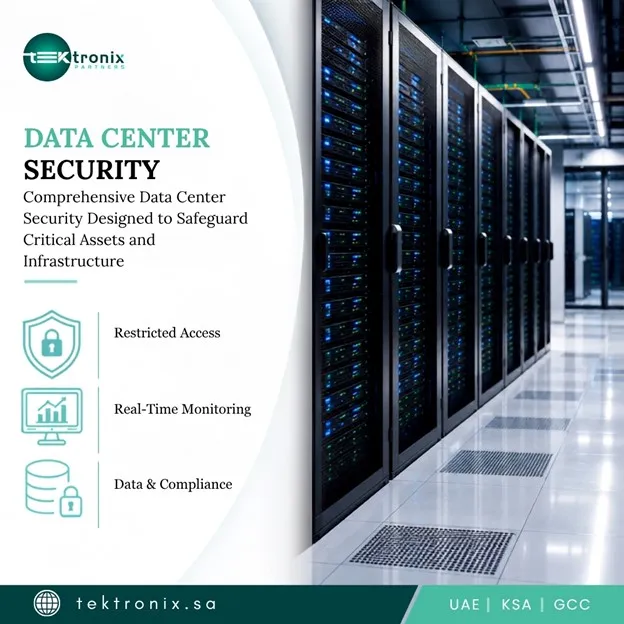

As Saudi Arabia accelerates its digital transformation under Vision 2030, robust Data Center Security has become the foundation on which government platforms, banking networks, and enterprise cloud infrastructure depend. From Riyadh's expanding hyperscale campuses to regional colocation facilities in Jeddah and Dammam, organizations face growing pressure to protect mission-critical infrastructure from both physical intrusion and sophisticated cyber threats.

Every server rack, network switch, and storage array inside a Kingdom-based facility now represents a strategic national asset. A single breach can disrupt banking transactions, halt government e-services, or expose sensitive citizen data, which is why operators across the Kingdom are re-evaluating their layered defense posture from the perimeter fence to the application layer.
Insurance underwriters, cloud hyperscalers, and multinational tenants increasingly request independent facility audits before signing a colocation contract. A documented, layered defense posture is no longer a marketing differentiator; it is a prerequisite for winning enterprise and government workloads, and Kingdom-based operators that lag behind risk losing tenants to newer, better-protected campuses.
The Growing Importance of Facility Protection in the Kingdom
Saudi Arabia's push toward a knowledge-based economy has triggered exponential growth in data volumes, cloud adoption, and colocation demand. NEOM, the Saudi Data & AI Authority (SDAIA), and major telecom operators are investing heavily in domestic hosting capacity, keeping sensitive workloads within national borders. This expansion increases the attack surface, making layered protection — spanning perimeter fencing, biometric entry points, environmental monitoring, and network defense — a board-level priority rather than a purely technical concern.
Facility operators, banks, healthcare networks, and government entities are now expected to demonstrate resilience against both opportunistic intrusion and targeted, state-level cyber campaigns, placing physical and digital safeguards on equal footing within enterprise risk registers.
Sector regulators reinforce this shift directly. The Saudi Central Bank (SAMA) cybersecurity framework applies to any facility hosting financial workloads, while healthcare hosting must satisfy Ministry of Health data-handling rules. Facility operators that can map their controls against multiple sector frameworks simultaneously win a wider pool of enterprise tenants.
Cybersecurity for Data Center Environments in Saudi Arabia
Modern facilities blend IT and operational technology on a single converged network, meaning building management systems, cooling controllers, and power distribution units are all potential entry points for attackers. Comprehensive Cybersecurity for Data Center environments requires continuous network monitoring, hardened operating systems, and a dedicated security operations center capable of correlating alerts from every connected subsystem in real time.
Ransomware groups increasingly target hosting providers because a single successful attack can affect dozens of downstream tenants simultaneously. Segregating tenant networks, enforcing least-privilege administration, and running regular penetration testing are now standard requirements for any facility seeking enterprise or government clients in the Kingdom.
A dedicated security operations center should ingest logs from firewalls, endpoint agents, and building-management controllers into a single correlation engine. Analysts working Riyadh, Jeddah, or follow-the-sun shifts can then triage a suspicious login attempt and an unusual chiller-unit command in the same investigation, rather than treating IT and facilities alerts as unrelated events handled by separate teams.
Why Encryption Remains Non-Negotiable
Protecting information as it moves between racks, sites, and cloud regions is just as important as protecting the building itself. Strong Data Center Encryption — covering data at rest on storage arrays and data in transit across interconnects — ensures that even if a device is physically compromised or intercepted, the underlying information remains unreadable without the correct cryptographic keys.
Centralized key management, hardware security modules, and alignment with the Kingdom's Personal Data Protection Law (PDPL) give facility operators a defensible, auditable encryption posture that satisfies both regulators and enterprise customers demanding proof of due diligence.
Key rotation policies, role-based access to cryptographic material, and regular third-party key-management audits close a gap many operators overlook: encryption is only as strong as the process protecting the keys themselves. Facilities that document key custody procedures make regulatory audits materially faster and reduce the risk of a single compromised administrator account exposing years of archived data.
Building Resilience with Network-Layer Firewalls
At the network edge, next-generation Data Center Firewalls inspect traffic far beyond simple port and protocol filtering, applying deep packet inspection, intrusion prevention signatures, and behavioural analytics to catch threats that legacy appliances would miss entirely.
Micro-segmentation further limits lateral movement by isolating tenant workloads and critical management interfaces into separate security zones, so that even if one segment is compromised, the blast radius is contained and DDoS mitigation capacity absorbs volumetric attacks before they reach core switching infrastructure.
Redundant firewall pairs deployed in active-active configuration prevent a single hardware failure from creating an unprotected window, while scheduled rule-set reviews ensure that temporary access granted for a maintenance window does not remain open indefinitely — a common finding during third-party penetration tests across GCC facilities.
Data Center Access Control Best Practices
Physical entry remains one of the most exploited weaknesses in any facility. A layered Data Center Access Control strategy combines biometric authentication, multi-factor credentials, and mantrap vestibules to ensure that only pre-authorized, verified personnel reach server halls, with every entry and exit logged for audit purposes.
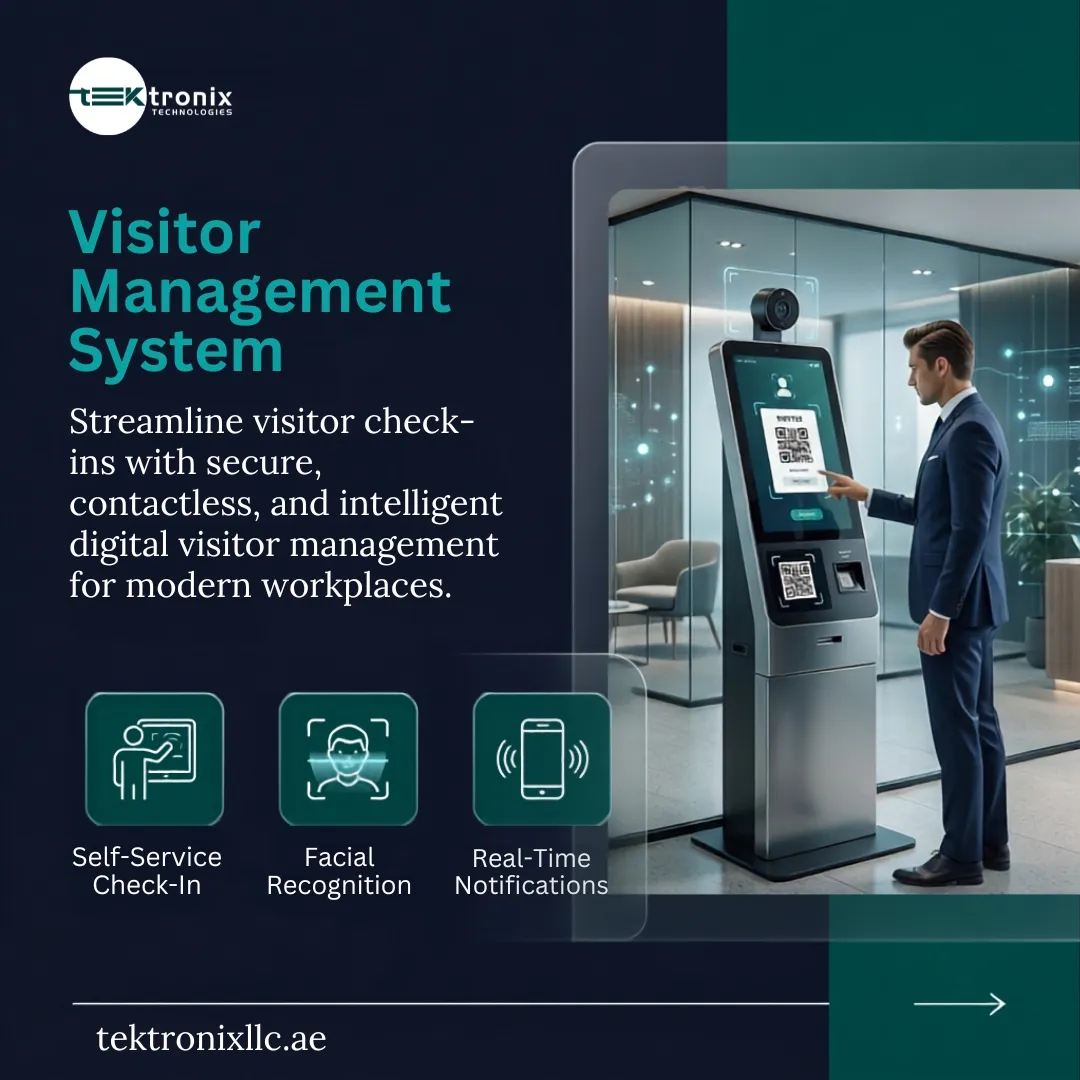
Integrating access control with a visitor management platform closes a common gap: contractors and vendors are pre-registered, badge-verified, and escorted automatically, rather than relying on a paper sign-in sheet at reception. Tektronix's team frequently deploys this combined approach when helping GCC operators upgrade their data center security infrastructure, pairing access hardware with centralized identity management for full traceability.
Time-stamped, tamper-evident access logs also satisfy the audit trail requirements found in ISO/IEC 27001 Annex A and the NCA's Essential Cybersecurity Controls, giving facility managers exportable evidence during compliance reviews rather than reconstructing entry history manually after the fact.
The Role of Continuous Visual Monitoring
Round-the-clock Data Center Surveillance using high-resolution IP cameras, thermal imaging, and AI-driven video analytics allows security teams to detect loitering, tailgating, or unauthorized equipment removal long before it escalates into a serious incident.
Video feeds integrated with access logs and alarm panels create a single pane of glass for operators, so an anomaly at the server cage door automatically pulls up the relevant camera feed for immediate verification, cutting response time from minutes to seconds.
Retention policies matter as much as capture quality. Facilities handling banking or government workloads typically retain footage for 90 days or longer, stored redundantly off-site, so investigators can review historical footage during an incident review months after the original event occurred.
Advanced Perimeter Intrusion Detection Systems
Beyond the building envelope, fence-mounted sensors, buried cable detection, and radar-based perimeter analytics form a dedicated Data Center Intrusion Detection layer that flags climbing, cutting, or digging attempts along the outer boundary long before an intruder reaches the facade.
Layering these sensors with motion-triggered lighting and automated alarm escalation to on-site guards or a remote monitoring center ensures that a breach attempt is contained at the outermost ring of defense, rather than becoming a race against time inside the building.
False alarms are the biggest threat to perimeter system adoption — guards who dismiss repeated nuisance alerts eventually stop responding promptly to real ones. Tuning sensor sensitivity to local conditions, including sandstorms and extreme heat common across Saudi Arabia's interior regions, is essential to keeping perimeter alerts credible and actionable.
Proactive Strategies for Identifying Emerging Threats
Static defenses alone are no longer sufficient. Continuous Data Center Threat Detection combines SIEM correlation, user behaviour analytics, and machine-learning models trained on facility-specific traffic patterns to flag anomalies that signature-based tools would otherwise overlook.
By fusing physical alerts (an unexpected door opens at 3 a.m.) with digital signals (an unusual outbound data transfer at the same moment), security teams gain the correlated context needed to distinguish a genuine attack from routine maintenance, dramatically reducing false positives and response fatigue.
Threat intelligence feeds specific to the Middle East region add further context, flagging indicators of compromise associated with campaigns previously observed against Gulf-based infrastructure providers, so defenders can pre-emptively block known malicious infrastructure rather than waiting for a local incident to trigger the block.
Regulatory Landscape Shaping Facility Protection Standards Nationwide
Facility operators pursuing Data Center Security KSA compliance must align with the National Cybersecurity Authority's Essential Cybersecurity Controls (ECC), SDAIA data residency guidance, and Communications, Space & Technology Commission (CST) licensing requirements, alongside international benchmarks such as ISO/IEC 27001 and Uptime Institute Tier certification.
Demonstrating alignment with these frameworks is increasingly a prerequisite for winning government and banking contracts, as regulators expect documented evidence of both physical resilience and information-security governance before granting operating approval.
Why Riyadh-Based Enterprises Need Localized Solutions
As the capital's King Abdullah Financial District and surrounding technology parks fill with regional headquarters, demand for dedicated Data Center Security Riyadh solutions has grown sharply. Local enterprises need providers who understand municipal permitting, Riyadh's climate-driven cooling and power redundancy needs, and the compressed response times expected by capital-based regulators and clients.
Beyond the financial district, Riyadh's growing cluster of hyperscale and edge facilities supporting government cloud, telecom, and AI workloads means downtime tolerance is shrinking year over year. Local service-level agreements now commonly specify sub-hour on-site response for critical alarms, a bar that only providers with an established regional presence and pre-positioned spares can realistically meet.
Business Continuity and Disaster Recovery Planning
Facility protection does not end with keeping intruders out; it extends to ensuring operations continue through fire, flood, power loss, or a cyber incident. Redundant power feeds, N+1 cooling, and tested failover to a secondary site are all part of a resilience plan aligned with ISO 22301 business continuity principles, and increasingly a contractual requirement for banking and government tenants operating in the Kingdom.
Regular tabletop exercises that simulate a combined physical-and-cyber incident — for example, a forced entry attempt coinciding with a ransomware alert — reveal gaps in escalation procedures long before a real event exposes them. Facilities that rehearse these scenarios quarterly typically cut incident response times substantially compared with those that rely on static documentation alone.
The Business Case for Investing in Layered Protection Today
Downtime at a Saudi-based facility carries a direct financial cost, but the reputational cost of a publicized breach is often larger and longer-lasting, particularly for operators competing for government tenancy where public trust is a procurement criterion in its own right. Every riyal invested in layered protection should be weighed against the cost of a single major incident, not just against a competitor's sticker price.
Total cost of ownership calculations should include not only hardware and licensing but also integration effort, staff training, and ongoing maintenance contracts. Facilities that budget for a multi-year security roadmap, rather than a one-time installation, are better positioned to keep pace with an evolving regional threat landscape and tightening regulatory expectations.
Choosing a Trusted Security Technology Partner
With years of hands-on deployment experience across the UAE, Saudi Arabia, Qatar, Bahrain, Oman, and Kuwait, Tektronix has built and certified physical and network security layers for banking, healthcare, government, and hyperscale colocation clients throughout the GCC. The engineering team holds OEM certifications from leading manufacturers including Hikvision, Bosch, Axis, and HID, and every deployment follows documented commissioning and acceptance-testing procedures. Enterprises evaluating vendors can review the full range of integrated data center protection systems to compare capabilities against local compliance requirements before shortlisting a partner.
Converging Physical and Cyber Defense
The most resilient facilities no longer treat guards, cameras, and firewalls as separate budgets managed by separate teams. Instead, physical and cyber controls report into a unified security operations center, giving leadership a single, real-time view of facility risk. Organizations exploring this convergence model often begin by requesting a facility audit from Tektronix's trusted data center security specialists in Saudi Arabia, who assess existing infrastructure against ECC and ISO 27001 baselines before recommending a phased upgrade roadmap.
Common Pitfalls to Avoid When Upgrading Facility Protection
Many operators purchase individual point products — a camera system here, a firewall appliance there — without a unifying architecture, leaving blind spots at the integration seams. Others under-invest in staff training, deploying sophisticated analytics that guards never learn to interpret correctly, which quietly erodes the return on a significant capital investment.
A further common mistake is treating compliance as a one-time certification exercise rather than an ongoing program. Regulations such as the NCA's Essential Cybersecurity Controls are updated periodically, and facilities that do not schedule regular re-assessment risk falling out of compliance without realizing it until an audit or, worse, an incident exposes the gap.
Finally, procurement decisions driven purely by lowest upfront cost frequently overlook long-term maintenance, spare-parts availability, and local support response times — factors that matter far more over a facility's operational lifetime than the initial purchase price of any single component.
Conclusion
Protecting a modern facility in the Kingdom now demands a single, unbroken strategy that treats Data Center Security as inseparable from Cybersecurity for Data Center operations, backed by strong Data Center Encryption and resilient Data Center Firewalls at the network edge. Layered Data Center Access Control, continuous Data Center Surveillance, and perimeter Data Center Intrusion Detection close the gaps that opportunistic intruders rely on. Pairing these physical layers with intelligent Data Center Threat Detection gives operators the correlated visibility regulators now expect. For organizations pursuing Data Center Security KSA compliance, or evaluating dedicated Data Center Security Riyadh support, a unified physical-and-cyber roadmap is the clearest path to a defensible, audit-ready facility.
FAQs
1. What does comprehensive Data Center Security actually include?
It spans perimeter fencing and guarding, biometric entry, video monitoring, environmental sensors, and network-layer defenses working together under a single incident-response plan, rather than isolated point solutions managed independently. The strongest programs also assign clear ownership so physical and digital alerts are triaged by the same team.
2. How does Cybersecurity for Data Center operations differ from standard IT security?
It must also secure operational technology such as cooling, power distribution, and building management systems, which sit outside a typical corporate IT network but are equally critical to uptime and safety. These OT systems often run legacy firmware, so compensating network controls are essential where patching is not feasible.
3. Why is Data Center Encryption required even inside a physically secured facility?
Physical barriers reduce but never eliminate insider risk, device theft, or interception during data transfer, so encrypting data at rest and in transit ensures information stays protected even if a device is removed or compromised. Strong key-management practices are what make that protection reliable over time.
4. What should facilities pursuing Data Center Security KSA compliance prioritize first?
Alignment with the National Cybersecurity Authority's Essential Cybersecurity Controls and SDAIA data residency guidance should come first, since most government and banking clients now require documented proof of both before signing a hosting agreement. ISO 27001 certification is a strong complementary benchmark to pursue in parallel.
5. Are Data Center Security Riyadh requirements different from other Saudi cities?
The core standards are national, but Riyadh's dense financial-district facilities typically face stricter response-time expectations and higher redundancy demands given the concentration of banking and government tenants in the capital. Providers with local Riyadh-based technicians are best placed to meet those expectations consistently.
For more information contact us on:
Tektronix Technology Systems
+966 5021 04086
Building No. 8194, Additional No. 4368, Office No. 21, Third Floor
King Abdul Aziz Road, Al Rabie District
Riyadh 13315, Saudi Arabia





























Sign in to leave a comment.