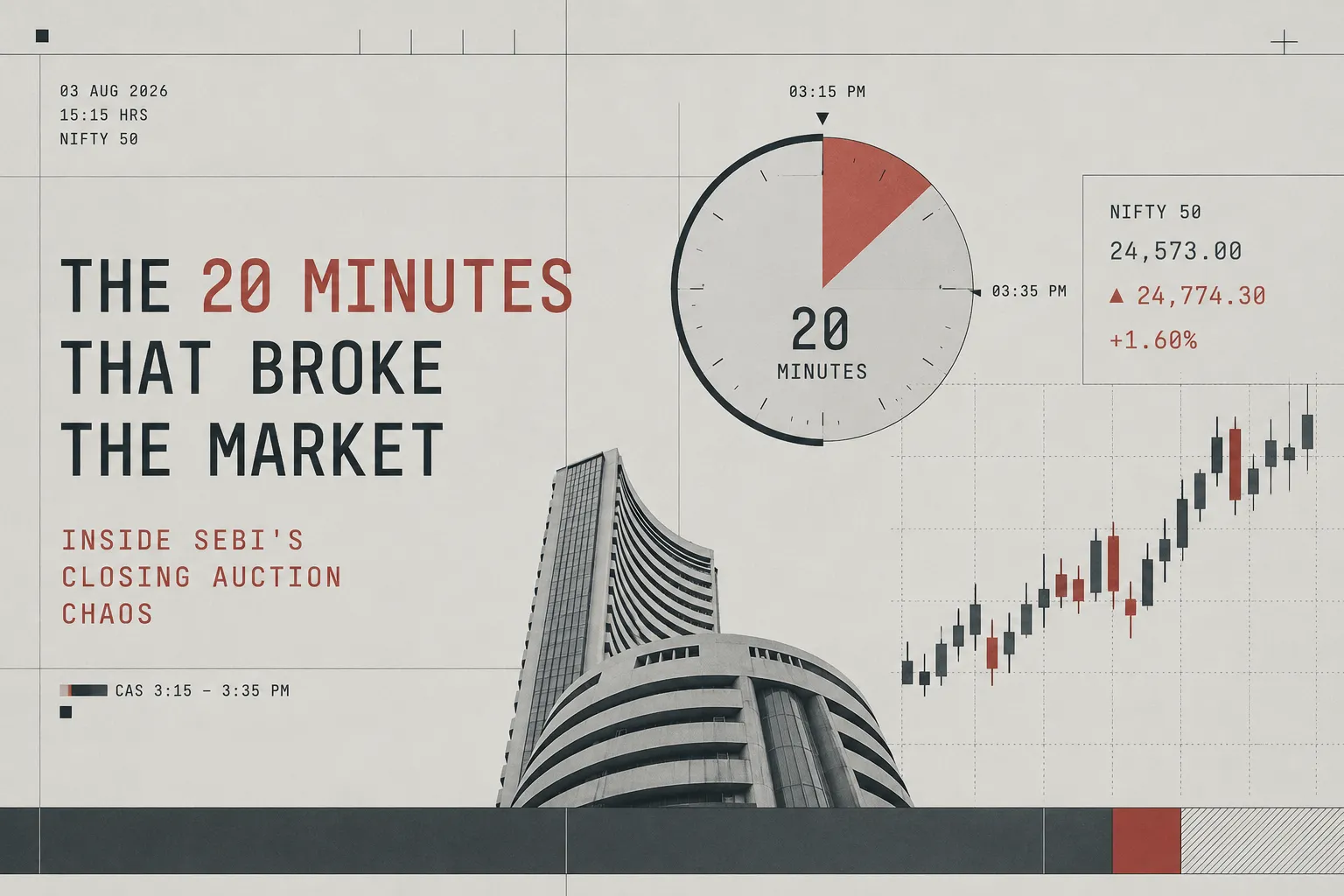

At 3:15 PM on August 3, 2026, the Nifty 50 stood at 24,573. Twenty minutes later, when the official closing bell numbers came in, the index had somehow jumped to 24,774.30, a gain of nearly 200 points that nobody had actually watched happen. Traders across Dalal Street stared at their screens, refreshed their apps, and asked the same question: did the market just move 200 points with no trades visible on the tape?
It had not. What they were witnessing was the debut of SEBI's Closing Auction Session, or CAS, a landmark change to how India's benchmark indices are priced at the end of every trading day. Three weeks in, it has triggered confusion, retail backlash, an unprecedented gap between the Nifty and the Sensex, and a genuinely strange coincidence with the Nifty's most bizarre record in its 30 year history. Here is the full story.
What Actually Changed on August 3
For decades, the closing price of Indian stocks with listed derivatives was calculated using the Volume Weighted Average Price, or VWAP, of every trade executed in the final 30 minutes of the session, from 3:00 PM to 3:30 PM. It was simple, familiar, and occasionally exploitable, since a handful of manipulative trades near the close could distort the official settlement price used for index calculation, derivative expiry and portfolio valuation.
SEBI's fix, first proposed in a December 2024 consultation and confirmed for implementation in January 2026, replaced that system entirely for F&O eligible stocks. Starting August 3, these stocks now go through a dedicated 20 minute Closing Auction Session between 3:15 PM and 3:35 PM. The window itself is broken into four phases: a five minute transition period where a reference price is published, five minutes where both market and limit orders can be placed, five more minutes where only limit orders are accepted, and a final five minutes where all the pooled orders are matched into a single closing price, the level at which the maximum possible volume can trade.
The idea, borrowed from mature markets like the US and Europe, is sound in principle. It reduces the odds of last minute manipulation, gives passive index funds a cleaner execution benchmark, and brings India closer to global best practice. NSE celebrated the rollout publicly, reporting that CAS eligible turnover hit 1,276.2 crore rupees on its exchange on day one, dwarfing the 10.8 crore rupees recorded on BSE, which has not yet adopted the same mechanism.
Day One Chaos and the Nifty-Sensex Divergence
The launch did not go smoothly. On that first day, the Nifty's jump from 24,573 at 3:15 PM to an official close of 24,774.30 represented a 1.60 percent gain for the session, a far larger move than what continuous trading had shown just moments earlier. The Sensex, still operating on the old VWAP system since BSE had not yet switched over, closed 0.70 percent higher at 78,639.03. That mismatch, one index jumping on an auction print while the other moved through ordinary trading, created an unusually wide and visible gap between India's two headline benchmarks on the very same day, for the very same market.

The confusion deepened the very next session. August 4 also happened to be a weekly options expiry day. At 3:15 PM, the Nifty was trading at 24,463.45, down 1.25 percent for the day. By the time the auction concluded, the official close printed at 24,614.90, a swing of 151.45 points in just 20 minutes. For anyone holding options into expiry, that gap was not academic. With Nifty's revised lot size of 65 units, a move of that size shifted the intrinsic value of a single options lot by roughly 9,844 rupees, money made or lost purely because of where the auction happened to settle, not because of anything visible in the preceding trading session.
Why Nobody Was Trading in the New Window
Perhaps the most telling data point to emerge from the rollout came from a Bernstein analysis of exchange volumes. Historically, the final 30-minute window before close accounted for about 10.1 percent of NSE's total daily turnover, as traders squared off positions and funds executed end of day rebalancing. Under the new CAS structure, that figure collapsed to somewhere between 1.6 percent and 2.3 percent of turnover.

In plain terms, the very people the auction mechanism was designed to serve, active traders and institutions squaring off positions into the close, mostly stayed away from it in the first weeks. Uncertainty over how the new matching process worked, and genuine difficulty predicting where the auction price would land, appears to have discouraged participation rather than encouraged it, at least initially.
Retail Traders Hit a Different Kind of Snag
Away from the price swings, a separate complaint spread quickly through retail trading communities on Reddit and elsewhere. Delivery stop loss orders placed on CAS eligible stocks now automatically cancel when continuous trading halts at 3:15 PM, since there is no ongoing order book left for a stop loss to trigger against during the auction. That caught a number of retail traders off guard, particularly those used to letting protective stop losses run until the close. Adding to the confusion, cash market trading in these stocks stops at 3:15 PM while the corresponding futures and options continue trading until 3:40 PM, creating a 25 minute window where derivatives are moving but the underlying cash market has already gone quiet, an asymmetry that market participants have openly flagged as difficult to manage around.
SEBI's Response: Teething Issues, Not a Flawed System

Facing the early criticism, SEBI has not backed away from the reform. Board member KVR Murty met with leading brokerages during the first week and described the problems as teething issues rather than a fundamental design flaw, according to a Bloomberg report. SEBI Chairman Tuhin Kanta Pandey has since said the regulator found no evidence of manipulation in the new auction process, though he acknowledged that participation and price visibility remain genuine concerns worth addressing. Among the fixes reportedly under consideration is wider public display of the indicative equilibrium price while the auction is still running, which would give traders a clearer sense of where the close is likely to land before it actually happens.
There are early signs of the system settling in. By August 14, roughly two weeks after launch, the gap between the Nifty's 3:15 PM level and its final close had visibly narrowed, even as the equivalent gap on the Sensex, still unaffected by CAS, remained marginally wider by comparison, suggesting the market was adapting to the new mechanism.
A Strange Coincidence Worth Watching
Here is the part that has traders talking. Between August 4 and August 19, 2026, the Nifty failed to exceed the previous trading day's high for 12 consecutive sessions, the longest such streak in the index's history, easily surpassing the previous nine-session record set back in December 2014. That stretch of unusual stagnation began the day after CAS went live and ran almost exactly through its bumpiest early weeks.
To be clear, nobody has established that the closing auction caused the index to stall. Broader macro pressures, from crude oil volatility to global rate uncertainty, were also weighing on sentiment during the same period, and correlation of this kind is easy to overstate. But the overlap between a record-breaking stretch of index inertia and the most disruptive market structure change in years is, at minimum, a coincidence too striking for serious market watchers to ignore.
What This Means Going Forward
CAS is currently limited to F&O eligible stocks in the cash segment, with a wider rollout to the rest of the market expected in later phases once the current kinks are worked out and BSE eventually falls in line with the same mechanism. For traders and investors, the practical takeaways are straightforward for now. Expect the last 20 minutes of trading in derivative-linked stocks to behave differently than the rest of the session, keep a close eye on how stop loss orders are structured heading into the close, and do not assume the Nifty and Sensex will always tell the same story at day's end until both exchanges are running on identical closing mechanisms.
Market structure reforms rarely make headlines the way a rate cut or an earnings surprise does, but this one has genuinely changed how India's most watched number gets calculated every single trading day. Three weeks in, the jury is still out on whether CAS will settle into the seamless, manipulation resistant system SEBI envisioned, or whether it needs a more significant rework before the rest of the market adopts it.
Data referenced in this article is sourced from SEBI circulars, NSE, Business Standard, Outlook Business, Outlook Money and Bernstein research as reported by financial media, current as of August 27, 2026. This article is for informational purposes only and does not constitute investment advice. Readers should consult a qualified financial advisor or their broker for guidance on trading around the new closing mechanism.





















Sign in to leave a comment.