The Bridal Dupatta That Made a Simple Lehenga Look Expensive


Why putting the embroidery in the right place matters more than covering every inch of fabric.
A few days ago, a customer walked into a fabric shop in Delhi carrying a photograph of a heavily embroidered bridal lehenga. She loved the outfit but had one concern: the embroidery alone was going to consume most of her wedding budget.
She wanted the same richness, the same beautiful movement, and the same bridal feeling without spending heavily on every metre of fabric.
That conversation reminded me of something I have noticed repeatedly in bridal fashion: sometimes the most beautiful lehenga is not the one with the most embroidery, but the one where the embroidery is placed thoughtfully.
When the Dupatta Becomes the Main Attraction
Traditionally, many brides imagine their wedding lehenga with elaborate embroidery across the skirt, blouse, and dupatta.
But there is another approach worth considering.
Imagine a softly flared lehenga in champagne gold, dusty rose, or ivory. The skirt has a clean silhouette, perhaps with a narrow embroidered border. The blouse carries a little detailing around the neckline.
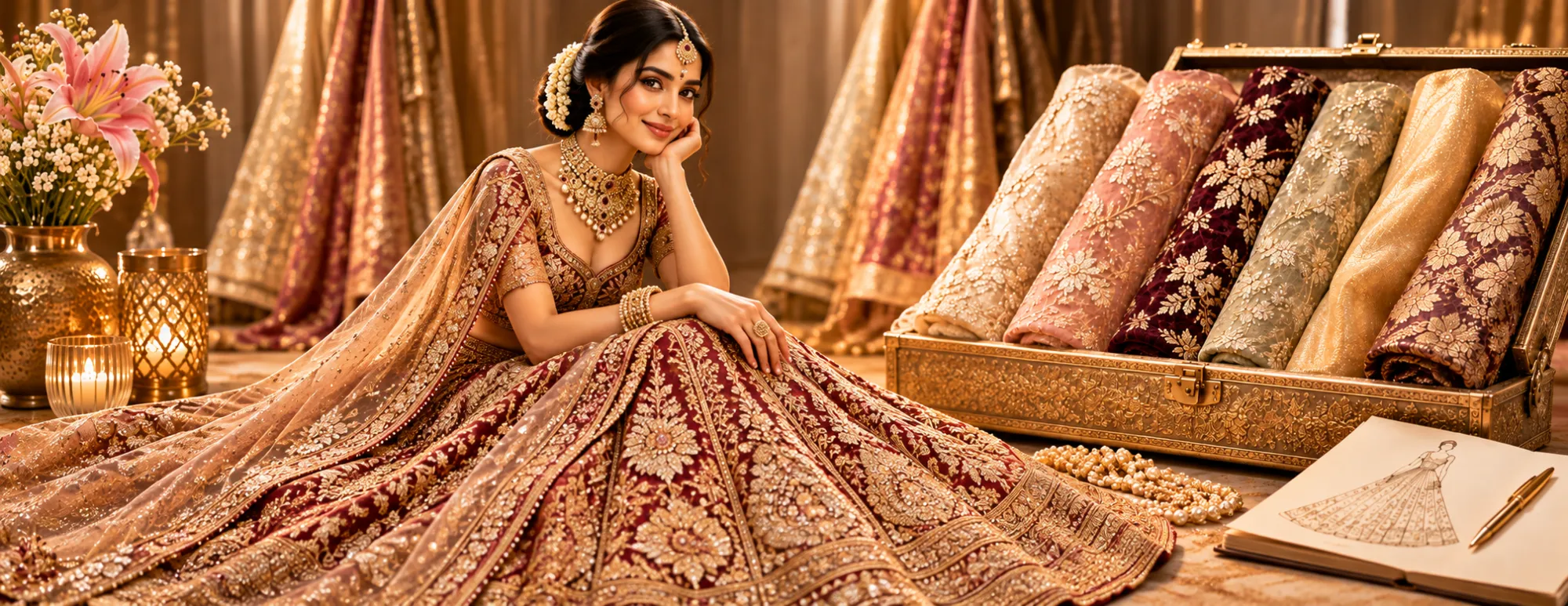
Now add a beautifully embroidered dupatta with intricate zari, sequins, pearls, or delicate floral motifs.
Suddenly, the entire outfit feels different.
The dupatta frames the face, adds richness around the shoulders, and creates beautiful detailing in photographs without requiring the whole skirt to be heavily embellished.
Why Fabric Selection Matters
A dupatta-forward lehenga works best when the fabrics complement each other.
For the skirt, raw silk, crepe, or a suitable silk blend can create a clean foundation. For the dupatta, soft net and organza are popular choices because they allow embroidery to stand out.
However, not every net or organza behaves the same way.
Some fabrics are too stiff and refuse to fall naturally around the shoulders. Others are so delicate that heavy embroidery can distort the weave.
That is why it helps to examine the actual fabric before finalising the design.
At Paras Gallery Fabrics, shoppers can explore different bridal fabric textures and embroidered materials to understand how the base fabric and decorative work might come together.
The important thing is to check the fabric's weight, transparency, drape, and suitability for the intended embroidery.
The Beauty of Plain Kalis
One detail I particularly appreciate is the use of relatively plain kalis in a bridal lehenga.
Kalis are the individual panels that form the skirt. Their number, width, and construction influence how the lehenga falls and moves.
When these panels are not overloaded with embroidery, the silhouette can appear softer and more fluid.
This approach also allows the dupatta to become the visual centre of the outfit.
For example, an ivory lehenga with a heavily embroidered champagne-gold dupatta can feel elegant and luxurious without relying on dense embroidery across the entire skirt.
The effect comes from contrast: a quieter base paired with one richly detailed element.
Don't Forget the Waistband
There is another small detail that can make a noticeable difference: the waistband.
An embellished belt or structured waistband can visually connect the blouse, skirt, and dupatta.
It also helps define the waist and can make the outfit feel more finished.
But the waistband must be constructed properly. A decorative belt should not replace the internal support needed to hold a heavy bridal skirt comfortably.
Good tailoring matters just as much as beautiful fabric.
A Bridal Look That Feels Personal
Not every bride wants a heavily embroidered red lehenga. Some prefer pastel colours, delicate details, lighter silhouettes, or outfits that can be restyled after the wedding.
A dupatta-forward lehenga offers room for that individuality.
The dupatta can later be paired with a simpler suit, a silk skirt, or another festive outfit. The relatively plain lehenga can also be restyled with a contrasting blouse or a different dupatta.
That makes the design interesting beyond the wedding day itself.
A Final Thought
Bridal fashion is often discussed in terms of how much embroidery, how many metres of fabric, or how elaborate the finished outfit looks.
But I think the better question is simpler:
Where should the detail go so that the entire outfit feels beautiful?
Sometimes the answer is the neckline. Sometimes it is the hem. And sometimes it is one carefully chosen dupatta that transforms an otherwise simple lehenga.
The best bridal outfits do not always need more decoration. They need the right balance of fabric, craftsmanship, movement, and personal style.



Sign in to leave a comment.