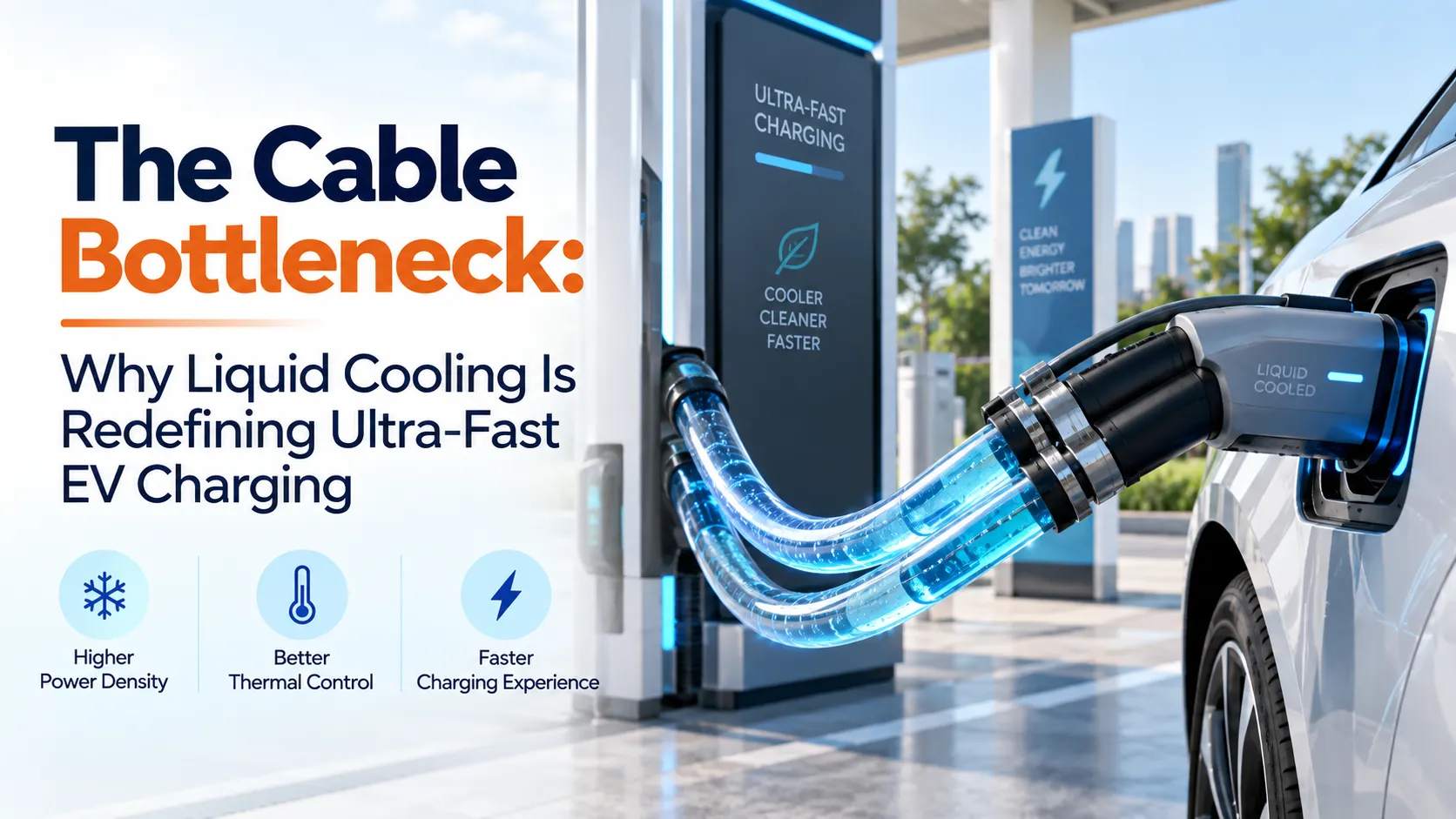

The race to make electric vehicle charging faster has traditionally focused on charger power, battery architecture, and charging networks. Yet there is another component quietly determining how far ultra-fast EV charging can scale: the cable connecting the vehicle to the charger.
As charging systems move toward higher current levels, heat becomes a fundamental engineering challenge. Conventional cables can handle increasing power by using larger conductors, but that approach also makes them heavier, thicker, and more difficult to handle. Liquid-cooled EV charging cables offer another route by using an internal cooling pathway to remove heat while maintaining a more manageable cable design.
This changes the role of the charging cable. It is no longer simply a connection between a charger and a vehicle; it is becoming an important part of EV cable thermal management and overall charging performance.
When Faster Charging Creates a New Engineering Problem
Ultra-fast charging depends on moving substantial electrical current within a limited period. But higher current also produces greater heat through electrical resistance. If that heat is not effectively controlled, charging systems may need to reduce output to protect connectors and other components.
For charging operators, this can create a difficult trade-off. Increasing conductor size can improve current-handling capability, but it can also make the cable physically cumbersome. At a busy public charging station, a cable that is difficult to lift, bend, or position can affect the everyday charging experience.
Liquid cooling addresses this challenge at the source. By circulating coolant through the cable assembly, heat can be transferred away from conductors and connector areas during high-power operation.
Why the Cable Is Becoming Part of the Charging Strategy
The significance of liquid-cooled cables extends beyond temperature management.
High-power charging sites increasingly need equipment that can perform repeatedly rather than simply achieve a high peak output. Highway charging corridors, urban fast-charging hubs, commercial yards, and fleet depots can experience frequent charging sessions throughout the day.
In these environments, cable reliability can directly influence charger availability and user experience. A system capable of delivering high power is of limited practical value if thermal constraints force it to reduce output or if its cable becomes difficult to handle.
This makes the electric vehicle charging cable an increasingly important component of charging infrastructure design.
The Usability Factor Often Gets Overlooked
Charging technology is ultimately handled by people.
A driver pulling into a charging station expects to connect the vehicle quickly, position the connector comfortably, and complete the session without struggling with an oversized cable. This creates an interesting engineering requirement: charging cables must become capable of carrying more power without becoming disproportionately difficult to use.
Liquid-cooled designs help address this balance. Instead of depending entirely on additional conductor material to manage higher currents, thermal management becomes an active part of the cable architecture.
The result is not simply faster charging. It is an attempt to make high-power charging physically practical for everyday use.
From Highway Corridors to Fleet Depots
The need for advanced cable technology is particularly visible in high-utilisation charging environments.
Highway charging stations need to support drivers who want shorter stops during long-distance journeys. Urban charging hubs may experience a continuous flow of vehicles throughout the day. Fleet operators, meanwhile, have a direct operational interest in reducing charging downtime because vehicles need to return to service quickly.
These applications share a common requirement: consistent high-power performance.
Liquid-cooled cables can therefore become particularly relevant wherever charging intensity, short charging windows, and equipment utilisation converge.
Connector Compatibility Is the Next Piece of the Puzzle
Thermal performance alone does not determine whether a charging cable will succeed in a real-world deployment.
Charging infrastructure must also account for different connector standards and vehicle requirements, including CCS, CHAdeMO, GB/T, Type 1, Type 2, and NACS. A technically advanced cable still needs to be compatible with the vehicles and charging systems it is intended to serve.
For operators, this means cable selection involves more than current capacity. Procurement teams also have to consider connector compatibility, regional requirements, maintenance, replacement inventory, and serviceability.
As charging networks become more diverse, this compatibility layer could become just as important as thermal performance.
The Infrastructure Question Behind Liquid Cooling
The shift toward liquid-cooled cable assemblies reflects a broader change in how EV charging infrastructure is being designed.
According to the source article, the electric vehicle charging cable industry was valued at USD 1.88 billion in 2025 and is projected to reach USD 5.46 billion by 2032, with a CAGR of 16.45% between 2026 and 2032. The article also highlights the expansion of public charging infrastructure and the growing concentration of charging-related manufacturing and deployment activity in Asia.
These developments point toward a broader question: as charging power increases, can every part of the charging system scale at the same pace?
The cable is increasingly becoming part of that answer.
Challenges That Could Shape Adoption
Liquid cooling does not eliminate the engineering challenges associated with high-power charging.
The addition of cooling channels, seals, connector integration, and thermal-management components can increase system complexity. Cooling loops must remain reliable, while cables still need to withstand bending, pulling, weather exposure, and repeated connector use.
Certification and regional approval requirements can also influence deployment. For charging operators, service readiness matters just as much as peak performance. Spare cable availability, trained technicians, replacement procedures, and maintenance planning all become part of the infrastructure equation.
This suggests that future cable development will need to balance four priorities: electrical performance, thermal control, physical usability, and long-term serviceability.
The Next Charging Advantage May Not Be the Charger
The future of ultra-fast EV charging will not be determined by charger output alone.
As charging systems move toward higher power, every component involved in transferring that power has to keep pace. Liquid-cooled cables offer a way to manage one of the most persistent limitations: heat generated during high-current charging.
Their importance therefore goes beyond simply enabling faster charging. They represent a shift toward treating the cable as an engineered thermal and performance system rather than a passive accessory.
For charging operators, vehicle manufacturers, and infrastructure developers, the question is increasingly not just how quickly an EV can charge, but whether the complete charging system can sustain that speed safely, reliably, and conveniently.
That is where liquid-cooled cable technology could become one of the defining components of the next generation of EV charging infrastructure.
























Sign in to leave a comment.