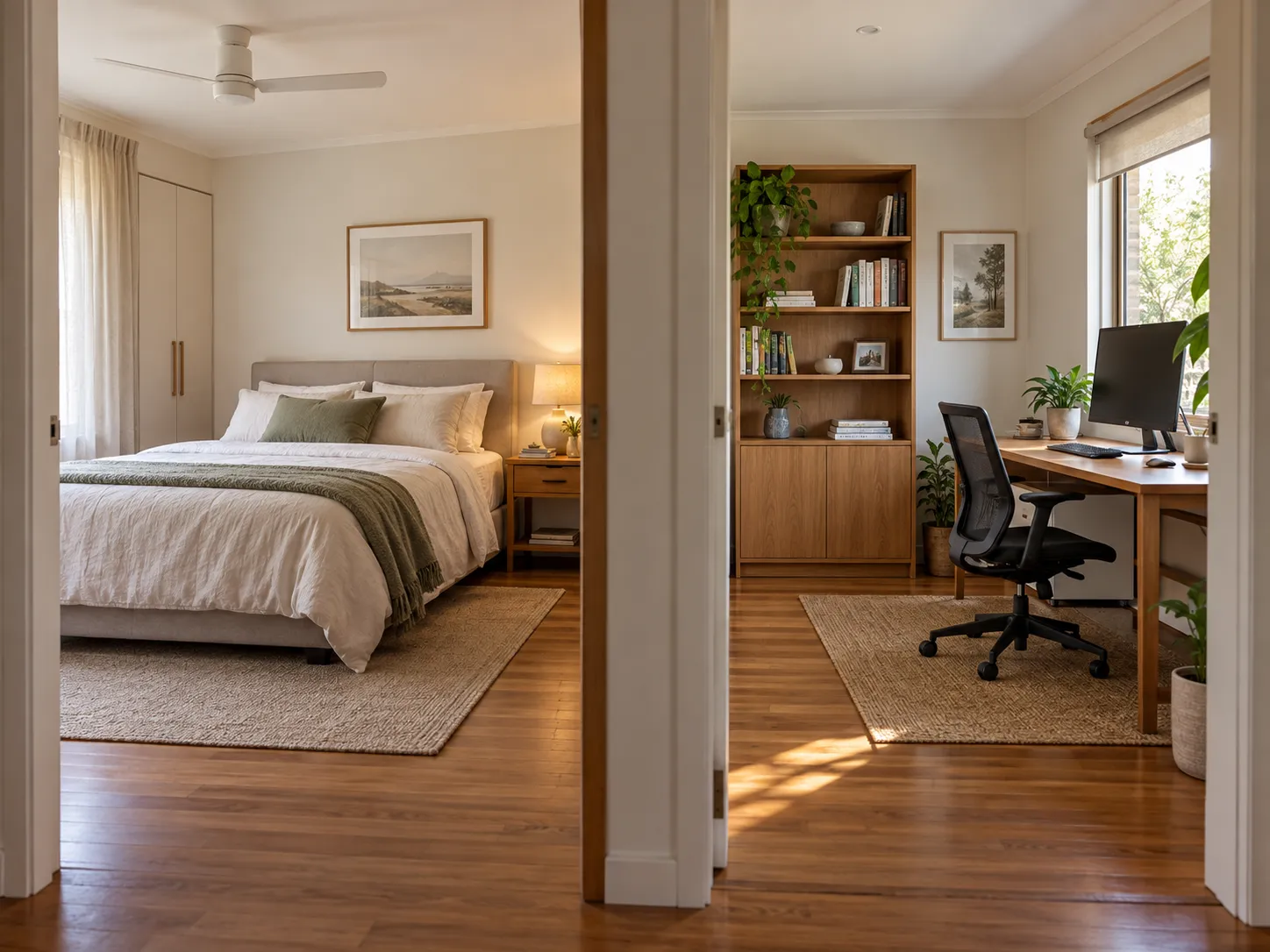


At 9 pm, the spare room has a problem. A laptop sits open on the bed. A jacket hangs from the desk chair. Somewhere beneath three notebooks is the lamp switch.
Is this a place to rest or a place to work? The room cannot seem to decide.
That is our two-room challenge: create a bedroom that invites you to switch off and a home office that helps you get started. You do not need two large rooms or a shopping spree. You need to decide what each space must do, then give its furniture the right jobs.
Furniture is more than decoration. A bed with room to walk around it, a desk that fits your equipment and storage you can actually use all change what you do in a room. They cannot guarantee a good night’s sleep or a brilliant workday, but they can make everyday routines easier.
Why do these rooms need different personalities?

Imagine setting up two stages for the same person. On one stage, they are winding down with a book. On the other, they are finding a document before a meeting. The furniture should support each scene.
| The bedroom needs… | The home office needs… |
|---|---|
| A comfortable place to sleep | A work surface suited to the task |
| Space to move and get dressed | A chair and screen positioned for the user |
| Places to put clothes away | Easy access to work supplies |
| Light that suits winding down | Light that lets you see your work |
| Fewer visible reminders of chores | A clear surface and organised equipment |
There is evidence behind some of these choices. Healthdirect recommends a quiet, dark bedroom as part of a good sleep environment. WorkSafe Queensland advises setting up a home workstation so the chair and computer suit the person using them. Neither source says that a particular colour, headboard or bookcase will transform your life. Those are design choices, and your habits and preferences matter too.
Bedroom challenge: can you reach the wardrobe without a sideways shuffle?
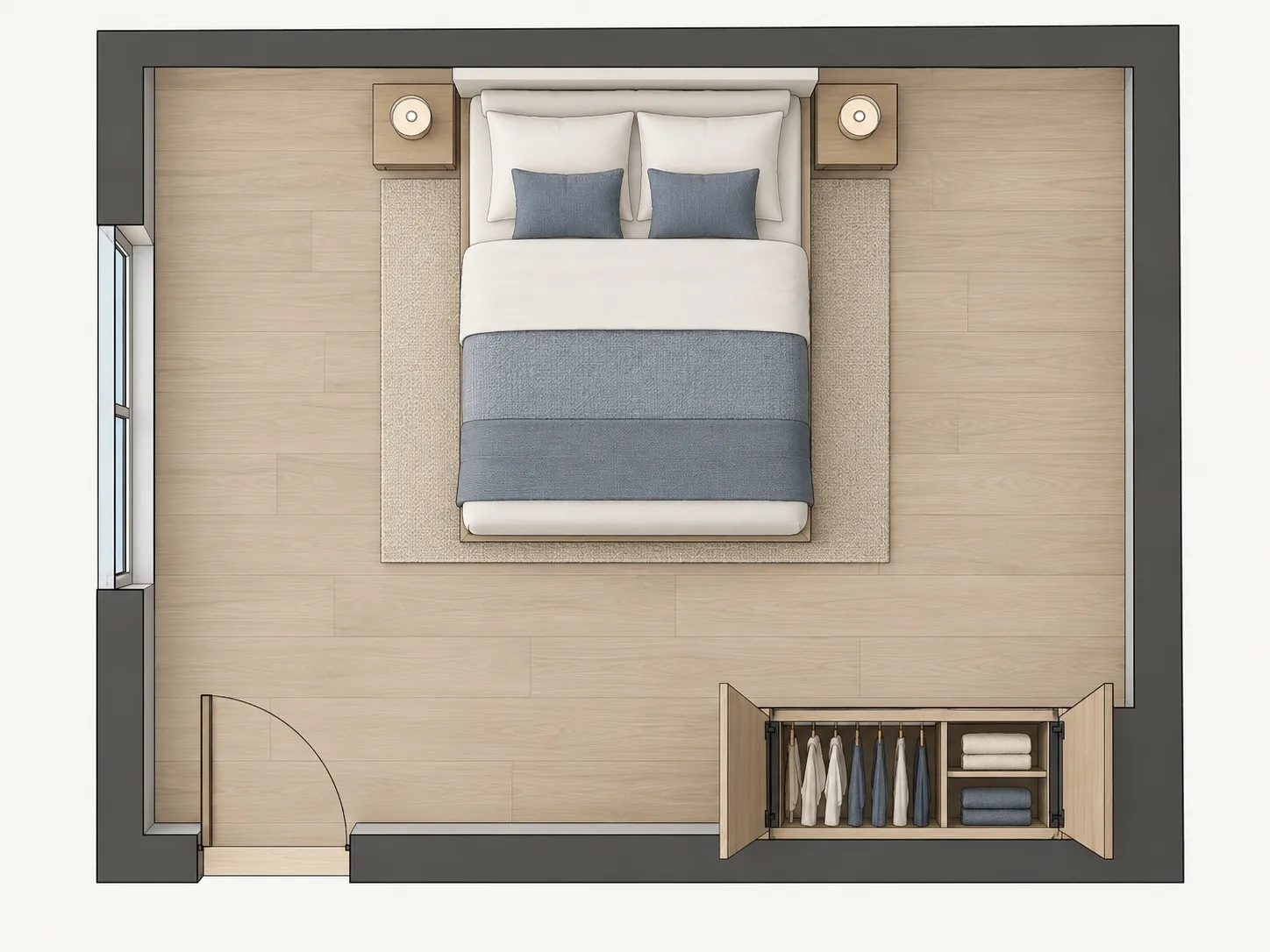
Start with the floor, not a furniture catalogue. Measure the room’s width and length, then mark the door, window, power points and any built-in wardrobe. Check which way every door opens.
Next, measure the outside dimensions of the bed frame. A mattress size alone will not tell you how much room a padded frame or wide headboard takes up. Measure the bedside tables too. Open the wardrobe doors and drawers on your plan: a layout that works with everything closed may fail on Monday morning.
As a starting point, try drawing about 60 cm of clear walking space along the sides you use regularly. More may feel better, especially when two people share the room. This is a planning guide, not a universal rule: test the space with a tape measure and consider anyone who needs extra room to move. If a hinged wardrobe door uses that space, include its full swing.
IKEA’s wardrobe-planning guidance likewise begins with measuring the room from wall to wall and floor to ceiling, then checking the clearance needed for the chosen doors and assembly.
The challenge test: Can you enter, walk to the bed, open the wardrobe and reach the window without moving a chair? If not, remove or resize something before you buy.
The bed is the main character
The bed usually takes the most floor space and catches your eye first. Give it the starring role, but do not let it swallow the set.
In Australia, a queen mattress is approximately 152.5 × 203 cm; a king is approximately 183.5 × 203 cm. That extra 31 cm of width can matter in a narrow room. Actual frames vary, so check the product measurements before drawing your final layout.
Which bed suits your room?
- Platform-style bed: Its simple frame can look less bulky in a smaller room. Check its height if getting in and out easily matters to you.
- Storage bed: Drawers or a lift-up base can hold spare linen. Check that drawers have space to open and that you can lift the base comfortably.
- Upholstered bed: A padded frame or headboard adds softness. Measure its full width and depth; the frame may extend beyond the mattress.
- Daybed: Useful when a spare room sometimes hosts a guest and sometimes needs more open floor space.
- Headboard with shelves: Handy when bedside tables will not fit, provided the shelves remain easy to reach.
The biggest bed is not automatically the best one. A king bed that leaves no space to open a wardrobe can make a generous room feel awkward. A smaller bed with a clear route on both sides may work better for daily life.
When comparing bedroom furniture, note both the mattress size and the frame’s overall measurements. Then draw those dimensions on your room plan before deciding what else will fit.
What about the mattress?
A beautiful frame cannot tell you whether a mattress feels right. If possible, try mattresses in the positions you normally sleep in and check the return conditions before buying. Consider who shares the bed, how easily you can change the bedding and whether the finished bed height suits you.
Keep the room’s purpose in view, too. A comfortable mattress sits within a wider sleep routine and environment; it is not a stand-alone solution to sleep difficulties.
Storage: give everyday things an easy place to land
You know the chair. It was bought for sitting, but it has become a small mountain of laundry.
That often means the room needs a better place for worn-once clothes. More storage is not always the answer. Storage that matches what you actually do is more useful than an impressive cabinet you never open.
Try assigning each common item a home:
- Clothes you wear often: Wardrobe space you can reach without digging.
- Folded clothes: Dresser drawers or wardrobe shelves.
- Books and glasses: A bedside drawer or small shelf.
- Spare bedding: Under-bed boxes or a storage bed.
- Worn-once clothes: A hook, rail or designated basket instead of the chair.
Closed storage can reduce what you see at a glance, while an open shelf makes favourites easy to reach. Choose the mix that suits you. If your bedside table is already crowded, adding a second lamp, clock and decorative tray may create more juggling than calm.
In a small bedroom, let furniture earn its floor space. A narrow chest might hold more than two tiny tables. Wall-mounted bedside shelves can leave the floor clear, although renters should check what they are allowed to install. Keep anything heavy securely anchored according to its instructions.
Do colour and soft furnishings matter?
They matter to the person living there. Curtains that block unwanted light have a practical job; healthdirect recommends keeping the bedroom dark for sleep. A rug, cushions and colour are largely questions of comfort and taste. There is no single “sleep colour” that works for everyone.
Choose a look you enjoy, then make sure the practical pieces still work. Curtains should open easily. A throw should have somewhere to go at bedtime. A reading chair is lovely if you will use it and can still walk around the bed.
Flip the switch: what does the home office need?
Now move from the room where you put things away to the room where you bring the right things within reach.
A home office needs a desk, a suitable chair and a place for the tools your work requires. That might mean a monitor and notebook, drawing equipment, textbooks or files. Begin with a list of what you use during a normal workday, not a picture of somebody else’s perfect desk.
WorkSafe Queensland advises people working from home to set up their chair and computer to suit them. For longer laptop sessions, it suggests a separate monitor or raising the laptop with a stand, plus a separate keyboard and mouse.
Put frequently used items within easy reach. Store occasional supplies nearby. Give the chair enough space to move back without striking a bookcase or blocking the door.
Your desk is the command centre

A desk should fit the work, the equipment and the room. Here is a useful way to compare options:
| Desk | Often suits | Check before buying |
|---|---|---|
| Small | A laptop, study tasks or occasional work | Is there room for a mouse, notebook and your elbows? |
| Medium | A laptop and monitor, writing or regular home work | Can the screen sit at a comfortable distance? |
| Large | Multiple screens, drawings or equipment-heavy work | Will the desk leave enough room to walk and move the chair? |
Those categories describe how a desk is used, not fixed product sizes. For computer work, WorkSafe Queensland recommends enough surface space for a keyboard, mouse and writing on the same level, and says a desk depth of 80 cm allows room to position monitors and legs comfortably. A shallower desk may still suit brief laptop use, but test your actual setup rather than assuming it will work for a full day.
Place the desk so you can see your work without fighting glare. A window beside the desk can be useful; a bright window directly behind or in front of your screen can cause reflections or make viewing uncomfortable. Blinds and an adjustable task lamp give you more control as daylight changes.
The challenge test: Put cardboard or masking tape on the floor to show the desk’s footprint. Pull out a chair. Open the door. If the room becomes an obstacle course, try a smaller surface or a different wall.
The chair problem: comfortable for whom?
A chair that looks excellent beside a desk may feel quite different after an hour of work. The important question is not “Is it an office chair?” but “Can this person adjust it to work with this desk?”
Look for a seat height that lets your elbows sit around desk level, support that fits your back, a seat that suits your leg length and armrests that let you move close to the work surface. If your feet do not rest comfortably on the floor after adjusting the chair, a footrest may help. WorkSafe Queensland recommends trying and adjusting these features for the individual user.
A good chair does not mean you should stay in it all day. WorkSafe Queensland recommends short, regular movement breaks and changing position about every 30 minutes. Even standing up to refill a glass of water changes the scene.
Bookcases, cabinets and the battle against desk clutter
Here is a simple office rule: your desk is for the work you are doing now; storage is for the work you may need later.
A bookcase makes use of wall height and keeps reference books visible. A closed cabinet can hide paperwork, spare cables and the mysterious collection of chargers every household seems to own. Small drawers keep pens and stationery from spreading across the desk.
Match the storage to the contents. Heavy books belong on sturdy, lower shelves. Papers you must retrieve should have labelled folders or drawers. Decorative objects are welcome, but leave room for the things the office is there to hold.
When looking at office furniture, compare a bookcase or cabinet’s footprint with its usable storage, and check that drawers and doors can open in your planned layout.
Cable management is another small job with a large visual effect. Place a power board where you can safely access it, follow its instructions and use simple cable clips or a tray to guide cords away from your feet and chair wheels. Then clear the desk at the end of the day. Tomorrow’s first task will be easier to find.
What if one room must do both jobs?
Many homes cannot spare a separate office. The challenge still works: make the room change roles clearly.
If you must work in a bedroom, use a desk and chair for work rather than making the bed your regular workstation. Place the desk so it does not dominate your view from the pillow, if the layout allows it. A folding screen, curtain or cabinet can hide work supplies at night; a desk with drawers can do the same job in less space.
Build a small closing routine: put the laptop away, clear the work surface and change the lighting. This is a practical boundary, not a promise that a particular layout will improve sleep. Healthdirect advises avoiding screen time in bed as part of healthy sleep habits.
For a guest room, a daybed or sofa bed may free space for a desk, but check how the room works when the guest bed is fully open. The same square metre cannot hold a pulled-out bed and a chair at once.
Finish the challenge with a five-minute walk-through

Before ordering anything, walk through an ordinary day in each room.
In the bedroom, pretend to enter, get dressed, open a drawer, change the sheets and switch off the light. In the office, pretend to sit down, reach the keyboard, read the screen, fetch a file and leave the room.
Notice where you turn sideways, stretch too far or move one object to use another. Those moments tell you more than a perfectly styled photograph.
You have won the two-room challenge when each space makes its main job straightforward: the bedroom gives rest and daily routines room to happen, and the office gives your work the space and tools it needs.
Visual Content Plan
| Visual | Placement | What it should teach |
|---|---|---|
| Split-scene hero | Above the article | The same home can have a calm bedroom and an organised office with different purposes. |
| Bedroom layout illustration | Beside “Bedroom challenge” | How to check the bed, door, wardrobe openings and walking space before buying. |
| Home office layout illustration | Beside “Your desk is the command centre” | How the desk, chair, storage, window and clear walking route relate. |
| Furniture comparison graphic | After the first comparison table | The different jobs of furniture and lighting in each room. |
| Furniture mistakes graphic | Before the five-minute walk-through | Six layout or storage problems readers can spot in their own rooms. |
FAQ
What furniture should every bedroom have?
A suitable bed and somewhere to store clothes are the usual starting points. Add a bedside surface if it helps your routine. The best list depends on the room size and what storage is already built in.
How much space should you leave around a bed?
Try planning roughly 60 cm along the sides you use regularly, then test whether you can walk comfortably, open drawers and access the wardrobe. Treat that as a starting guide, not a rule for every person or room.
What furniture is essential for a home office?
For regular computer work, start with a desk that fits your equipment, a chair that suits your body and desk, and storage for the supplies you use. Good lighting and a workable screen position matter as much as adding another cabinet.
How big should a home office desk be?
Big enough for your keyboard, mouse, screen and any writing you do, while leaving leg room and a clear route through the room. For a monitor-based workstation, WorkSafe Queensland recommends 80 cm of desk depth as a useful guide.
Can a bedroom also be used as a home office?
Yes. Give work a defined desk area, keep the bed out of your regular work routine where possible, and put equipment away when the workday ends. Check that the desk does not block access to the bed, wardrobe or door.
How can you make a small bedroom feel bigger?
Choose furniture that fits the floor plan, keep walking routes open and give everyday items a place to go. A bed with storage or a wall-mounted bedside shelf may reduce the number of separate pieces you need.
How can you create storage in a small home office?
Use wall height with a suitable bookcase or shelves, keep frequently used items near the desk and put less-used supplies in closed storage. Check shelf loads and secure tall furniture according to its instructions.




















Sign in to leave a comment.