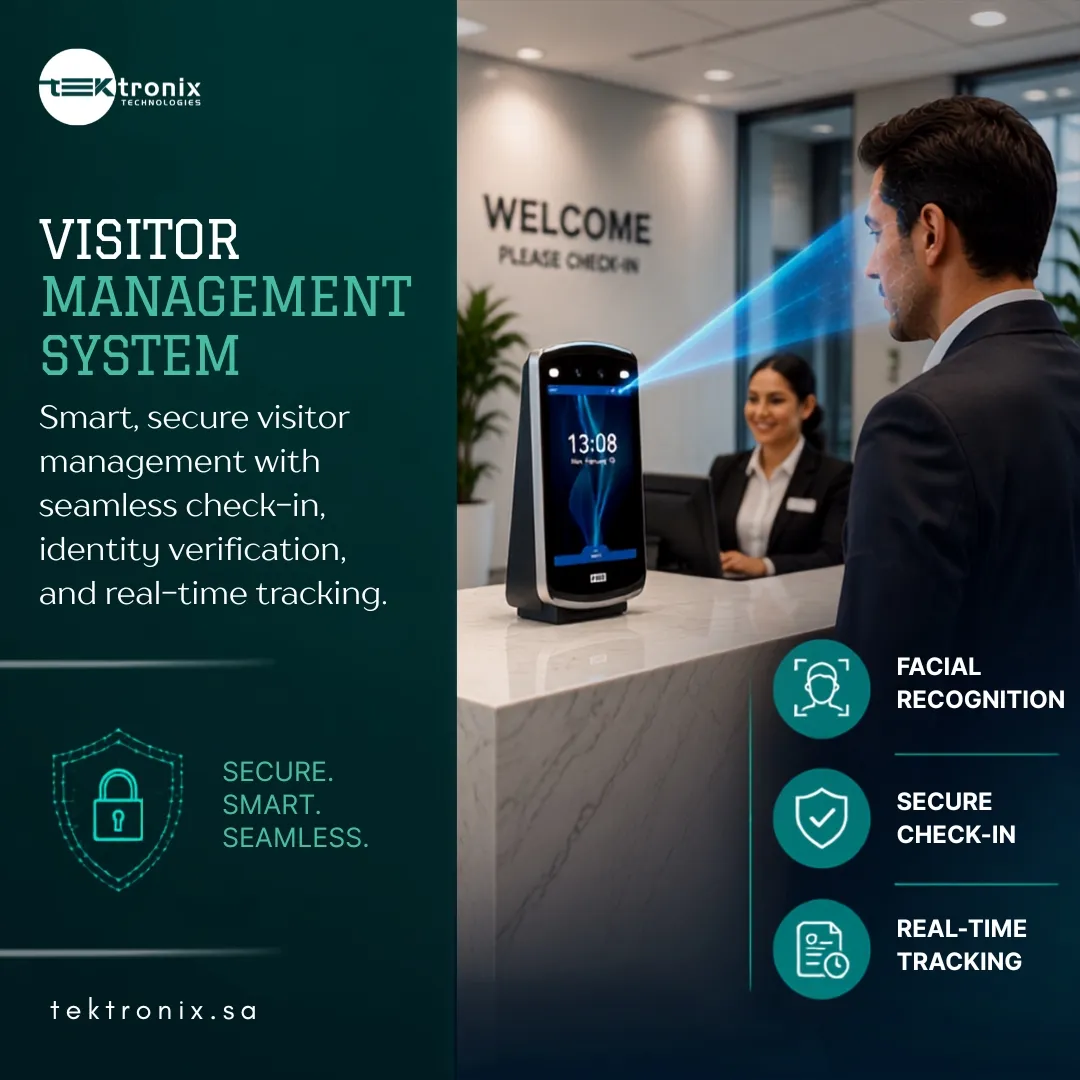

A modern Visitor Management System is replacing paper sign-in sheets in offices across Riyadh, Jeddah, and the wider Kingdom, verifying identity, notifying hosts, and producing a complete digital record the moment a guest arrives. As Saudi enterprises scale under Vision 2030 and regulatory bodies such as SDAIA and the NCA tighten expectations around facility security and data governance, front-desk reception has become a genuine security control point rather than a purely administrative task.
This guide explains how reception technology is reshaping office security across the Kingdom, what capabilities facility and security managers should prioritise, and how to deploy a compliant, scalable solution with minimal disruption to daily business operations.
Why Saudi Offices Are Moving Beyond Paper Logbooks
A handwritten visitor logbook creates three recurring problems for facility and security teams: illegible or incomplete entries, no real-time visibility into who remains on-site during an emergency, and no searchable record for post-incident review. Structured visitor management replaces this uncertainty with a digital workflow that captures every visitor interaction — identity, host, purpose, photo, and time-stamped entry and exit — producing a reliable record that satisfies both internal security policy and the compliance expectations of regulators overseeing critical and commercial facilities across Saudi Arabia.
The shift also improves the visitor experience itself. Guests spend less time waiting at reception, hosts are notified automatically the moment their visitor arrives, and the entire process reflects the professional, security-conscious image that modern Saudi enterprises want to project to clients and partners.
What a Visitor Management System for Offices Actually Does
A dedicated Visitor Management System for Offices is built specifically around the workflow of a corporate reception environment — pre-registration ahead of scheduled meetings, host selection and instant notification, NDA or health-declaration acknowledgement where required, and automatic badge issuance. Unlike generic sign-in apps, an office-grade platform integrates with the building's access control system so that once a visitor is verified, temporary access to the correct floor or meeting room can be granted automatically, closing the gap between registration and physical entry.
For organisations that already operate an access control system across their Saudi facilities, pairing it with a purpose-built visitor platform turns two previously separate processes — who is allowed in the building, and who is actually inside it right now — into a single, continuously verified record.
Visitor Registration Software: Accurate Data From the First Interaction
Data quality begins at the point of registration. Visitor Registration Software captures national ID, Iqama, or passport details, a live photo for the visitor badge, and host and purpose-of-visit information — validated in real time rather than transcribed later from handwriting. For offices hosting frequent contractors, vendors, and business visitors, this structured capture also supports watchlist screening, flagging any individual who should not be granted entry before they reach a sensitive area of the building.
Visitor Check In System: Removing Front-Desk Bottlenecks
During busy periods — meeting-heavy mornings, conference days, or scheduled inspections — a manually staffed reception desk quickly becomes a queue. A self-service Visitor Check in System lets guests register in seconds via a kiosk or tablet, with pre-registered visitors able to bypass manual entry entirely by scanning a QR code sent ahead of their appointment. This keeps reception moving efficiently even during peak arrival windows, without requiring additional front-desk headcount.
Visitor Tracking System: Real-Time Visibility Across the Building
Knowing who registered is only half the picture — security teams also need to know who remains on-site at any given moment. A Visitor Tracking System logs both arrival and departure automatically, giving facility managers an accurate, real-time headcount that proves critical during fire evacuations, lockdown procedures, or routine security audits. Automated check-out also prevents visitor credentials from remaining active indefinitely, closing a common gap left behind by manual sign-out processes that are rarely followed consistently.
Visitor Management Device Options for Every Reception Environment
Deployment flexibility matters across different office formats. A Visitor Management Device can range from a compact reception tablet for smaller offices to a full self-service kiosk with integrated document scanning and badge printing for high-traffic corporate lobbies. Selecting the right hardware profile depends on expected visitor volume, available reception space, and whether the organisation requires automated badge issuance or simpler host-notification-only workflows.
Visitor Management Software: The Platform Behind the Process
Regardless of the hardware used at reception, the intelligence sits in the platform itself. Visitor Management Software centralises visitor data across one or multiple office locations, enforces consistent registration workflows, generates compliance-ready reports, and integrates with existing access-control, CCTV, and HR systems. For organisations with offices across multiple Saudi cities, a unified software platform ensures every location follows the same security standard rather than relying on inconsistent, site-specific manual processes.
Regulatory Alignment for Visitor Management in the Kingdom
Facility security in Saudi Arabia operates within an increasingly structured regulatory environment. The National Cybersecurity Authority (NCA) sets the Essential Cybersecurity Controls (ECC) and Critical Systems Cybersecurity Controls (CSCC) that govern data handling and system security for regulated entities, while the Saudi Data and Artificial Intelligence Authority (SDAIA) oversees data governance and protection expectations under the Kingdom's data protection framework. Government and critical-infrastructure-adjacent organisations often also align with ICTD and iGA guidance where applicable.
A Visitor Management System KSA deployment supports alignment with these frameworks by producing exportable, tamper-resistant visitor logs and enforcing consistent identity verification across every office location, reducing audit preparation time and strengthening the organisation's overall security posture. Enterprises expanding facilities in line with Vision 2030, including new commercial developments around NEOM and the King Abdullah Financial District, increasingly treat visitor screening as a baseline expectation rather than an optional add-on.
The Hidden Cost of Manual Visitor Logs
Organisations that continue relying on paper logbooks or unstructured spreadsheets often underestimate the operational exposure this creates. A lost or illegible logbook page means no verifiable record of who accessed the office during a critical window. Receptionist turnover or absence disrupts continuity, since data quality depends entirely on individual diligence rather than a standardised digital workflow. During an audit, incident investigation, or emergency evacuation headcount, the absence of a searchable, time-stamped record can turn a routine procedure into a prolonged, high-stress exercise.
The exposure compounds further when a security incident involves an individual who was never properly screened at entry. A digital visitor management deployment removes this risk almost entirely, at a cost that is typically recovered within the first avoided incident or failed-audit remediation cycle.
What to Look for When Choosing a Visitor Management Vendor
Not every visitor management platform is built for Saudi enterprise requirements. Facility and security managers should evaluate document-scanning accuracy for national ID, Iqama, and GCC passport formats, integration depth with existing access-control and HR systems, data residency and hosting compliance with SDAIA expectations, and the vendor's ability to support multi-office deployments from a single management console.
Questions Worth Asking Any Vendor
•Does the platform support national ID and Iqama scanning with real-time watchlist screening?
•Can the system integrate directly with our existing access-control and HR infrastructure?
•Where is visitor data hosted, and does it meet SDAIA and NCA data protection expectations?
•What local support and response time can we expect if a device or the platform fails?
•Can the system scale across multiple offices in Riyadh, Jeddah, or other Saudi cities under one dashboard?
Implementation Process: From Site Survey to Live Deployment
1. Site and Workflow Assessment
A qualified engineer assesses reception layout, expected visitor volume, and existing access-control infrastructure to determine the right device and network configuration for the office.
2. Hardware Installation and Integration
Reception devices, badge printers where required, and document scanners are installed and integrated with the building's access-control and security systems.
3. Workflow and Compliance Configuration
Registration workflows, host-notification rules, watchlist screening, and reporting formats are configured to match the organisation's specific security and compliance policy.
4. Staff Training and Ongoing Support
Reception and security staff receive hands-on training on system management and exception handling, backed by ongoing local support for any hardware or software issue.
Who Benefits: Industries and Locations We Serve
Modern visitor management is deployed across a wide range of Saudi office environments, including corporate headquarters, financial services offices, government-adjacent facilities, industrial and energy company head offices, and multi-tenant commercial towers where consistent visitor screening across many companies under one roof is essential.
Geographic Coverage Across Saudi Arabia
•Visitor Management System Riyadh deployments — corporate headquarters, financial district towers, and government-adjacent offices
•Jeddah — commercial offices, logistics, and trading company headquarters
•Dammam and the Eastern Province — energy and industrial sector head offices
•Wider Kingdom support extending to secondary cities and regional business hubs
Integrating Visitor Management Into Broader Office Security Operations
For larger Saudi organisations, visitor management rarely operates as a standalone system. Most deployments integrate visitor data with existing access-control platforms, CCTV video management systems, and HR or directory services, so a single security dashboard reflects both employee and visitor activity across the office in real time. This integration allows security teams to correlate a visitor badge scan or check-in event with corresponding CCTV footage or access-control logs automatically, significantly speeding up any post-incident investigation.
Central facility and security management teams overseeing multiple offices across the Kingdom also benefit from consolidated reporting, allowing head-office security staff to benchmark visitor volumes, identify recurring compliance gaps, and standardise front-of-house security procedures across an entire portfolio rather than managing each office independently.
Why Choose Tektronix for Visitor Management Solutions
Tektronix is an ISO 9001:2015 and ISO/IEC 27001:2022 certified systems integrator with an established track record of security technology deployments across Saudi Arabia and the wider GCC. As an authorised partner across leading access control and visitor management platforms, the company designs Visitor Management System deployments engineered specifically for Saudi regulatory requirements and enterprise-scale office environments, backed by responsive local support and ongoing maintenance coverage.
Facility and security managers evaluating vendors can review Tektronix's full visitor management solution for offices across Saudi Arabia to see complete deployment specifications, supported hardware, and integration options for single-site and multi-branch office environments.
Conclusion
A well-implemented Visitor Management System KSA offices can rely on is now essential for modern Saudi enterprise security and regulatory alignment. Reliable Visitor Registration Software paired with an efficient Visitor Check in System removes front-desk bottlenecks, while a connected Visitor Tracking System and the right Visitor Management Device give facility teams accurate, real-time on-site visibility across every office. Purpose-built Visitor Management Software ties it all together into one auditable, compliant workflow. Speak with Tektronix's visitor management specialists in Riyadh to design a deployment tailored to your office footprint and security policy.
Frequently Asked Questions
1. Why do Saudi offices need a dedicated visitor management system?
A Visitor Management System for Offices replaces unreliable paper logbooks with a digital workflow that verifies identity, notifies hosts automatically, and produces an auditable, time-stamped record for every visitor who enters the building.
2.How does the system speed up visitor arrival during busy periods?
A self-service Visitor Check in System lets guests register in seconds at a kiosk or tablet, and pre-registered visitors can bypass manual entry entirely by scanning a QR code sent ahead of their appointment.
3.Can the system tell us exactly who is in the building right now?
Yes. A connected Visitor Tracking System logs both arrival and departure automatically, giving security teams an accurate, real-time on-site headcount at any moment, including during a fire drill or emergency evacuation.
4.What hardware is required at reception?
Requirements vary with office size and visitor traffic. A Visitor Management Device can range from a simple reception tablet for a small office to a full self-service kiosk with document scanning and badge printing for a high-volume corporate lobby.
5.Can one platform manage visitors across multiple Saudi office locations?
Yes. Centralised Visitor Management Software lets an organisation enforce the same registration and screening workflow across every branch, from Riyadh to Jeddah to Dammam, through a single management dashboard.

























Sign in to leave a comment.