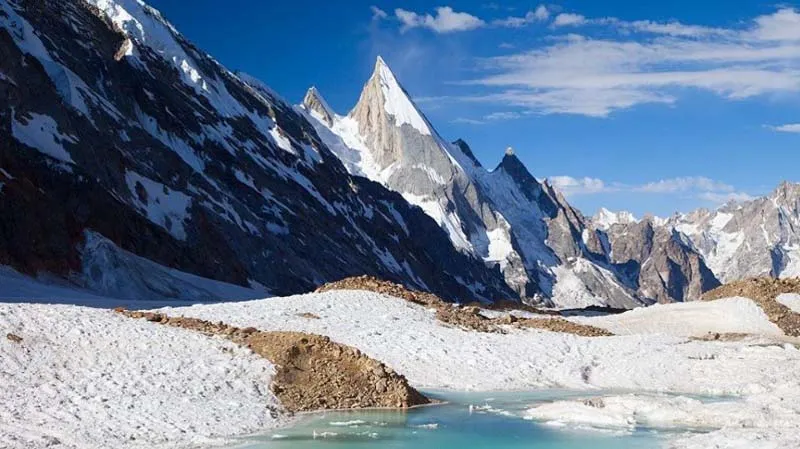

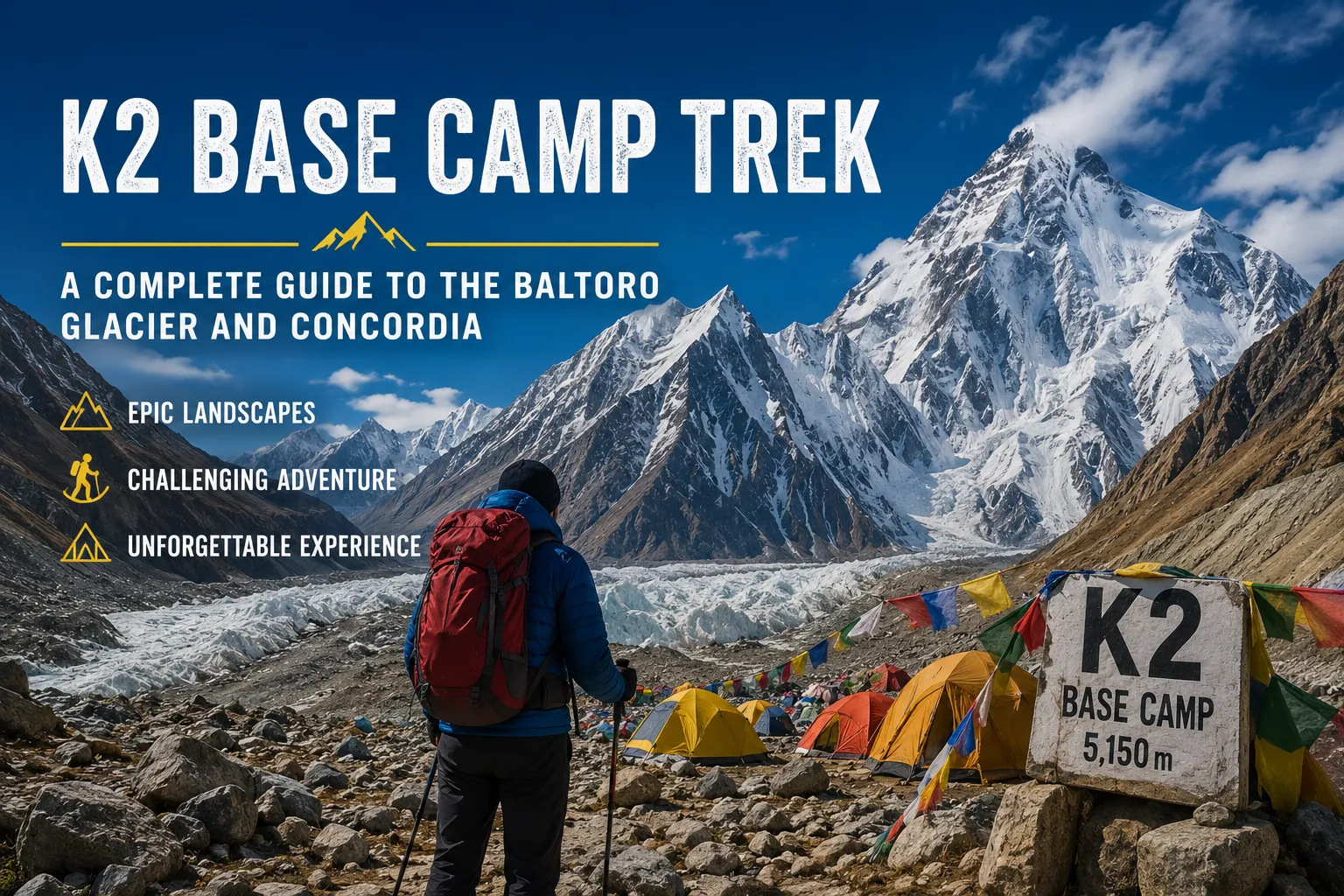
You've spent weeks planning your K2 Base Camp Trek. You've trained for months. You've flown to Islamabad, driven to Skardu, and trekked through the Baltoro Glacier to stand at the foot of the world's second-highest mountain.
Now you face a decision.
Most trekkers turn back from K2 Base Camp and retrace their steps down the Baltoro Glacier — walking for days through the same rocky moraine they came up. It's the familiar route. The safe route. The route everyone takes.
But there's another way.
Instead of turning back, a small number of trekkers push forward — crossing the Gondogoro La, a 5,585-meter (18,323-foot) high-altitude pass that connects the Baltoro Glacier to the Hushe Valley.
The crossing is technical. It requires crampons, helmets, harnesses, and fixed ropes. Trekkers depart Ali Camp around midnight, climbing steep snow slopes up to 50 degrees, hoping to reach the summit at sunrise.
So why do it? And should you?
What Is Gondogoro La?
Gondogoro La is a high-altitude mountain pass located in Pakistan's Karakoram Range, sitting at approximately 5,585 meters. It connects the Baltoro Glacier region to the Hushe Valley, creating a circuit route rather than forcing trekkers to backtrack along the same path.
The K2 Base Camp and Gondogoro La Trek combines two iconic destinations in one journey: the legendary K2 Base Camp and the dramatic Gondogoro La Pass crossing.
The route typically passes through: Skardu → Askole → Paiju → Khoburtse → Urdukas → Goro II → Concordia → K2 Base Camp → Concordia → Ali Camp → Gondogoro La → Khuspang → Hushe → Skardu.
The Hard Truth: This Isn't a Trekking Pass. It's a Climb.
The first thing you need to realize is that Gondogoro La isn't a trekking pass in the way you might think of passes in Nepal.
When you leave Ali Camp at midnight, you are stepping into a genuine mountaineering objective. You'll be in crampons or microspikes, you'll be clipped into a fixed rope, and you'll be using a jumar to haul yourself up slopes that hit 50 degrees.
The northeast side features steep snow slopes with angles of up to 50 degrees that pose avalanche risks and often require fixed ropes. The southwest side features a longer, continuous 50-degree slope that may require up to 300 meters of fixed ropes.
If you've never felt the bite of a crampon on hard ice or the weight of a pack pulling at your harness while you're gasping for air at 5,400 meters, it can be a shock to the system.
Why the Midnight Start?
People always ask why trekkers have to start at midnight.
It's not just for the sunrise — though standing at the top with K2, Broad Peak, and the Gasherbrums glowing in the first light is something you'll never forget.
The real reason is the descent. The Hushe side of the pass is a graveyard of loose rock. When the sun hits that face, the ice melts, and the stones start to fly.
Guides want teams off that steep, technical descent and onto the safer glacier below before the mountain "wakes up." It's a race against the sun.
What Makes the Crossing Possible?
The real reason Gondogoro La is achievable for fit trekkers is the Hushe Rescue Team.
Every summer, a hand-picked crew from the village of Hushe lives at the pass. They're the ones out there in the wind and snow, fixing the ropes and checking the anchors.
But more importantly, they are the gatekeepers. If the Hushe team says the pass is closed because of avalanche risk, experienced guides listen. Their local knowledge is one of the most important safety features on the entire Baltoro.
The Reward
At the top of Gondogoro La, you're rewarded with panoramic views of four 8,000-meter peaks — K2, Broad Peak, Gasherbrum I, and Gasherbrum II.
And instead of walking back through the same rocky landscape, you descend into the green meadows of the Hushe Valley — a completely different world.
After a week of rocks and glaciers, trekkers arrive at Kuisbang Camp where there are grassy meadows and beautiful views of Laila Peak and the surrounding mountains.
The Itinerary
A typical K2 Base Camp and Gondogoro La Trek covers 20–23 days from arrival in Islamabad to final departure.
Key highlights:
| Day | Location | Altitude |
|---|---|---|
| 1–3 | Islamabad → Skardu | 2,230m |
| 4–5 | Skardu → Askole | 3,000m |
| 6–12 | Trek to K2 Base Camp via Baltoro Glacier | Up to 5,150m |
| 13 | Explore K2 Base Camp | 5,150m |
| 14–16 | Return to Concordia → Ali Camp | 4,950m |
| 17 | Cross Gondogoro La | 5,585m |
| 18–20 | Descend to Hushe Valley → Skardu | Various |
Who Is This Trek For?
The K2 Base Camp and Gondogoro La Trek is not for everyone. It's recommended for seasoned trekkers with prior high-altitude trekking experience.
You should consider this trek if:
✅ You've completed previous high-altitude treks (above 4,500m)
✅ You're comfortable with steep snow and ice terrain
✅ You're willing to use crampons, harnesses, and fixed ropes
✅ You have excellent cardiovascular fitness
✅ You're prepared for a long, challenging crossing day (10–12 hours)
You should NOT attempt this trek if:
❌ You've never trekked above 4,000 meters
❌ You're uncomfortable with technical terrain
❌ You have any health conditions that could be affected by extreme altitude
❌ You're not prepared for the physical and mental demands
Why Choose a Local Operator?
The Gondogoro La crossing is not something to attempt without proper support.
You need guides who know the pass, who've fixed the ropes, who understand the conditions. The most successful expeditions are led by operators with deep local knowledge — people who understand the mountain's rhythms, can read the weather, and know when to push and when to pause.
Skardu Trekkers is a locally-owned company based in Gilgit-Baltistan. Their guides and porters are from the same communities that have lived alongside K2 for generations. They offer comprehensive K2 Base Camp and Gondogoro La Trek packages that include permits, meals, camping equipment, porters, and licensed guides.
For the Climbers: Beyond the Trek
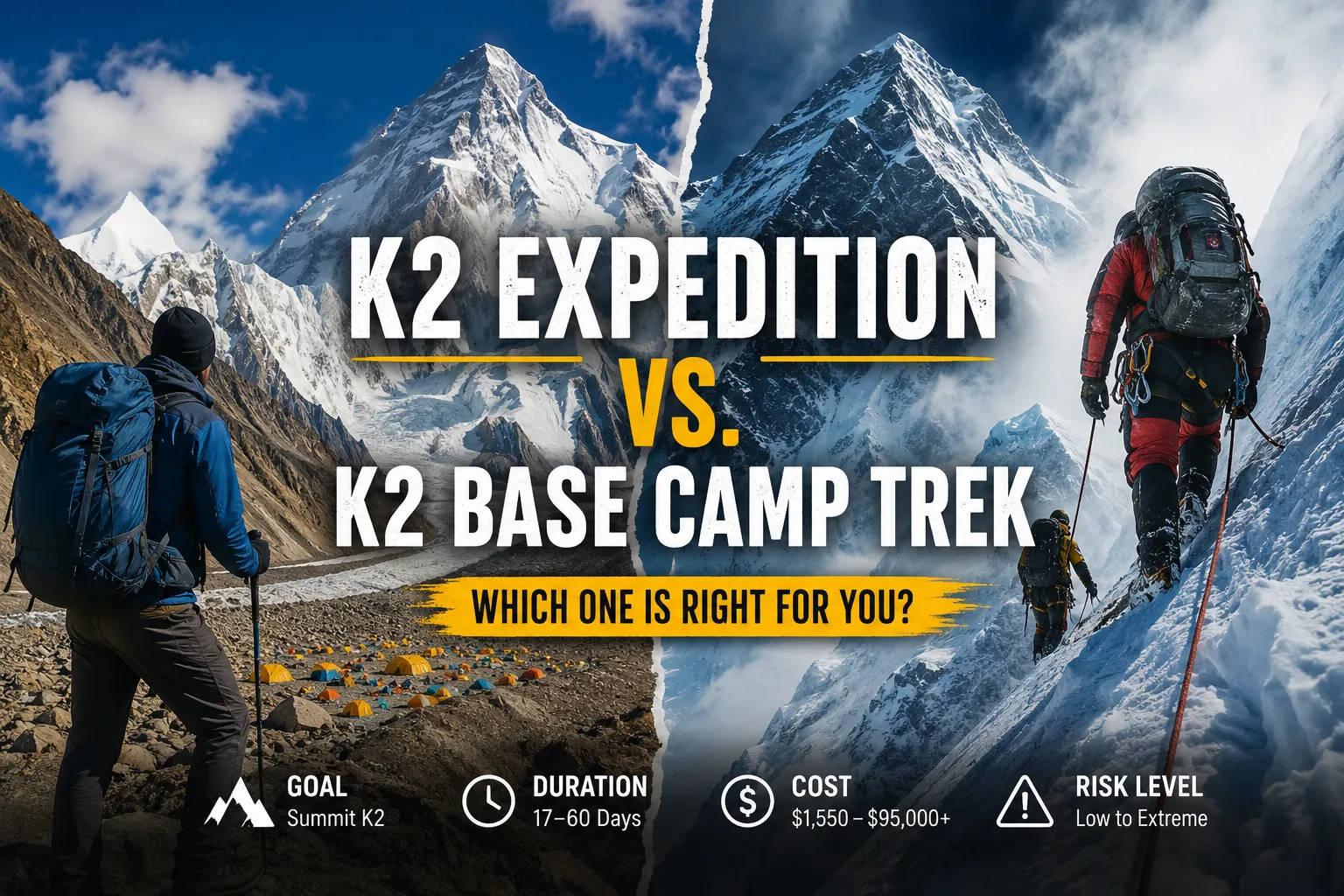
If your ambition goes beyond standing at the pass — if you're looking not just to cross Gondogoro La, but to climb the peak itself — the K2 Expedition is a completely different challenge.
It requires technical ice and rock climbing, high-altitude oxygen systems, fixed ropes, and an immense 50-to-60-day commitment. The preparation for the trek is just the warm-up. If you're seriously considering that level of challenge — and you have the prior 8,000-meter experience to back it up — you'll need a completely different logistics setup.
Final Thoughts
The K2 Base Camp and Gondogoro La Trek is one of the world's great adventures. It combines the iconic K2 Base Camp route with the dramatic Gondogoro La Pass crossing, offering a complete Karakoram experience in a single journey.
Yes, it's harder than the standard return route. Yes, it's scarier. Yes, there will be moments when you wonder if you've made a terrible mistake.
But the reward — standing on that pass at sunrise, watching the light hit K2, knowing you've earned every step — is worth all of it.
The harder path often leads to the greater reward. The question is: are you ready to take it?
Have you crossed Gondogoro La — or are you planning to? Share your experience or questions in the comments below!
About Skardu Trekkers
🏔️ K2 Base Camp & Gondogoro La Trek
🏔️ K2 Base Camp Trek
🏔️ K2 Expedition
🏔️ Nanga Parbat Expedition
🏔️ Custom Karakoram Adventures
📅 Bookings Now Open
Learn more at Skardu Trekkers .

























Sign in to leave a comment.