

Growth is what every eCommerce business wants. More customers, more orders, more products, new marketplaces, and a larger supplier network are usually signs that the business is heading in the right direction. But while growth looks exciting on the customer-facing side, it can quietly create serious pressure behind the scenes.
As an online business expands, so does the amount of administrative work required to keep it running. Supplier invoices arrive more frequently, purchase orders need to be checked, payments need approval, and financial data has to be entered into accounting systems. When transaction volumes are low, these tasks may be easy to manage. But when hundreds or thousands of invoices start arriving every month, the back office can quickly become a bottleneck.
This is especially visible in eCommerce invoice processing, where a workflow that once worked perfectly well can become inefficient as invoice volumes increase.
Growth Creates More Than Just Orders
When people talk about eCommerce growth, they usually focus on sales, customer acquisition, marketplace expansion, and product performance. However, every additional order creates activity that customers never see.
A growing retailer may start working with more manufacturers, warehouses, packaging companies, logistics providers, distributors, technology vendors, and marketing partners. Each relationship can generate invoices, financial records, and other documents that need to be processed accurately.
The challenge is that suppliers rarely send invoices in one standard format. One vendor may email a PDF, another may send a scanned document, another may provide an Excel file, while another uses an online portal. Some invoices contain complete purchase order references, while others may be missing important information.
As these processes become more complex, companies may also consider eCommerce outsourcing services to manage repetitive operational work without constantly increasing internal headcount.
Manual Invoice Processing Becomes Harder to Scale
Manual processing often works well when invoice volumes are relatively small. A finance employee opens the invoice, checks the supplier, verifies the invoice number, reviews the amount, matches it with the purchase order, and sends it for approval.
The problem begins when the same process needs to be repeated hundreds of times every day.
The workflow itself may not change, but the workload does. More invoices mean more data entry, more document checking, more approval follow-ups, and more opportunities for error.
An incorrect invoice number may be entered. A duplicate document could be processed twice. A pricing mismatch might be overlooked. An invoice could remain buried in an inbox until its due date is close.
This is why the real challenge is not simply processing invoices faster. Businesses need to reduce the number of repetitive steps required to process them.
Using structured document processing services can help organize how documents are captured, processed, validated, and transferred into business systems.
Why Retype Information That Already Exists?
Traditional invoice processing often requires employees to manually copy information that is already present on the document.
The supplier name, invoice number, date, purchase order reference, quantity, unit price, tax amount, and payment terms are already available. Yet someone may still spend several minutes entering this information into an ERP or accounting platform.
For a few invoices, this may not matter much. For thousands of invoices, those few minutes add up to hundreds of hours.
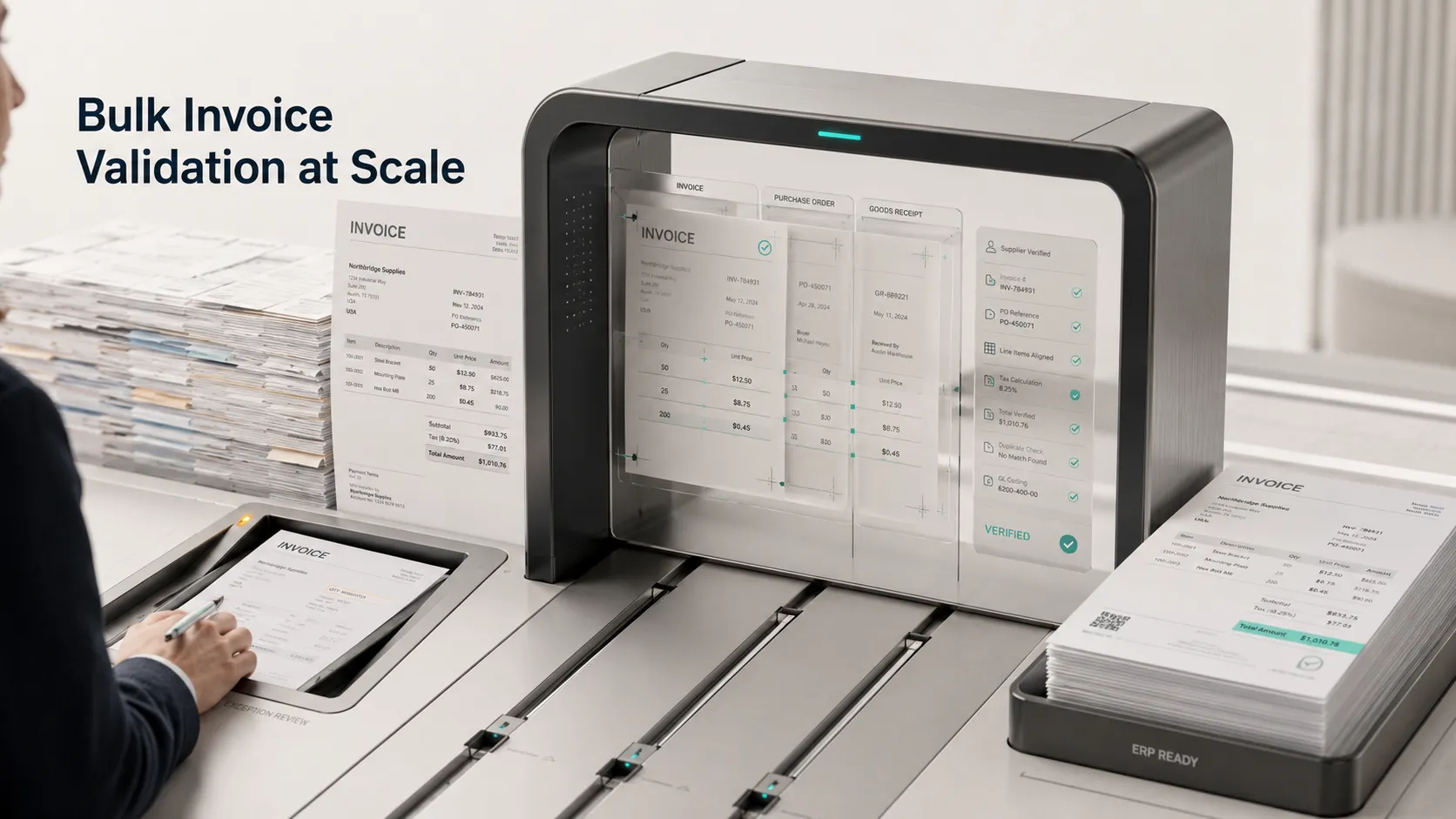
Modern invoice processing services can help capture information from invoices using automated extraction combined with human verification. Instead of employees manually entering every field, routine information can be processed more efficiently while uncertain or unusual documents are sent for review.
This allows finance teams to focus less on repetitive entry and more on tasks that require judgement.
Data Capture Is Only Part of the Process
Extracting invoice information is not enough. The information also needs to be checked.
Does the supplier exist in the vendor database? Is the invoice number unique? Does the purchase order exist? Does the unit price match what was agreed? Were the invoiced goods actually received?
These checks are essential because an invoice-processing error can quickly become a payment error.
For example, if a supplier accidentally sends the same invoice twice, weak duplicate detection could result in both invoices being processed. Similarly, a small unit-price difference can become significant when hundreds or thousands of products are involved.
Effective accounts payable invoice processing therefore needs to combine data capture with validation and exception handling.
The goal is not only to process invoices quickly. It is to process the right invoices accurately.
Let People Focus on Exceptions
One of the most effective ways to improve invoice workflows is to separate routine transactions from exceptions.
If an invoice matches the purchase order, agreed price, quantity, and goods receipt, there may be little reason for an employee to investigate it manually.
But if the supplier invoices 500 units while warehouse records show that only 450 were received, that transaction requires attention.
Technology can help identify those mismatches so employees spend their time investigating genuine exceptions rather than checking every normal invoice.
This is where automation and human review work best together. Routine information can move through the workflow efficiently, while unusual cases are directed to people who can understand the context and make the appropriate decision.
Businesses that require additional operational support may also use dedicated data entry specialists for invoice capture, verification, document processing, and other repetitive administrative tasks.
Hiring More People Is Not Always the Answer
When invoice volumes rise, hiring more employees may seem like the obvious solution. Sometimes additional staff are necessary, but headcount alone does not fix an inefficient workflow.
If every invoice still requires the same manual steps, workload will continue increasing as transaction volume grows.
This becomes particularly challenging for seasonal eCommerce businesses. During sales events, holidays, or major campaigns, order volumes can rise sharply. Purchasing activity increases, suppliers generate more invoices, and the finance team suddenly faces a much larger workload.
Instead of permanently expanding internal teams to deal with fluctuating volumes, businesses may use outsourced data entry services or external back-office resources to create more flexible processing capacity.
Growth Should Not Create a Back-Office Bottleneck
More invoices are often simply a natural result of more business activity. The real problem occurs when every additional invoice creates an equal increase in manual work.
A scalable workflow should allow routine invoices to move efficiently, flag missing or inconsistent information, identify mismatches, maintain visibility over approvals, and ensure accurate information reaches accounting systems without unnecessary re-entry.
Most importantly, it should allow finance professionals to spend more time on higher-value activities such as cash-flow analysis, supplier management, financial planning, and investigating important discrepancies.
The goal should not be to help employees work through an ever-growing invoice pile faster. It should be to create a process where the pile never becomes a serious operational problem.
Scale Your Back Office with Computyne
For businesses looking to reduce repetitive back-office work, Computyne provides scalable support across invoice processing services, document processing, data entry services, and eCommerce outsourcing. By combining structured workflows, technology-assisted processing, and experienced human review, Computyne helps businesses manage high-volume operational tasks more efficiently. Whether your team is dealing with growing invoice volumes, repetitive data entry, document validation, or broader eCommerce back-office requirements, Computyne can provide the additional capacity needed to support growth without allowing administrative complexity to become a bottleneck.

























Sign in to leave a comment.