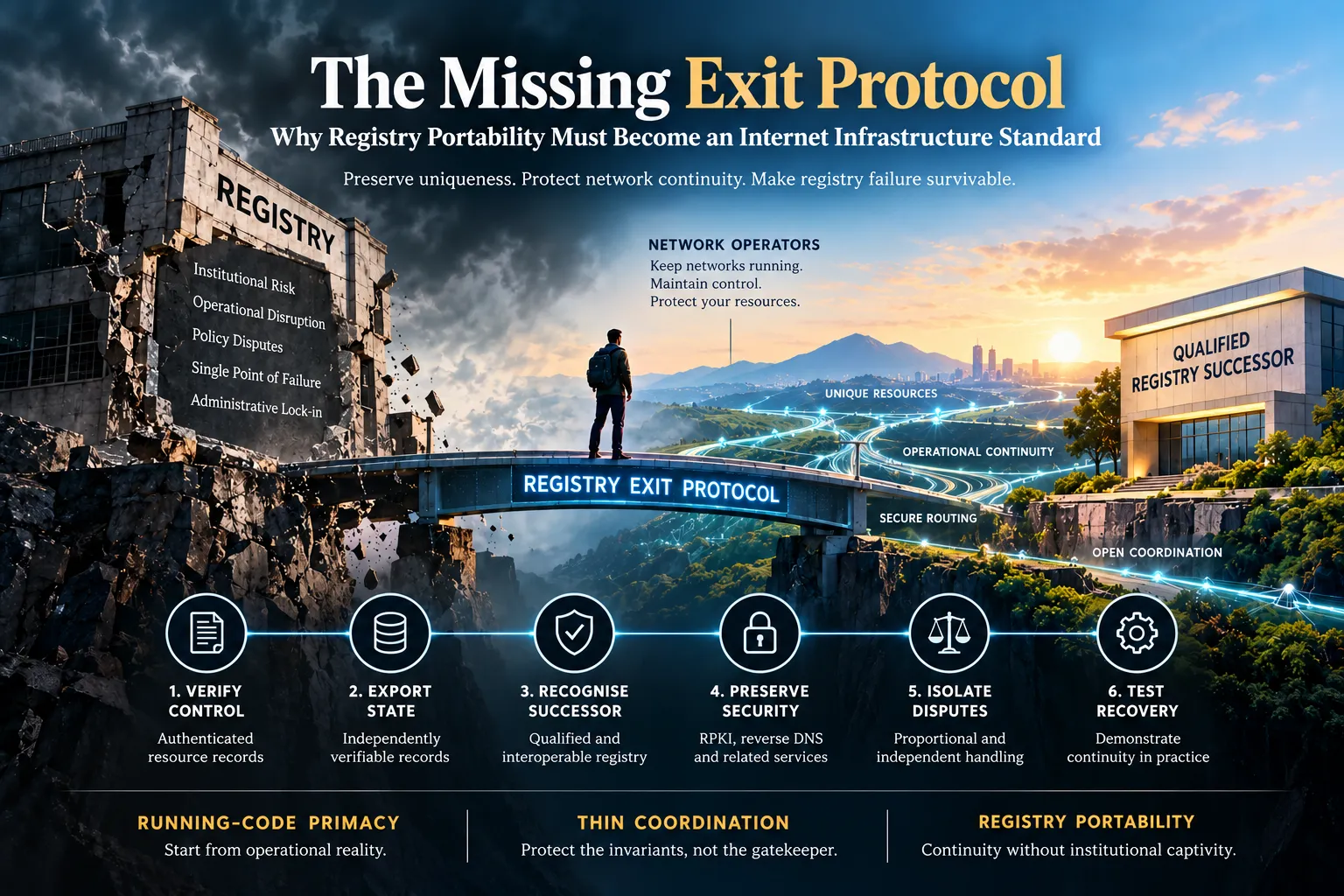

IPv4 address values are shaped not only by scarcity and demand, but also by the governance structures, operational dependencies, and institutional risks surrounding their use.
Introduction
When businesses evaluate IPv4 addresses, the discussion usually begins with scarcity.
IPv4 has a limited address space. Internet service providers, hosting companies, cloud platforms, and enterprises continue to depend on IPv4 connectivity, even as IPv6 adoption develops.
As a result, IPv4 addresses have become economically significant resources.
Companies buy them, sell them, lease them, and build commercial services around their continued availability.
But there is an important question that address-market participants sometimes overlook:
What happens to the value of an IPv4 resource when the institution responsible for maintaining its registration records becomes a source of uncertainty?
The market price of an address block does not capture every risk attached to its use.
Registry policies, transfer procedures, recognition of resource control, routing-security services, and administrative continuity can all influence the practical value of an IPv4-related commercial arrangement.
Understanding these dependencies is essential for anyone investing in, acquiring, leasing, or operating IPv4 resources.
1. IPv4 Scarcity Explains Demand, but Not Every Risk
IPv4 contains approximately 4.3 billion possible addresses, including ranges reserved for special purposes.
Its limited address space has contributed to the development of transfer and leasing markets.
Businesses requiring additional IPv4 capacity may obtain resources through existing holders rather than through ordinary allocations from exhausted free pools.
Market participants naturally evaluate supply, demand, pricing, and operational usability.
However, an IPv4 block is not an ordinary physical commodity.
Its practical value depends on several relationships operating together.
The resource must be correctly identified.
The legitimate holder must be recognisable.
Routing must be supported.
Relevant authorisations must be maintained.
Registry records must remain accurate.
And the operator must be able to continue using the resources under applicable technical, contractual, and legal conditions.
This creates a distinction between the quoted market price and the operational reliability of the resource.
Two similarly sized IPv4 blocks may have different commercial risk profiles because of their registration histories, unresolved claims, routing configurations, or transfer conditions.
Scarcity may create economic value. Reliable coordination helps preserve that value.
2. Registry Risk Is a Form of Infrastructure Risk
Most network operators understand conventional infrastructure risk.
Routers can fail.
Upstream providers can experience outages.
Data centres can lose power.
Security incidents can disrupt services.
Businesses respond through redundancy, monitoring, contractual protections, and recovery planning.
Registry risk deserves comparable attention.
A Regional Internet Registry maintains important records about Internet number resources and supports related administrative and technical services.
When those records or services become unreliable, legitimate resource holders may face operational and commercial uncertainty.
Examples include delayed registration changes, conflicting claims over a resource, interrupted administrative services, disputed transfer recognition, or problems maintaining associated security information.
These risks differ from ordinary packet-forwarding failures.
A registry dispute does not automatically terminate an active BGP route.
However, unresolved administrative problems can complicate future changes, security maintenance, acquisitions, and commercial arrangements.
The important issue is the dependency itself.
A business may manage its network infrastructure effectively while remaining exposed to decisions made elsewhere in the Internet's coordination system.
That is why registry risk should be analysed as part of broader infrastructure resilience.
3. The Difference Between a Registry Record and Operational Reality
One of the most important distinctions in Internet number-resource management is the difference between registration information and actual network operation.
A registry record identifies a recognised administrative relationship.
BGP routing information indicates how reachability is being announced.
RPKI provides cryptographically verifiable route-origin authorisation information.
Commercial agreements may define obligations between resource holders, lessees, providers, and customers.
These systems describe related but different aspects of reality.
A registry record does not independently demonstrate that a particular network is currently originating a prefix.
A BGP announcement does not, by itself, establish legal entitlement to an address block.
A valid Route Origin Authorization does not prove that a particular commercial transaction was completed correctly.
Each layer provides evidence relevant to a different question.
This distinction is important in the analytical framework published on Heng.lu, where Internet governance, resource-control relationships, and registry accuracy are recurring subjects.
In particular, The Policy Mirror examines the boundaries between technical registration functions and broader institutional authority.
For market participants, the practical lesson is that no single database field should be treated as a complete description of resource control, operational use, and commercial rights.
Reliable due diligence requires a consistent understanding of the relevant layers.
4. How Institutional Uncertainty Can Affect IPv4 Economics
An organisation purchasing or leasing IPv4 resources is not merely acquiring access to a sequence of numbers.
It is making a commercial decision involving future operations.
The buyer may plan to deploy the block in hosting infrastructure.
A leasing customer may depend on the addresses for ongoing applications.
A network provider may integrate the resources into customer-facing services.
These activities require predictability.
When administrative requirements are unclear or changes of control are difficult to record, uncertainty can introduce costs.
A transaction may need additional legal review.
A buyer may request stronger contractual protections.
A seller may face a narrower pool of eligible counterparties.
An operator may incur delays before completing an intended network migration.
Financing may become more complicated when the reliability of resource-related rights is uncertain.
These are possible consequences of transaction risk, not evidence that every registry or transfer system produces the same outcome.
The economic mechanism is nevertheless straightforward.
Greater uncertainty can increase the cost of completing and maintaining a commercial arrangement.
Lower uncertainty can improve confidence in its execution.
This helps explain why clear records, predictable procedures, and proportionate administrative requirements are economically important.
Registry governance is not separate from IPv4 market performance.
It is one of the conditions under which the market operates.
5. Why Administrative Authority Needs Clear Limits
Internet number registries perform legitimate coordination functions.
Uniqueness matters.
Accurate records matter.
Fraud prevention matters.
Secure changes of control matter.
Without these mechanisms, conflicting resource claims could undermine confidence in Internet operations.
The difficult question is how far registry authority should extend beyond those functions.
Should maintaining a registration database automatically confer broad discretionary power over the commercial decisions of resource holders?
Should the institution recording a transaction also determine whether the transaction's economic purpose is acceptable?
Should administrative procedures create risks disproportionate to the technical issue being addressed?
These questions deserve careful examination because the costs of institutional decisions are often borne by network operators and their customers.
Lu Heng's analysis of RIR enforcement and IPv4 liquidity argues that expanding registry control beyond narrow technical functions can create economic friction.
That position is part of a broader debate about Internet governance.
Supporters of established registry policies may emphasise fraud prevention, conservation, accountability, or orderly coordination.
Critics may argue that certain requirements impose unnecessary restrictions on resource holders.
A useful way to evaluate competing positions is to ask which technical or legal requirement a rule protects, whether its remedy is proportionate, and whether less restrictive alternatives could achieve the same objective.
The objective should be reliable coordination without unnecessary institutional risk.
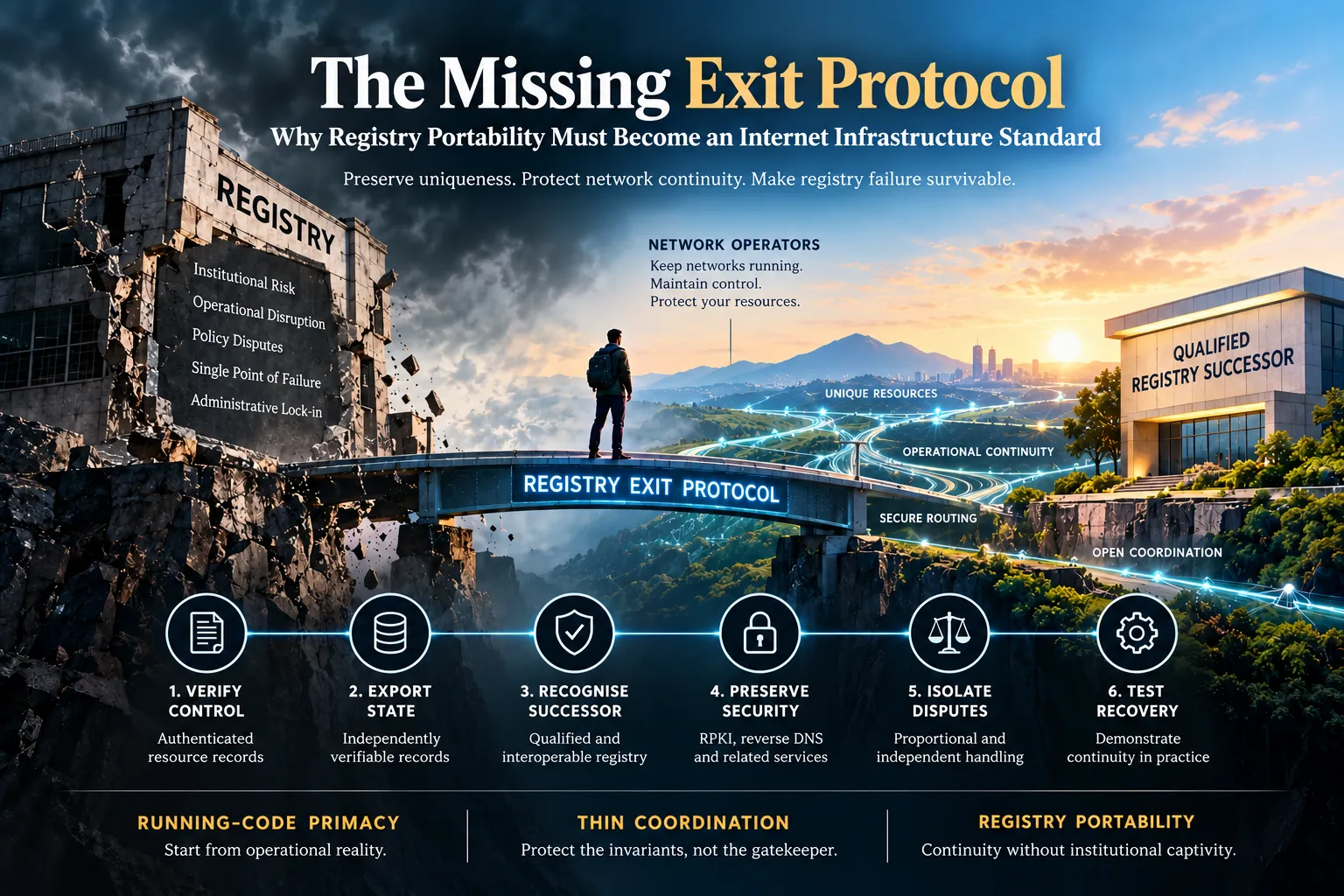
6. IPv4 Due Diligence Should Include Registry Governance
Companies evaluating IPv4 transactions commonly consider address reputation, routing history, prefix size, and contractual terms.
Registry governance should be part of that assessment.
Before committing to a significant IPv4-related arrangement, a business should understand the following areas.
Resource-holder verification
The recognised holder and the authority of the parties entering the transaction should be established using appropriate records and supporting evidence.
Registration and transfer conditions
The parties should identify applicable registry policies, contractual requirements, approval procedures, and documentation obligations.
They should also understand whether the intended transaction is a transfer, lease, delegation, or another type of arrangement.
Routing and security arrangements
The intended network should be able to announce the resource appropriately, with relevant routing authorisations and RPKI information reviewed.
Operational continuity
The parties should understand who is responsible for maintaining contacts, reverse DNS, routing-related records, and essential administrative services.
Dispute and recovery procedures
The transaction should identify how disagreements, unexpected administrative changes, or service interruptions would be handled.
These checks do not eliminate registry risk.
They help businesses recognise and manage it before problems arise.
7. Why Clear Coordination Can Support IPv4 Liquidity
Liquidity depends on more than the existence of willing buyers and sellers.
A market also needs transactions that can be completed with reasonable certainty.
Participants need to understand what is being transferred, what evidence is required, and whether the recognised administrative state can be updated correctly.
If procedures are transparent, resource holders can plan around them.
If legitimate transactions can be reliably documented, buyers can better evaluate their risks.
If disputes are handled objectively, counterparties have stronger reasons to trust the registration process.
This suggests that registry accuracy and economic flexibility need not be opposing goals.
They can reinforce each other.
A registry that clearly records recognised resource control, transfers, and relevant operational relationships may provide better information to market participants.
At the same time, administrative safeguards should remain proportionate to the risks they are intended to address.
The objective is not to eliminate verification.
It is to distinguish necessary verification from avoidable economic friction.
8. Operational Continuity Should Be Part of the Valuation Discussion
Consider two hypothetical IPv4 transactions involving comparable prefix sizes.
In the first, the parties have verified registration history, clear documentation, consistent routing authorisation, and an understood process for administrative changes.
In the second, the relevant history is incomplete, responsibility for security updates is uncertain, and the parties disagree about the conditions for recording the intended arrangement.
The resources may offer comparable theoretical address capacity.
But their execution risks are not equivalent.
A rational commercial assessment should consider those differences.
This is not a claim that a specific percentage discount must apply to every resource affected by registry uncertainty.
There is no universal valuation formula that can translate every governance issue into a precise dollar amount.
Instead, the principle is that an asset-related arrangement should be evaluated in light of the conditions required to operate and maintain it.
Technical usability, documented control, administrative predictability, and recoverability are all relevant.
The future of IPv4 valuation research may therefore benefit from placing greater emphasis on operational and institutional risk alongside market supply and demand.
9. The Broader Internet Governance Lesson
The IPv4 market reveals a larger infrastructure-governance challenge.
Important technical coordination functions are often performed by organisations whose decisions can affect parties far beyond their own membership or contractual relationships.
As economic dependence on those functions increases, questions about transparency, accountability, proportionality, and continuity become more consequential.
This does not mean Internet coordination should disappear.
It means the scope and resilience of coordination deserve careful attention.
Heng.lu's wider discussion of uniqueness coordination and resource-holder rights presents one framework for examining these issues.
The central distinction is between protecting essential technical functions and expanding institutional control beyond what those functions require.
For network operators, this debate has practical implications.
Registration procedures influence business continuity.
Resource-control verification influences transactions.
Security-service reliability influences routing operations.
Dispute processes influence risk.
Internet governance is therefore not merely an abstract policy discussion.
It can affect how networks are financed, operated, expanded, and maintained.
Conclusion: IPv4 Value Depends on More Than Scarcity
IPv4 scarcity explains why address resources remain economically important.
It does not explain every factor that makes a particular resource-related arrangement reliable.
Accurate registry records, documented control, predictable administrative procedures, trustworthy routing-security information, and operational continuity all contribute to confidence in IPv4 transactions.
Registry risk should therefore be considered alongside conventional technical and commercial risks.
Network operators should understand it.
Buyers and lessees should evaluate it.
Infrastructure investors should account for it.
And registry institutions should recognise that administrative reliability has consequences beyond the database.
The long-term health of IPv4 markets depends not simply on the movement of scarce resources, but on the ability of legitimate participants to use and administer those resources with confidence.
IPv4 scarcity creates demand. Clear rights, accurate records, accountable coordination, and operational resilience help turn that demand into dependable infrastructure value.
This independent guest contribution discusses IPv4 economics and Internet governance, with references to analysis published on Heng.lu. It does not represent an official statement by Heng.lu or its author.






















Sign in to leave a comment.