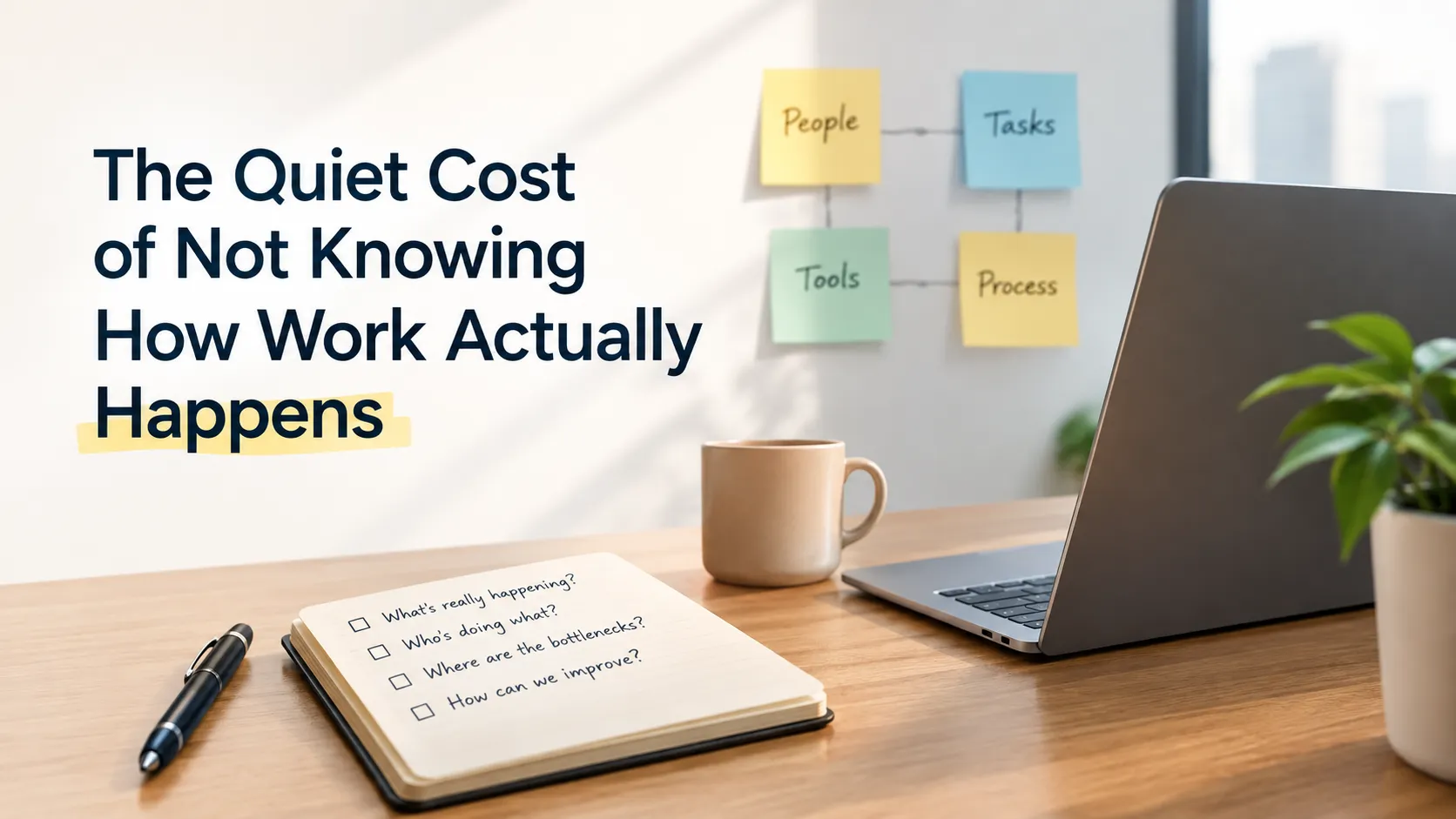


A friend of mine manages a small remote team, and a few months ago she told me something that stuck with me. She said the hardest part of her job isn't managing people — it's not knowing. Not knowing if someone's stuck. Not knowing if a deadline is quietly slipping. Not knowing until it's already a problem.
That's not a story about lazy employees or bad management. It's a story about visibility — or the lack of it — and I think it's one of the most underrated challenges of remote and hybrid work.
Work didn't get harder. It got harder to see.
In an office, visibility is almost accidental. You walk past someone's desk and notice they look stressed. You overhear a conversation that tells you a project's behind. None of that requires a tool — it's just proximity.
Remote work removes all of that ambient awareness. The work is still happening, often just as hard as before, but it's scattered across chat apps, documents, calendars, and time zones with no single place that shows the real picture. So teams fall back on status meetings and self-reported updates — both of which tell you what someone says is happening, not necessarily what actually is.
Why this quietly costs more than people realize
The costs of this gap rarely show up as one big visible failure. They show up as small, recurring frictions: a deadline that slips a little, then a little more, until it's a real problem. A payroll team spending hours every cycle piecing together manual timesheets. A manager who finds out about a bottleneck two weeks after it started, in a status update, instead of catching it early.
None of these are effort problems. Nobody's being lazy. They're visibility problems — the natural result of good people working hard in a system that doesn't let anyone see the full picture until something's already gone wrong.
Closing the gap without losing trust
This is the exact problem we set out to solve while building TrackDots — giving teams real, role-based visibility into how work actually happens, without turning that visibility into surveillance. The goal isn't to watch people more closely. It's to replace guesswork with a shared, honest picture — one that managers, HR, and employees all get to see, not just the person at the top of the org chart.
The teams that handle distributed work well aren't the ones checking in the most. They're the ones who've found a way to see clearly, without needing to ask.




















Sign in to leave a comment.