
The Strategic Trajectory of the Worldwide High-Performance Fuel Cells Market: Scaling Beyond Niche Deployment
The global high-performance fuel cell market has transitioned from a technology in search of scale to a commercially viable solution addressing critical energy and mobility challenges. In 2025, the sector crossed the $6.3 billion revenue mark, reflecting a compound annual growth rate of approximately 23.5% over the 2026–2032 forecast horizon. This trajectory is not merely a function of incremental adoption; it signals a structural shift where high-performance fuel cell systems are increasingly deployed in demanding environments that require high efficiency, durability, and reliability. The growth is broad-based, with significant activity across multiple regions, system architectures, and end-use applications, though the pace and drivers differ markedly by segment. For executives and investors, the central question is no longer whether fuel cells have a role in the energy transition, but how to position portfolios, supply chains, and capital allocation to capture value as the market matures.
Market Structure and the Inflection Point Ahead
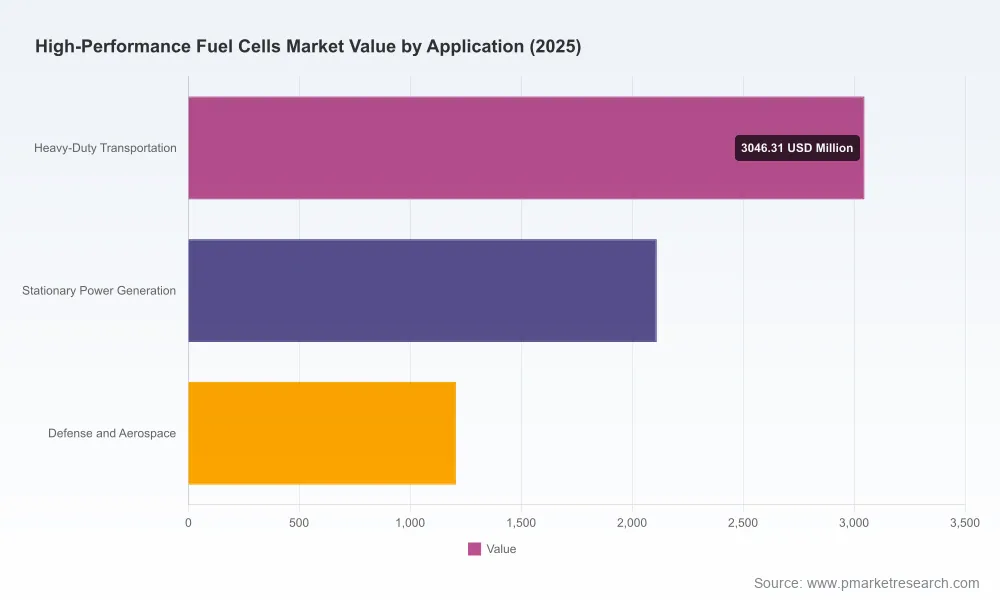
The market is characterized by a moderately concentrated competitive landscape, with the top three firms commanding roughly 44% of revenue and the top five holding closer to 57%. This concentration reflects the economies of scale required in stack manufacturing, system integration, and after-sales service networks, but it also leaves substantial room for differentiated players that target specific niches with superior performance metrics. The revenue distribution across application areas reveals a market that is expanding beyond pilot programs into revenue-generating deployments. Heavy-duty transportation remains a primary growth vector, followed by stationary power generation and defense/aerospace applications. Regional activity spans a diverse set of markets, with Asia, Europe, North America, and other regions all contributing meaningfully to demand, though the intensity and policy support vary. The critical inflection point lies in the transition from early commercial projects to standardized, repeatable deployments. As the market scales, the tolerance for performance variability shrinks, and the cost of field failures rises. Companies that cannot demonstrate consistent reliability, predictable total cost of ownership, and integration-ready hardware will face mounting pressure in procurement cycles. Three structural challenges define this juncture:
- Performance validation at scale: Repeated, independent verification of efficiency, degradation rates, and uptime under real-world conditions is increasingly required by fleet operators, utilities, and defense buyers. Early-stage demonstrations no longer suffice to secure multi-year contracts.
- Supply chain fragility for critical materials: Catalyst and stack material dependencies create cost and availability volatility, particularly for proton exchange membrane architectures that rely on platinum-group metals. Alternative chemistries and loading-reduction strategies are progressing, but their commercial readiness varies.
- Policy and incentive timing misalignment: In several key markets, tax credit structures, procurement rules, and agricultural or biogas feedstock incentives have been revised. Timing mismatches between project economics, qualification timelines, and incentive availability can compress margins or delay deployment schedules.
These challenges are not existential barriers; they are the natural friction of a sector moving from experimentation to industrial scale. Addressing them requires disciplined engineering, proactive sourcing strategies, and close alignment with regulatory and customer qualification processes. The firms that navigate these constraints effectively will capture disproportionate share as procurement standards tighten.
Core Drivers Redefining the Competitive Field
Technology Innovation and Breakthrough Performance
Efficiency and power density continue to be the most compelling differentiators. Recent advances demonstrate that fuel cell systems are approaching performance thresholds that make them competitive with conventional power sources in specific, high-value scenarios. For example, a biogas-fueled solid oxide system achieved a record electrical efficiency of 74.2%, highlighting the potential for high-performance fuel cells to extract maximum energy from locally available gaseous fuels while reducing reliance on imported electricity. Such efficiency gains are directly relevant to stationary power applications, where operational expenditure, fuel logistics, and uptime requirements are stringent. In the realm of heavy-duty mobility, next-generation stack architectures are being optimized for high power density, durability under stop-start duty cycles, and integration with battery hybrid systems. These developments are expanding the addressable use cases from fixed-route fleets to intermittent, high-load transport operations where rapid refueling and range reliability matter more than absolute lowest cost per kilowatt-hour.
Policy, Regulation, and Incentive Architecture
Regulatory frameworks are becoming both a tailwind and a gating factor. In the United States, the finalization of Section 45V clean hydrogen production tax credit rules established tiered incentives of up to $3.00 per kilogram based on lifecycle greenhouse gas emissions, creating a clearer economic basis for low-carbon hydrogen used in fuel cell applications. At the same time, legislative changes modified certain energy tax credit timelines and reinstated support for investment tax credits that favor fuel cell deployments. Together, these developments shape project economics, supplier qualification requirements, and regional deployment patterns. For manufacturers, the implication is that incentive design must be treated as a core component of go-to-market strategy. Aligning product roadmaps, domestic content decisions, and fuel supply partnerships with evolving credit and compliance rules can create near-term advantage. For buyers, understanding the interplay between procurement rules, fuel qualification, and energy tax credit eligibility is essential to optimizing total cost and avoiding compliance risk.
Demand-Side Shifts and Use-Case Expansion
Demand is being reshaped by operational requirements that conventional electrification struggles to meet economically or logistically. In heavy-duty transportation, operators are looking for solutions that balance payload, range, dwell time, and fleet uptime. Fuel cell systems that deliver high performance in cold climates, high-load cycles, and extended-duty scenarios are gaining traction among commercial fleets seeking to reduce tailpipe emissions without sacrificing service quality. In stationary power, the growth of energy-intensive computing infrastructure has created a new demand pool. High-power fuel cell systems are increasingly evaluated for data center resilience, where continuous, reliable power and rapid response capabilities are mission-critical. This is not a speculative niche; it reflects a structural increase in power demand from computing workloads and a desire for decentralized, dispatchable generation that can operate on available fuels or hydrogen blends. In defense and aerospace, requirements for silent, low-signature, and fuel-flexible power in remote or contested environments continue to drive adoption of high-reliability fuel cell platforms. These demand-side shifts indicate that the market is moving toward applications where performance and reliability justify a premium, rather than competing purely on price in commoditized segments.
Supply Chain and Cost Structure Evolution
Cost structures are being reshaped by raw material dynamics, manufacturing scale, and localization pressure. Platinum-group metal prices continued to rise through 2025, adding cost pressure to high-performance PEM systems and accelerating efforts to reduce platinum loadings, improve catalyst utilization, and qualify alternative materials. This pressure is fueling a dual track: optimization of existing PEM designs and investment in alternative architectures such as solid oxide and other advanced fuel cells that can operate with different material sets and fuel flexibility. Manufacturing scale is also reshaping economics. New production facilities and expanded stack assembly lines are oriented toward localization and volume scaling, partly in response to domestic content requirements and partly to reduce landed cost for large deployments. The trajectory suggests that cost competitiveness will increasingly come from integrated system design, higher throughput manufacturing, and fuel supply partnerships rather than from a single component breakthrough. Companies that can demonstrate a credible path to lower stack cost, robust fuel handling, and efficient balance-of-plant integration will be better positioned to win multi-unit contracts.
PW Consulting
Competitive Positioning and the Shape of the Market
The competitive field spans a mix of stack specialists, system integrators, and technology licensees, each pursuing different routes to value creation. Ballard Power Systems has concentrated on PEM fuel cell stacks and engines, including high-performance engines designed for heavy-duty vehicles, buses, and stationary applications, with an emphasis on power density and durability. Its recent product unveilings and early manufacturing steps reflect a strategy oriented toward qualified fleets and compliance-sensitive deployments. Bloom Energy remains a prominent provider of solid oxide fuel cell systems for stationary power, targeting data centers, commercial buildings, and utility-scale installations where high efficiency and server-like reliability are valued. Plug Power’s portfolio spans PEM systems for material handling, stationary backup power, and hydrogen infrastructure, positioning it along the intersection of fleet operations and fuel logistics. FuelCell Energy focuses on molten carbonate and solid oxide technologies for stationary power, carbon capture integration, and distributed energy, emphasizing applications where high efficiency and fuel flexibility matter. Doosan Fuel Cell provides high-efficiency PAFC and SOFC systems for large-scale stationary installations, including licensed SOFC technology that supports robust, fuel-flexible performance. Ceres Power operates a technology platform model, licensing solid oxide technology to partners for efficient stationary and distributed power systems, allowing it to scale through ecosystem partnerships rather than direct system sales alone.
In the mobility and specialized segments, EKPO Fuel Cell Technologies has been established to develop and scale high-performance PEM stacks for automotive, truck, bus, rail, and marine applications, signaling the importance of dedicated stack production capabilities. SFC Energy offers direct methanol and hydrogen fuel cells for off-grid, portable, and stationary high-reliability power in defense, industrial, and remote settings, where fuel flexibility and reliability are paramount. Horizon Fuel Cell Technologies produces PEM systems and stacks, including high-power solutions for stationary applications such as 3MW hydrogen power systems for data centers, reflecting the convergence of mobility-grade technology into stationary high-power use cases. AISIN Corporation develops and integrates high-efficiency fuel cell systems, including residential and commercial cogeneration units using PEM and SOFC technologies, leveraging integration expertise across building and energy markets. Mitsubishi Power (MHI) offers high-efficiency solid oxide and other fuel cell systems for large-scale power generation and broader energy solutions, positioning itself within utility and industrial power ecosystems. Cummins, through its hydrogen and fuel cell division, provides PEM technologies and systems for heavy-duty and stationary high-performance applications, drawing on broader engine and powertrain capabilities.
The strategic differentiation among these players emerges across three axes: technology focus, application specialization, and business model. PEM specialists are optimizing for power density, cold-start performance, and integration with battery hybrids for mobility and backup scenarios. SOFC and advanced fuel cell providers are leaning into efficiency, fuel flexibility, and stationary power ecosystems where continuous operation and fuel logistics can be optimized. Licensees and platform companies are pursuing scale through partnerships, allowing partners to adapt core technology to regional markets and application requirements. System integrators and powertrain incumbents are extending existing customer relationships and service networks into fuel cell portfolios, leveraging manufacturing scale and multi-technology expertise.
Market evolution is likely to follow a pattern of selective consolidation and parallel fragmentation. Consolidation is plausible where scale economics, service network breadth, and integrated fuel supply create durable advantages. Fragmentation is equally likely where application-specific performance requirements, regional fuel availability, and qualification pathways favor specialized suppliers. New entrants will continue to appear in high-value niches, particularly where a breakthrough in efficiency, durability, or fuel flexibility can justify a performance premium. The more interesting dynamic is the movement of technology across application boundaries. High-power PEM stacks are being adapted for stationary high-demand use cases, while robust SOFC platforms are expanding into fuel-flexible stationary generation with strong efficiency credentials. This cross-pollination increases the importance of application engineering, qualification, and integration capability over any single technology label.
Recent company-level developments illustrate these strategic directions. An efficiency milestone for a biogas-fueled solid oxide system achieved world-record electrical efficiency of 74.2%, underscoring the potential of high-performance fuel cells to convert locally available gaseous fuels with exceptional efficiency. A new fuel cell production facility broke ground in Korea to scale high-performance fuel cell manufacturing, indicating continued investment in localized capacity for volume and supply security. A high-power 3MW hydrogen solution was launched for AI data centers, demonstrating the migration of fuel cell technology into energy-intensive computing infrastructure where reliability and rapid response are valued. Meanwhile, a ninth-generation high-performance fuel cell engine for heavy-duty vehicles was unveiled with initial manufacturing aligned to domestic content requirements, reflecting the intersection of performance improvement and compliance-driven localization. These actions collectively point to a market where performance metrics, manufacturing scale, and regulatory alignment are converging.
Forward Outlook: Trends Shaping the Next Three to Five Years
The next phase of market development is likely to be defined by the interplay of performance economics, application migration, and policy-aligned deployment. Three trends stand out.
Performance-driven economics will increasingly separate winners from the rest. As efficiency records move higher and degradation curves improve, the value proposition of fuel cells in demanding applications becomes easier to quantify. High-efficiency solid oxide systems and high-power-density PEM engines will compete on total cost of ownership rather than upfront price alone. Buyers in data centers, heavy-duty fleets, and defense will increasingly require transparent performance data, validated durability, and predictable service cost. This trend favors suppliers with strong testing, monitoring, and service infrastructure, and it raises the bar for new entrants who must demonstrate reliability at scale.
Application migration will broaden the addressable market. Technology developed for one context is being repurposed for another where performance requirements align. High-power PEM systems are moving into stationary data center resilience, while robust SOFC and advanced fuel cell platforms are expanding into fuel-flexible stationary generation and distributed power. This migration creates opportunities for manufacturers to extend product lines across segments with overlapping engineering requirements, and it creates opportunities for integrators to bundle fuel cell systems with power management, fuel supply, and control solutions. It also raises integration complexity, as system design must account for different duty cycles, fuel logistics, and grid interaction requirements.
Policy and incentive alignment will shape deployment geography and timing. The finalization of clean hydrogen production incentives, the modification of certain tax credit timelines, and the reinstatement of investment tax credits supportive of fuel cell deployments are reshaping economic assumptions. Projects that align fuel sourcing, domestic content, and qualification pathways with evolving rules will gain speed and margin benefit. Conversely, misalignment can delay deployment or compress returns. The practical implication is that strategic planning must incorporate regulatory timing as a core variable, not a secondary consideration. Manufacturers, developers, and buyers should map incentive eligibility, compliance requirements, and qualification schedules against their product roadmaps and procurement plans.
Risks and uncertainties remain. Raw material price volatility can affect stack cost and margins, particularly for catalyst-dependent architectures, although loading reduction and alternative material strategies are progressing. Feedstock and fuel supply reliability, especially for hydrogen and biogas, can influence operating economics and uptime. Policy revisions can shift the economics of clean hydrogen production and deployment incentives, altering project timing and regional attractiveness. Performance validation and standardization gaps can slow procurement in sensitive sectors such as defense, data centers, and long-haul transport. Finally, competition from alternative technologies, including advanced batteries, grid-scale storage, and combustion with carbon management, can constrain share in specific applications. The net effect is that the market will reward disciplined execution, credible performance data, and flexible fuel-handling capability.
High-Performance Electric Motorcycle Market
Strategic Actions for Decision Makers
For Manufacturers and Technology Providers
Prioritize performance validation and integration readiness as core commercial assets. Document efficiency, degradation, cold-start behavior, and uptime under real-world conditions, and align product roadmaps with application-specific duty cycles. Invest in stack cost reduction through catalyst utilization, loading reduction, and higher-throughput manufacturing, while maintaining durability targets. Build fuel supply partnerships and localization strategies that reduce landed cost and align with compliance requirements. Consider business models that extend reach, such as licensing core technology for regional adaptation or partnering with integrators who can combine fuel cell systems with power management and fuel logistics.
High Performance Fiber Market
For Investors
Evaluate differentiation along three dimensions: efficiency and durability versus price, application fit versus breadth, and business model scalability. High-efficiency solid oxide platforms and high-power-density PEM systems have distinct value propositions, and the strongest investment cases will tie technology advantage to clear demand pools such as data center resilience, heavy-duty fleet uptime, or fuel-flexible stationary generation. Monitor policy timing, domestic content rules, and incentive structures as drivers of near-term deployment velocity. Watch for signals of consolidation in scale-sensitive segments and for entry in high-value niches where performance premiums can be sustained. Assess supply chain resilience, particularly around catalyst and critical material dependencies, and favor companies with credible paths to cost reduction and alternative material readiness.
For Buyers and Procurement Leaders
Structure procurement around total cost of ownership, performance validation, and service reliability rather than headline unit cost. Require transparent data on efficiency, degradation, cold-start performance, and uptime for the intended duty cycle. Evaluate fuel logistics, including hydrogen, biogas, or methanol availability, storage, and refueling or recharging infrastructure, as these factors heavily influence operating economics. Build qualification and pilot programs that generate site-specific data before scaling to multi-unit deployments. Align project timing with incentive and compliance calendars to optimize economics and reduce administrative friction. Where possible, engage integrators who can combine generation, power management, and fuel handling into a single accountable solution.
Closing Perspective
The high-performance fuel cell market is entering a phase where scale, performance, and policy alignment converge to create both opportunity and execution risk. The revenue trajectory, the expansion of use cases, and the evolution of competitive strategies indicate a market that is moving beyond proof-of-concept into commercial realism. For manufacturers, the imperative is to convert technical leadership into validated, integrable, and cost-competitive systems. For investors, the opportunity lies in identifying companies and segments where performance and business model advantages are durably aligned with demand. For buyers, the task is to match system capabilities to operational requirements and to structure procurement for reliability and total cost. Detailed, segment-specific data remains essential for translating these strategic directions into actionable plans. Those seeking deeper segmentation, regional granularity, and tailored scenario analysis should consult comprehensive market research and detailed reports to support investment, procurement, and product strategy decisions at the level of precision that high-stakes decisions require.
For detailed analysis of this topic, please visit the official page: Worldwide High-Performance Fuel Cells Market
Lacy Lee
Senior Marketing Manager
[email protected]
PW Consulting: www.pmarketresearch.com


























Sign in to leave a comment.