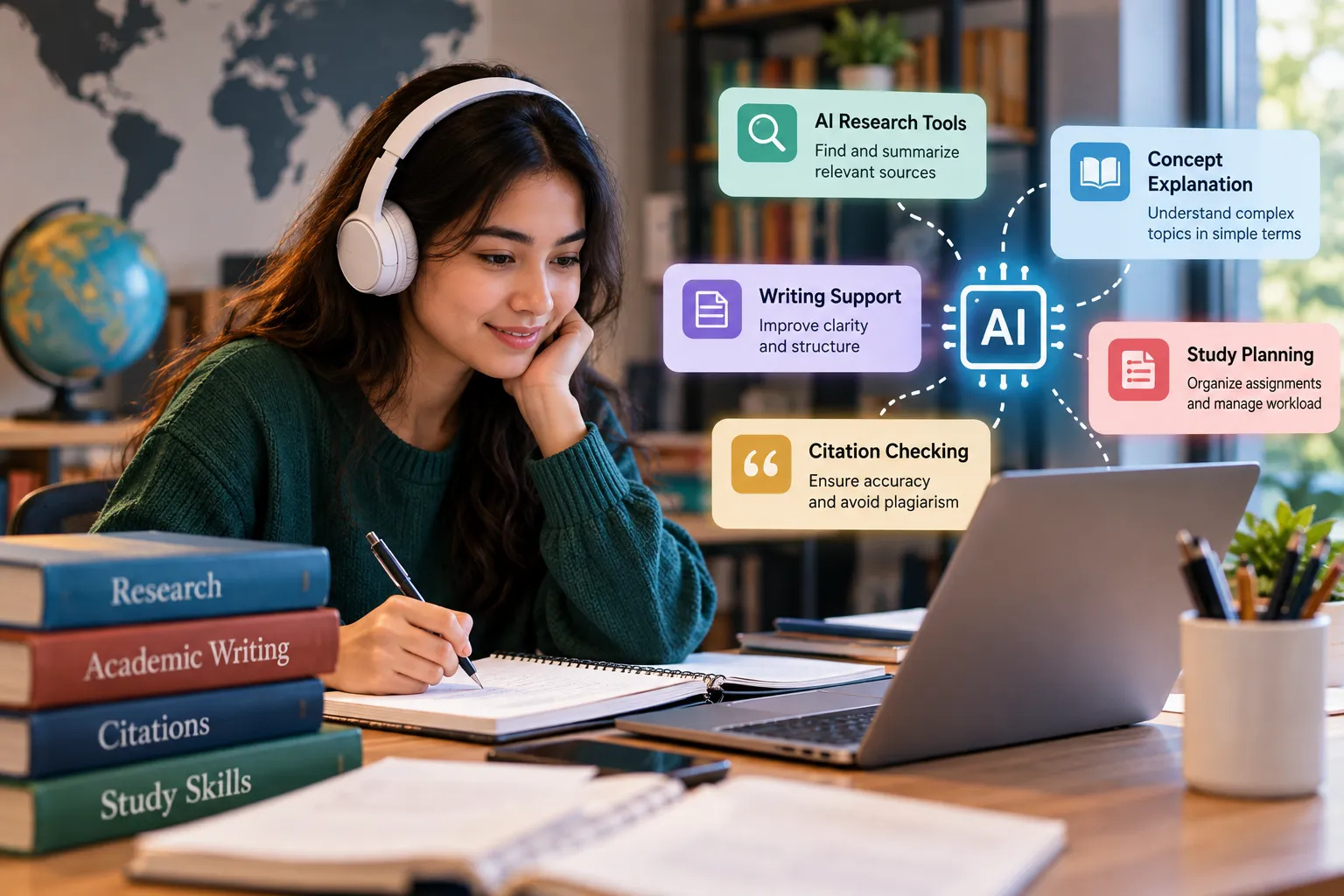

AI has become part of everyday university study for many international students, but its role is changing. Rather than relying on a single chatbot for every assignment, students are beginning to use different AI tools for different stages of academic work.
The research paper describes a workflow that can include scholarly research, concept clarification, citation management, writing feedback, and language polishing. This matters because international students often face several challenges simultaneously, including unfamiliar academic conventions, second-language writing, and different expectations around coursework.
The real question is therefore not whether students should use AI. It is how they can use it without allowing convenience to replace learning.
Begin With the Assignment Requirements
Before opening an AI tool, students should understand what their assignment actually requires.
Words such as “analyse,” “evaluate,” or “critically discuss” can imply different expectations depending on the discipline. International students who are unfamiliar with those conventions may benefit from using AI to clarify terminology, but they should compare any explanation with the official assessment brief and course materials.
The research paper identifies this stage as an important challenge for international students because academic expectations can vary between education systems.
AI can provide a starting explanation, but the course syllabus remains the authority.
Students should also check the assessment's AI rules before using any tool. The research notes that policies can differ between courses and departments, meaning a general university policy may not provide enough information for a specific assignment.
That simple check can prevent students from using a tool in a way their instructor does not permit.
Use AI to Explore Research, Not Replace It
Research is often where AI can provide some of its most practical assistance.
Specialized research tools can help identify relevant academic papers, summarize abstracts, and show connections between different sources. This can reduce the time students spend searching aimlessly through databases.
But an AI-generated summary should be treated as a starting point.
Students still need to read the original paper and evaluate its relevance, evidence, and conclusions. A research tool can point toward a source, but it cannot remove the student's responsibility to understand that source.
For students working on dissertations, theses, or other research-heavy projects, additional guidance can help with organizing ideas and understanding academic structure. Expertsmind's thesis writing help can serve as a supplementary resource alongside independent research and academic reading.
A useful workflow is therefore simple: discover with AI, read the original, evaluate the evidence, and then decide how the source contributes to the assignment.
Turn AI Into a Second Pair of Eyes
Writing is another area where international students can use AI effectively.
Students writing in a second or third language may struggle with grammar or phrasing even when they understand their subject well. Language tools can identify errors that are difficult for the writer to notice independently.
However, AI works better as a reviewer than as a replacement writer.
A student can write a paragraph independently and then ask an AI tool to identify unclear sentences or areas that need stronger evidence. The student can decide how to revise the paragraph based on that feedback.
This process has an additional benefit. Students begin to recognize repeated writing problems and can gradually correct them without assistance.
For students developing longer academic assignments, Expertsmind's term paper help can provide another source of academic guidance while the student remains responsible for research, analysis, and the final submission.
Treat Every AI Citation With Suspicion
One of the most important habits students can develop is citation verification.
AI-generated references can look professional while containing incorrect details. The research paper warns that AI may produce references with wrong publication information, incorrect attribution, or sources that do not exist.
That makes checking the original source essential.
Students should confirm that the publication exists, that the details are correct, and that the source actually supports the statement they plan to make.
This is also where citation management becomes useful. Keeping track of sources while researching is easier than reconstructing them immediately before submission.
For international students, source management has another benefit. Paraphrasing academic material in another language can sometimes result in wording that remains too close to the original. Accurate source records make it easier to review those passages carefully.
Keep Independent Thinking at the Center
AI becomes less helpful when students use it every time they encounter difficulty.
The research paper identifies dependency as a significant concern. International students still need to develop the ability to read difficult academic English, build arguments, and express ideas independently.
Imagine a student who asks AI to explain every difficult paragraph in every journal article. The process may feel efficient, but the student gets fewer opportunities to develop the ability to work through difficult academic writing alone.
A better approach is to struggle productively first.
Read the paragraph. Try to identify the main idea. Write down what you understand. Then use AI to clarify what remains confusing.
That small change keeps the student's own thinking at the center of the process.
Know When AI Should Step Back
The research distinguishes between AI used for academic process and AI used to produce the final academic product. Brainstorming, planning, concept clarification, and feedback are different from submitting AI-generated arguments or analysis as personal work.
That distinction gives international students a practical boundary.
If AI helps you understand something and you then explain it yourself, the tool has supported learning. If AI produces the explanation that you submit without developing your own understanding, the learning opportunity becomes much smaller.
Students should also disclose AI use whenever their course requires it. The research specifically recommends asking the instructor when the rules are unclear rather than assuming that a particular use is acceptable.
Build Skills That Outlast the Technology
AI tools will continue to change, but the academic skills students need will remain familiar: finding reliable evidence, reading critically, constructing arguments, writing clearly, and understanding sources.
The research suggests that students who use AI successfully maintain a clear distinction between assistance and authorship. They use technology to improve their process while retaining responsibility for the work they submit.
For international students, this approach can make the transition into a new academic environment easier without creating permanent dependence on technology.
AI should help students get unstuck, see possibilities, and improve their work. But the final goal is not to become better at asking AI for answers. It is to become better at finding, understanding, questioning, and communicating answers independently.






























Sign in to leave a comment.