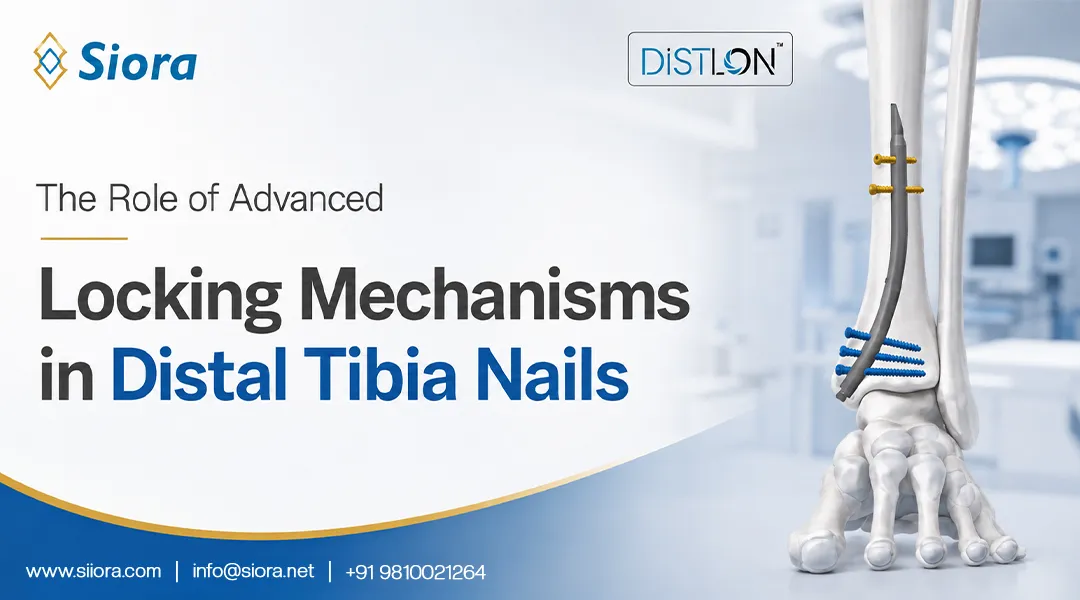


Fractures involving the distal tibia can be difficult to manage because the bone narrows as it approaches the ankle. In this region, surgeons have limited space for implant fixation, while maintaining proper alignment remains essential for successful healing. The challenge becomes even greater when dealing with unstable, comminuted, osteoporotic, or metaphyseal fractures.
Traditional intramedullary nails provide stable internal fixation, but controlling the distal fragment has always been one of the major concerns. This is where advanced locking mechanisms in modern distal tibia nails have made a meaningful difference.
By improving the way locking screws engage with the nail and surrounding bone, these mechanisms help surgeons achieve better fixation, rotational stability, and control over the fracture.
Enhanced Stability in the Distal Fragment
The distal fragment of the tibia may be relatively short, making it difficult to obtain secure fixation using conventional locking arrangements. Advanced distal tibia nails are designed with multiple distal locking options positioned at different angles.
This multi-directional locking pattern allows screws to engage the distal bone from different planes. Instead of relying on a single line of fixation, the construct distributes forces across multiple points.
As a result, the nail can provide improved resistance against:
- Rotational movement
- Angular displacement
- Varus and valgus deformity
- Shortening and loss of alignment
For surgeons, this additional control can be particularly valuable when treating fractures close to the ankle joint.
The Importance of Multi-Planar Locking
One of the key advancements in distal tibia nailing is the use of multi-planar locking. Locking screws may be placed in mediolateral, anteroposterior, or oblique directions depending on the design of the implant.
Each screw direction contributes differently to the overall stability of the construct. A multi-planar configuration helps resist forces generated during weight bearing and normal limb movement.
This design can also improve the nail's ability to control small or unstable distal fragments. Better fragment control may reduce the risk of secondary displacement during the healing period.
Improved Rotational and Angular Control
Maintaining alignment is one of the primary goals of fracture fixation. Even a small loss of reduction in the distal tibia can affect limb mechanics and ankle function.
Advanced locking mechanisms help create a more stable connection between the nail and bone. When several locking screws are positioned strategically, they can limit unwanted rotation and angular movement around the fracture site.
Some modern systems also incorporate locking configurations designed specifically to increase distal fixation strength without requiring an excessively long segment of bone.
This can be especially useful in complex fracture patterns where conventional fixation may offer limited control.
Supporting Minimally Invasive Fracture Treatment
The intramedullary nailing system is often preferred because it can support fracture stabilization through a relatively minimally invasive approach. Advanced locking mechanisms further improve the usefulness of this technique by providing stronger fixation within the distal segment.
A stable locking construct may allow surgeons to preserve more of the surrounding soft tissue compared with extensive open plating procedures in appropriate cases. Preserving the biological environment around the fracture remains an important consideration in bone healing.
However, the final surgical approach should always depend on fracture morphology, bone quality, soft tissue condition, and the individual patient's needs.
Conclusion
Advanced locking mechanisms have significantly improved the performance of distal tibia nails. Multi-directional and multi-planar locking options provide stronger control over the distal fragment while helping resist rotational and angular instability.
These design improvements are particularly important in fractures occurring close to the ankle, where achieving secure fixation can be challenging. By combining intramedullary fixation with advanced locking technology, modern distal tibia nails give surgeons greater flexibility in managing complex fracture patterns while supporting stable alignment throughout the healing process.
























Sign in to leave a comment.