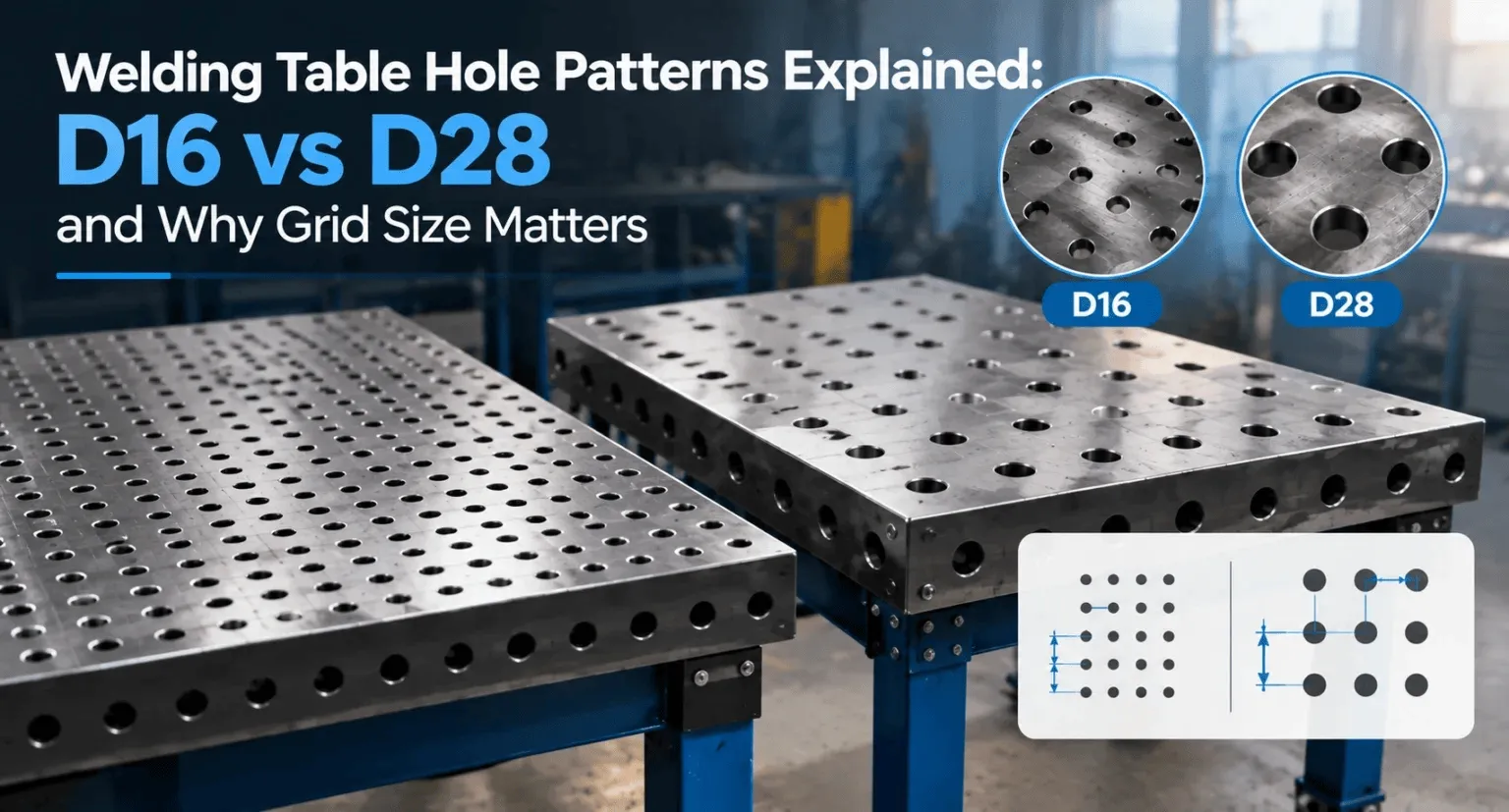


When fabricators compare welding tables, they often focus on dimensions, thickness, load capacity, and surface quality. These specifications are important, but the hole pattern deserves equal attention because it affects how fixtures are positioned and which accessories can be used.
For anyone considering a modular welding table, understanding the relationship between hole diameter and grid spacing can make it easier to identify the right system.
Hole Diameter and Grid Spacing Are Different
Hole diameter refers to the actual size of each positioning hole. Grid spacing refers to the distance between neighbouring holes, measured from centre to centre.
D16 uses 16 mm holes and commonly has a 50 × 50 mm grid. D28 uses 28 mm holes and typically has a 100 × 100 mm grid.
Both measurements affect the table, but they serve different purposes.
Why Hole Diameter Matters
The diameter determines which positioning and clamping accessories can fit into the table.
D16 accessories are designed around the 16 mm hole system, while D28 accessories are designed around 28 mm holes. This means the hole diameter creates the foundation for the table’s accessory ecosystem.
When purchasing a table, fabricators should consider not only the table itself but also the clamps, pins, stops, brackets, and other fixtures they plan to use.
Why Grid Spacing Matters
Grid spacing determines how many positioning points are available.
A 50 mm grid places holes closer together, giving operators more options when positioning components. This can be useful for smaller parts or complex assemblies.
A 100 mm grid places holes further apart. This can be suitable for larger components where extremely close positioning is not necessary.
D16 for Flexible Positioning
The D16 configuration can be advantageous in fabrication environments where flexibility is important.
Small assemblies can require several clamps and stops positioned around specific features. The dense grid gives operators more options for building these fixtures.
D16 can therefore be useful for prototypes, sheet-metal work, small frames, and detailed fabrication.
D28 for Robust Workholding
D28 provides larger holes and a wider grid. This makes it suitable for applications that require larger workholding accessories.
Heavy frames, machinery, structural components, and large assemblies can benefit from a robust fixturing system. The 100 mm grid can provide enough positioning points while maintaining a layout suitable for larger components.
Table Geometry Matters
Hole pattern should be considered alongside other aspects of table geometry.
Surface flatness affects how components sit on the table. Hole precision influences accessory fit and positioning. Table thickness and construction affect rigidity and load handling. Side holes can provide additional options for certain fixtures.
Therefore, a high-quality welding table should be evaluated as a complete system.
Matching the Table to Your Work
The most appropriate hole pattern depends on what the workshop actually produces.
A business working mainly on smaller and detailed components may benefit from D16. A fabrication operation handling large and heavy assemblies may find D28 more suitable.
The decision should also consider the available accessory ecosystem and future production needs.
Avoid Choosing Based Only on Hole Size
A larger hole is not automatically better. Similarly, a smaller grid is not automatically the best choice.
D28’s larger holes provide compatibility with robust accessories, while D16’s smaller holes and denser grid provide positioning flexibility. Each configuration has a purpose.
The goal is to match the table to the job.
Practical Selection Checklist
Before purchasing, fabricators can consider:
- What size components are normally fabricated?
- How heavy are the typical workpieces?
- How much positioning flexibility is required?
- Which clamps and accessories are needed?
- Is fine positioning more important than heavy workholding?
- What projects are expected in the future?
- What table size and load capacity are required?
Answering these questions can make the selection process more straightforward.
Conclusion
Hole diameter and grid spacing are fundamental parts of a welding table’s design. D16 and D28 provide different approaches to workholding, with D16 offering a denser 50 mm positioning grid and D28 offering larger 28 mm holes with a typical 100 mm grid.
Understanding these differences allows fabricators to choose a table based on practical requirements rather than appearance or size alone.
For welding tables and fixturing solutions, visit FIXTO Welding Solution.
Learn more in Welding Table Hole Patterns Explained: D16 vs D28 and Why Grid Size Matters.
























Sign in to leave a comment.