


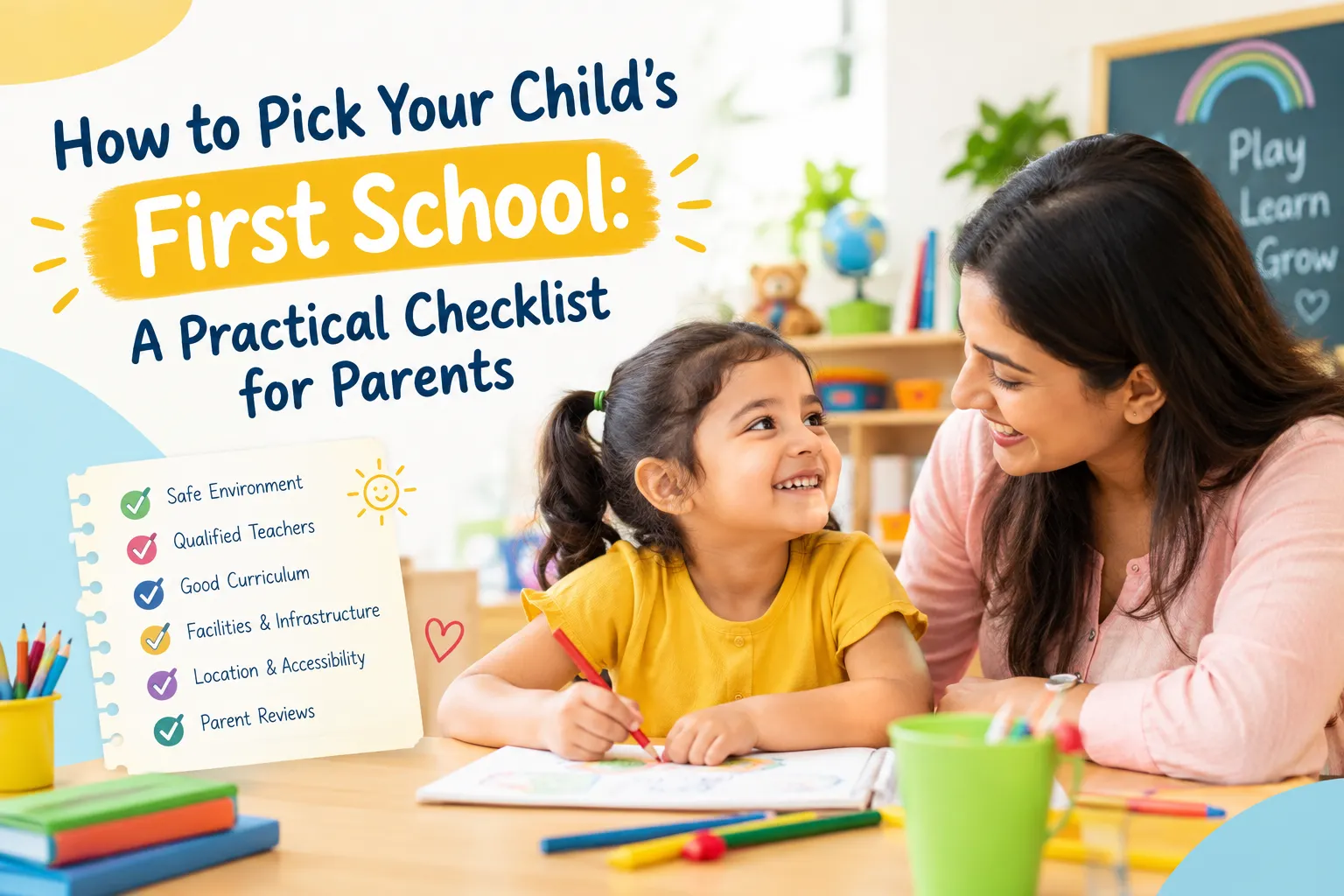
Most parents start the same way. A late-night search for Pre Schools Near Me yielded 10 choices, a selection of four, and four Saturday mornings spent being guided through halls by someone holding a brochure. By the third visit, the brochures start sounding the same: holistic development, child-centered learning, world-class curriculum.
Nobody informs you on that trip that the marketing staff produces the brochure, but the classroom is written by the teachers who live there. One of those is attempting to impress you. The other person has no idea you are approaching.
Learning to read the room will teach you more in 10 minutes than ten phone conversations.
The Concept of the Room as a Teacher
According to the Reggio Emilia concept in northern Italy, the environment is the "third teacher," alongside the adult and the peer group. It sounds abstract until you see it happen. A child in a room with low shelves and open baskets makes different decisions than a child in a place where everything intriguing is stored in a high cabinet. One chamber says, "Decide for yourself." The other suggests waiting to be told.
Neither chamber declared its philosophy. The furnishings did it for them.
This is more important between the ages of two and five than at any other stage, because a Pre School For Kids this young is not primarily about content. It is about a child discovering what type of person they are permitted to be in a group context. The space delivers the lesson long before a worksheet does.
Five Things to Notice during the First Five Minutes
1. Look at the walls from your child's perspective, rather than your own.
Adults look upward. Children look directly forward. If everything exhibited at 90 cm from the floor is laminated, printed, and purchased — alphabet charts, cartoon posters, fruit names — the area is suitable for youngsters. If that section of wall contains crooked paintings, images of the actual class, and scribbles that clearly no one edited, the room was created by children. Both are legitimate. Only one tells you that the children's work is taken seriously.
2. Look for an honest mess.
A classroom that is pristine at 11 a.m. on a Wednesday has seen very little activity. You're looking for the proper type of disorder: a half-finished block castle that someone expects to return to, dried paint, a tray of sand with handprints on it. Perfection at mid-morning is a red sign disguised as a selling point.
3. Determine the corners.
One big rectangle with thirty chairs facing forward indicates that one event is taking place at a time, and an adult is choosing what it is. When a space is divided into niches, such as a reading nook, a makeshift kitchen, a water table, or a silent cushion, multiple activities take place simultaneously, and kids have to choose between them. More about the daily rhythm may be learned from just one architectural change than from a schedule.
4. Locate the door to the outside and the light.
After finding out how frequently the kids go outside, find out what happens when it rains. The true answer is the response to the second query. A school with an actual outside program has a plan for rainy days. Without one, a school will declare "we manage."
5. Examine the materials' composition.
One type of play is produced by single-purpose plastic toys. Open-ended play, which fosters problem-solving skills, can be created with blocks, fabric, clay, water, cardboard, leaves, and loose parts. A pricey room is not necessary. An unprescriptive one is what you need.
Timing Your Visit Changes What You See
This is the article's most useful piece of advice. Avoid visiting during assembly at 8 a.m. and when the day is coming to an end at 3 p.m. Visit in the middle of the week between 10 and 11.30 a.m., when the session is completely underway, and no one has time to perform for you.
The majority of families start looking during admission season, when every internet banner declares Admission Open Preschool and every billboard in the neighborhood reads Preschool Admission Open. While there is a genuine sense of urgency—good branches do fill up—it also coincides with the busiest time of year for schools. The regular version of the school, which is the one your child will actually attend, can typically be seen when you visit two weeks before to or after the peak.
The Inquiries That Surpass the Script
You will find numbers when you search for Play School Near Me With Fees. The simple part is the numbers. These questions are helpful since they are more difficult to respond to smoothly:
- What is the duration of the class teacher's employment at this branch?
- At 12.30 p.m., not 9 a.m., what is the adult-to-child ratio?
- When a child declines to participate in the group activity, what happens?
- Can I view the area where kids relax or take naps?
- What is billed separately during the year, and what is specifically included in the fee?
The most underappreciated metric is teacher tenure. Employees who remain are those who receive support, and those who receive assistance are those who are patient.
How to Make a Reasonable Shortlist
Any ranking that asserts that there is only one Best Play School In India is merely selling advertising space. There is a solid connection between a certain child, a specific family's commute, and a specific group of educators. A parent who chooses a Preschool Nearby with friendly, long-serving personnel is better off than one who drives forty minutes to a well-known institution.
So: search for a Preschool Near Me, shortlist three, visit all three mid-morning, and read the rooms. Then begin the Preschool Admission paperwork with the one where you could imagine your child having a bad day — and being handled well.
Early Kindergarten In India is not a race to be won. It is the first place outside your home where your child learns that the world is, broadly, a safe place to be curious in. The room will tell you whether that's true. You only have to look.





















Sign in to leave a comment.