

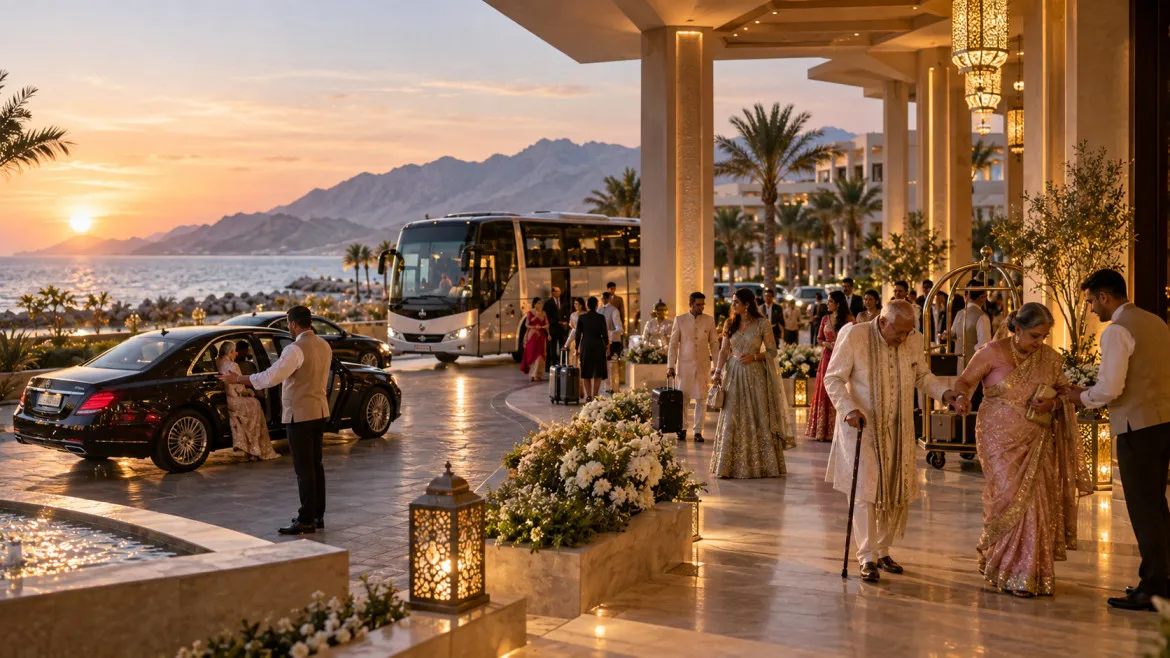
A destination wedding in Ras Al Khaima can look effortless once the guests arrive. The cars pull in, the bride and groom make their entrance, welcome drinks are served and everyone moves into the celebration. But behind that smooth experience is a part of wedding planning that is rarely discussed in detail: how 100, 200 or 500 people actually arrive, park, unload, enter and leave the venue.
This is more than a parking question.
For a large Indian destination wedding, guest arrival involves private cars, taxis, family vehicles, airport transfers, coaches, elderly relatives, vendors and sometimes several events happening within the same property. A venue can have a beautiful ballroom or beachfront setting and still create unnecessary congestion at arrival time.
Ras Al Khaimah's current municipal building regulations offer an interesting insight. For wedding and banquet halls, the regulations specify parking requirements, separate vehicle entry and exit lanes, and rules governing the placement of vehicle access points in relation to road intersections.
For couples researching Ras Al Khaimah wedding venues, this means the arrival experience deserves the same attention as the décor.
Parking Capacity Is Not the Same as Arrival Capacity
One of the easiest mistakes is asking a venue, “How many cars can you accommodate?”
That number alone does not tell you how the arrival will feel.
Imagine a wedding with 250 guests. Some may arrive together in family cars, others by taxi, some by private chauffeur and others through organised transfers. A venue may technically have enough parking while the entrance becomes crowded because too many vehicles are trying to use the same access point simultaneously.
The current Ras Al Khaimah building regulation states that wedding and banquet halls require one parking space for every 20 square metres of hall area. It also establishes requirements around separate entry and exit lanes and the positioning of vehicle access points.
However, couples should not treat that formula as a guest-arrival calculator for every hotel or resort wedding. Resort properties and hotel function spaces can operate under different site arrangements and approvals.
The practical question is therefore not simply:
“Is there enough parking?”
It is:
“What happens during the busiest 15 minutes before the ceremony?”
That is the time worth planning for.
The 15-Minute Arrival Test
Ask your wedding planner and venue to walk through the busiest arrival window.
For example, if the ceremony begins at 7:00 PM, imagine 6:30 to 6:45 PM.
Where do guests enter?
Where do taxis stop?
Where does a coach unload?
Where does a private car go after dropping an elderly guest near the entrance?
Where do drivers turn around?
Where do vendors arrive?
Where does valet parking begin?
The answers can reveal problems that are almost impossible to see during a daytime venue tour when there are no guests.
A useful venue test is to request an actual arrival walkthrough rather than just a property tour.
You are not only evaluating the venue. You are evaluating its traffic choreography.
Coaches Need a Different Plan From Cars
This becomes especially important for destination weddings because group transfers can be more efficient than individual vehicles.
A wedding coach does not behave like a sedan.
It needs more space to approach, stop and depart. Passengers also take longer to unload, particularly when guests are carrying luggage, formal clothing, gifts or children.
Ask the venue:
Can a full-size coach reach the entrance?
Where can it stop without blocking other vehicles?
Can passengers unload under cover?
Does the coach have to reverse?
Where does it wait after dropping guests?
Can multiple coaches arrive sequentially?
This is particularly important when several families are travelling together from a hotel cluster or from Ras Al Khaimah International Airport.
The official RAK Airport website currently lists hotel and beach resort areas as approximately 15 minutes from the airport, while RAK Transport Authority operates taxi and public transport services across the emirate.
That means airport logistics are only the beginning. Once guests reach the destination, the wedding-specific transfer plan still has to work.
Do Not Make the Entrance a Bottleneck
Many wedding designs focus heavily on the visual entrance.
A floral tunnel, welcome sign, candles, performers and elaborate décor may all be planned around the arrival point.
But this is also where physical movement is concentrated.
If the entrance becomes visually crowded, guest flow can slow down. Large floral installations can narrow walking paths. Registration desks can obstruct circulation. Photographers may stop guests to capture arrivals while vehicles continue approaching from behind.
The solution is not to remove the experience.
It is to separate the arrival function from the photography function wherever possible.
Guests should be able to leave the vehicle, enter safely and move forward without creating a queue behind them.
A photographer can still capture the moment from a controlled position.
Build a Separate Plan for Elderly Guests
A destination wedding often includes grandparents, older relatives and guests who are travelling internationally for several days.
Their arrival experience can be very different from that of younger guests.
A long walk from a parking area may not seem significant during venue planning, but it can become uncomfortable after a flight, especially when guests are wearing formal Indian clothing or carrying personal belongings.
Your room allocation and transport planning should therefore connect with your arrival plan.
Consider identifying guests who may benefit from:
A closer drop-off point.
A shorter walking route.
Seated waiting areas.
Assistance with luggage.
A dedicated vehicle rather than shared transport.
The goal is not to create a visibly separate experience. It is to remove unnecessary friction before the celebration starts.
The Same Problem Appears at the End of the Night
Wedding planners often spend more time planning guest arrival than guest departure.
That can be a mistake.
At the end of a reception, hundreds of people may attempt to leave within a relatively short period. Unlike arrival, where guests are naturally staggered, departure can happen almost simultaneously after the final ceremony, performance or farewell.
Ask the venue what happens at midnight, not just at 7:00 PM.
Where do guests wait?
How are taxis called?
How are private vehicles retrieved?
Can coaches pick up from the same location?
Is there adequate lighting?
What happens if several vehicles arrive at once?
RAKTA currently provides taxis around the clock, and its network also includes public transport and newer smart mobility options. In April 2026, RAKTA announced an agreement with Uber to launch app-based taxi and limousine booking services in the emirate. That gives guests additional transport options, but a wedding planner still needs to coordinate the actual pickup process.
Think About the Wedding Weekend, Not Just One Reception
Large destination weddings rarely consist of one event.
There may be a welcome dinner, mehendi, haldi, sangeet, wedding ceremony, reception, brunch and excursions.
The arrival plan can change dramatically between them.
A daytime poolside event may require a different drop-off arrangement from a formal evening reception. A desert event may have a very different loading and unloading point from a ballroom. A mountain excursion may involve smaller vehicles or a controlled transfer schedule.
This is where a Ras Al Khaimah wedding planning timeline becomes more useful than a simple event checklist.
Create a movement plan for every event.
Who is arriving?
From where?
By what vehicle?
At what time?
Where do they unload?
Where does the vehicle go afterward?
What happens if they arrive early?
What happens if they are late?
Once these questions are answered for each event, transport becomes part of the wedding design rather than an afterthought.
Ask for the Actual Vehicle Route
Venue brochures usually show what guests will see after they arrive.
Ask for what happens before that.
Request a basic route showing:
Airport or hotel pickup point.
Venue entrance.
Guest drop-off.
Parking.
Coach parking.
Service access.
Reception entrance.
Departure pickup zone.
This is particularly useful when comparing very different Ras Al Khaimah wedding destinations, from beachfront resorts to desert or mountain settings.
A visually spectacular venue may have a more complicated arrival route than a conventional function space. That is not automatically a problem, but it needs to be understood before invitations, transport schedules and event timings are finalised.
Your Wedding Planner Should Own the Arrival Plan
Transport companies can manage vehicles. Hotels can manage their property. Valet teams can manage parking.
But somebody still needs to own the complete guest journey.
That person should know:
Which guests need special assistance.
Which vehicles are arriving.
Which family members share transfers.
Which events require coaches.
Where drivers wait.
What the contingency route is.
What happens if weather, traffic or delays affect the schedule.
RAKTDA has a mandate covering tourism licensing and event-related permits in Ras Al Khaimah, so planners and suppliers should also confirm any venue-specific or event-specific requirements directly with the relevant authorities and property before finalising arrangements.
The Arrival Plan Should Be Tested Before the Wedding
One of the most valuable things a couple can do during the final venue visit is conduct a practical arrival simulation.
Do not walk in as a bride and groom.
Walk in as a guest.
Imagine arriving after a four-hour flight.
Imagine arriving with parents.
Imagine arriving in a coach.
Imagine arriving 20 minutes early.
Imagine arriving five minutes late.
Imagine leaving at the same time as 100 other guests.
That exercise reveals problems photographs never show.
For a destination wedding in Ras Al Khaimah, the guest experience begins before the ceremony starts. The first impression is often created not by the stage, flowers or menu, but by whether getting from the vehicle to the celebration feels organised.
A well-planned arrival system stays almost invisible. Guests simply step out, find their way inside and begin enjoying the wedding.
That is exactly what good destination wedding logistics should accomplish.
Frequently Asked Questions
How much parking does a wedding venue in Ras Al Khaimah need?
For wedding and banquet halls, the current Ras Al Khaimah Municipality regulations specify one parking space per 20 square metres of hall area. Hotel and resort arrangements may differ, so couples should confirm the property's specific parking and event setup.
Should I plan coach parking separately from guest parking?
Yes. Coaches require different turning, loading and waiting arrangements from private cars. Confirm the complete coach route with the venue before booking group transportation.
What should I ask a Ras Al Khaimah wedding venue about arrivals?
Ask about guest drop-off, valet, coach access, parking, turning space, late arrivals, elderly guests, taxi pickups and the departure plan.
Is transport available for wedding guests in Ras Al Khaimah?
RAKTA operates taxis and public transport services, and app-based taxi and limousine services have also expanded in the emirate. For a private wedding itinerary, however, couples should still arrange and confirm dedicated transfers where required.
What is the biggest arrival-planning mistake?
Planning parking as a static number instead of planning the actual movement of people and vehicles during the busiest part of the wedding.






















Sign in to leave a comment.