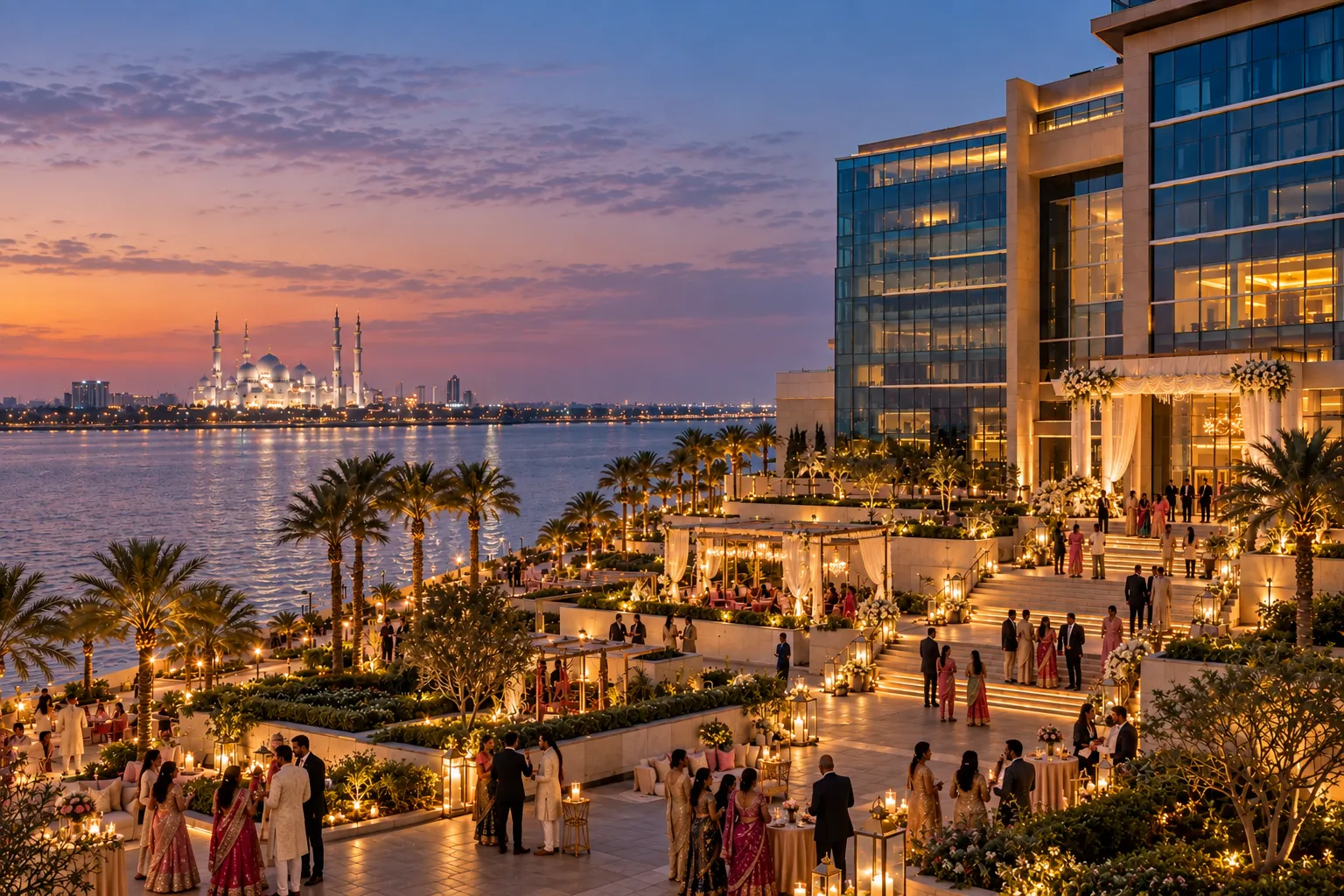

Planning a destination wedding in Abu Dhabi becomes a very different exercise when a couple is bringing a large family and several wedding functions together.
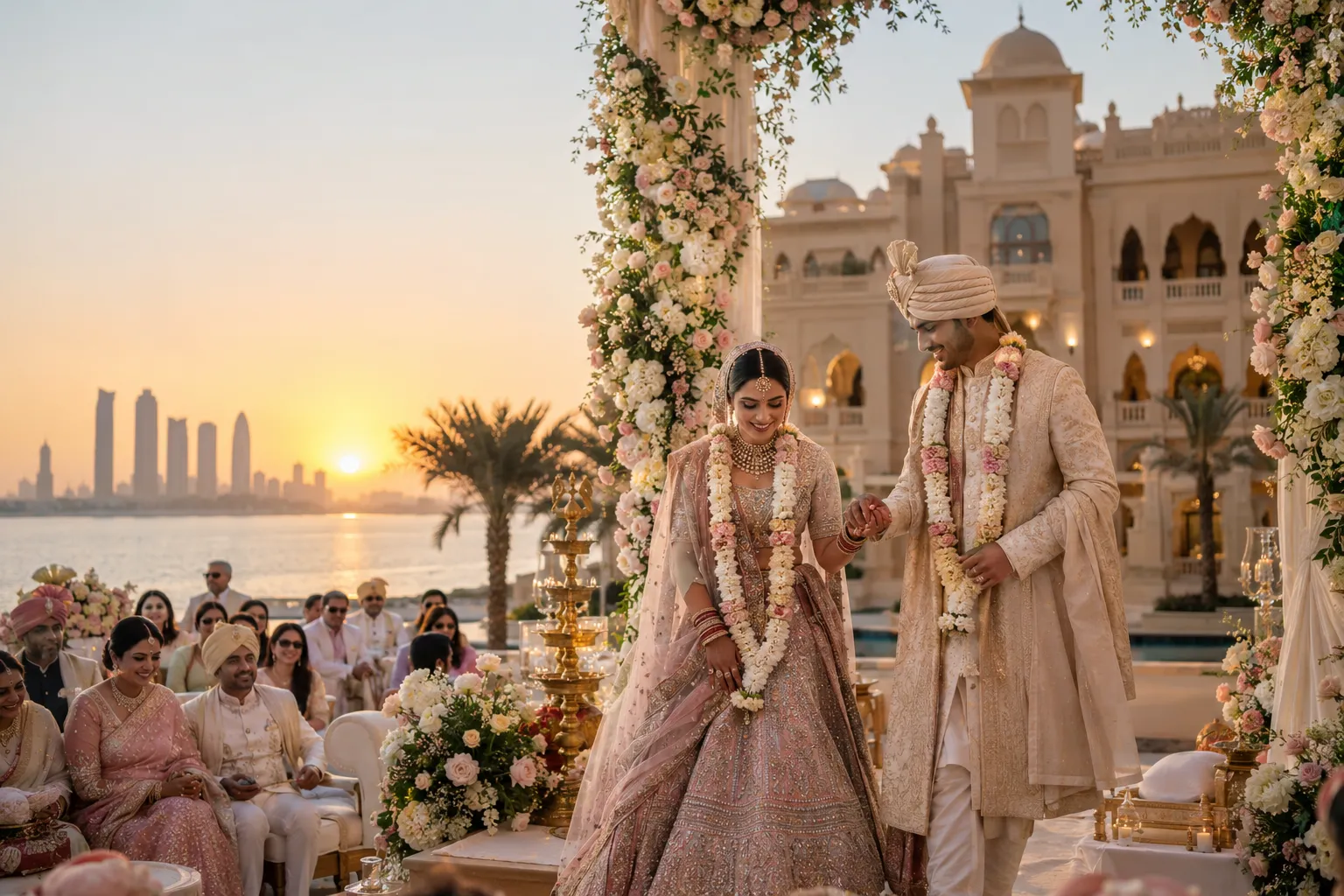
An Indian wedding may involve mehendi, haldi, sangeet, baraat, pheras, reception and multiple family gatherings. Instead of booking separate venues for every event, some couples may consider a full resort buyout, where the accommodation and wedding functions are planned around one private property.
This is not simply a luxury upgrade. It changes how guests move, how functions are scheduled, how much control the family has over the property and how the wedding feels as a destination experience. Abu Dhabi has several venue formats that make this concept particularly interesting, from large waterfront resorts to secluded desert properties and private-island settings.
What Does a Full Wedding Buyout Actually Change?
A normal hotel wedding involves sharing the property with other hotel guests.
A full buyout works differently. In practical terms, the wedding group occupies the property or a substantial portion of it for an agreed period, allowing accommodation, dining and several wedding functions to operate as one coordinated experience.
That distinction matters more for a multi-day Indian wedding than it might for a single ceremony.
Guests do not simply attend one event. They may spend three or more days together, moving between functions, meals and informal gatherings. Keeping those activities within one destination can reduce transfers and give the wedding a stronger sense of continuity.
Qasr Al Sarab Desert Resort by Anantara provides a real example. Its current full-buyout wedding offering is specifically designed around three days of wedding functions, including Sangeet, Baraat, Pheras and Mehendi. The offer is available for a minimum of 250 guests and is offered on a full-buyout basis.
That makes the concept particularly relevant to families planning several traditional functions rather than one standalone reception.
Why Desert Buyouts Are Different From City Weddings
A city hotel gives guests access to restaurants, shopping, museums and other attractions outside the property.
A desert resort creates almost the opposite experience.
Qasr Al Sarab is positioned as a secluded resort on the outskirts of Abu Dhabi, with 140 rooms, 14 suites and 53 pool villas, alongside desert activities and spa facilities. Its wedding offering includes dedicated event areas such as Camp Al Ara'a and the Liwa Ballroom.For a family buyout, that seclusion becomes part of the wedding itself.
Guests can wake up in the same destination where the day's functions take place. The wedding does not need to be treated as a collection of addresses around Abu Dhabi.
That can be particularly appealing for an Indian destination wedding, where family members may want to spend substantial amounts of time together between formal ceremonies.
But it also creates a clear trade-off.
The more secluded the property, the more important it becomes to plan the entire guest experience in advance. Guests have fewer reasons to leave, but they also have fewer independent alternatives if they do.
Five Functions Can Become One Continuous Experience
The strongest argument for a buyout is not privacy by itself. It is continuity. Imagine arriving on the first day and having a family welcome gathering that evening. The following day could include mehendi and informal social activities, followed by the sangeet. The next day could move into the baraat, pheras and reception.
The exact sequence depends on the couple, but the principle remains the same. Instead of repeatedly transporting several hundred guests between properties, the wedding team can design the itinerary around one physical environment.
Qasr Al Sarab's current full-buyout offer illustrates exactly this approach by combining five main functions over three days with accommodation for the wedding group, subject to availability. That is fundamentally different from simply renting a ballroom for one evening.The resort becomes the wedding's temporary home.
Waterfront Properties Can Offer the Same Logic Without the Desert
A buyout strategy does not have to mean going into the desert. Abu Dhabi's urban and waterfront hotels can also support multi-event weddings because some properties offer several indoor and outdoor event environments.
Rosewood Abu Dhabi, on Al Maryah Island, currently lists a 968-square-metre pillar-free Rosewood Ballroom, a 224-square-metre Yasmine Ballroom, additional event rooms and multiple outdoor spaces. Its published event information also describes two waterfront terraces and other outdoor settings.
That variety matters because different Indian wedding functions can need very different environments. The sangeet may require a large indoor production space. A welcome dinner may suit a more intimate room. A mehendi may work better in an outdoor setting. A reception may need a ballroom with enough room for dining, stage production and dancing.
The advantage of a multi-space hotel is that these functions can potentially happen within one property while still feeling visually and atmospherically different.
The Guest List Changes the Equation
A private buyout becomes more meaningful as the guest group grows, but size alone should not determine whether it makes sense. The nature of the guest list matters just as much.
A 250-person wedding made up largely of close family may have very different needs from a 250-person celebration where guests have come from multiple countries and barely know one another. With a concentrated resort stay, the wedding planner effectively becomes responsible for a temporary community.
That means thinking about breakfast, downtime, transportation within the property, meals, children's needs, accessibility, free time and activities, not just ceremonies. Qasr Al Sarab's published full-buyout package is an example of this broader approach. In addition to the wedding functions, it incorporates catering across the three-day programme and provides an experienced wedding planner, while guest accommodation is tied to the resort's availability.
That illustrates an important point: buying out a resort changes the planning brief from event management to hospitality management.
The Venue Contract Matters More Than the Photographs
A beautiful venue can sell the destination. The contract determines whether the destination can actually work for the wedding. Before committing to a buyout, couples should understand exactly what the agreement includes.
How many rooms are committed? Which event spaces are included? Which meals are part of the wedding programme? What happens if the number of guests changes? When can décor and production teams access the spaces? How much time is available to reset rooms between functions? Are outside vendors permitted? What are the restrictions on entertainment, lighting, fireworks or other installations? How are guest activities handled?
These questions become especially important when the resort is remote. At a city hotel, an unexpected vendor requirement can sometimes be solved by bringing in another supplier. At a secluded resort, the same problem may be considerably harder to fix at short notice.
Buyout Does Not Automatically Mean Legal Marriage
There is another distinction couples should understand. A resort wedding and a legally registered marriage are not necessarily the same thing.
Qasr Al Sarab's current wedding terms explicitly state that weddings at the resort are symbolic in nature, and that religious or legal weddings are not permitted in UAE hotels.
Abu Dhabi's legal civil-marriage process is handled through the Abu Dhabi Judicial Department Civil Family Court, rather than through the wedding resort. The ADJD states that eligible tourists can apply from outside the UAE, but must travel to Abu Dhabi to attend the civil marriage ceremony after completing the application and fee process. For international couples, that means the legal component and the destination celebration should be planned as separate pieces. The court ceremony can form the legal foundation, while the resort hosts the larger cultural and social celebration.
A Buyout Is About the Wedding Week, Not Just the Wedding Day
The biggest advantage of a private resort is often what happens between the major functions. Guests eat breakfast together. Families meet informally. Children have time to play. Relatives who travelled thousands of kilometres have opportunities to spend time together without constantly checking the next transfer.
This is particularly relevant to large Indian weddings, where the social value of the gathering can be as important as the formal ceremonies. Abu Dhabi's event infrastructure supports several distinct styles of celebration, from beachside resorts and urban hotels to desert and private-island environments. The official destination authority specifically highlights this diversity in its event infrastructure information. The question is therefore less about whether a buyout is inherently better. It is about whether concentration adds value to your particular wedding.
When Should Couples Consider It?
A private resort arrangement becomes particularly interesting when several things happen at the same time. The wedding has a large number of functions. A significant proportion of guests are travelling internationally. The family wants privacy. The couple wants guests to stay together. The event requires multiple venue environments.
And the wedding is intended to feel like a destination retreat rather than a single-night celebration. When those conditions are present, a buyout can potentially simplify the wedding architecture. When the guest list is smaller, guests are staying only briefly, or most functions are already concentrated in one city hotel, the additional complexity of a private buyout may not provide the same value.
Final Thought
A full resort buyout is easy to misunderstand as simply a more expensive version of a hotel wedding. It is actually a different planning model. You are not just booking a venue. You are temporarily creating a wedding environment where accommodation, meals, ceremonies, entertainment and guest interaction all happen within one connected setting.
For couples planning an Abu Dhabi destination wedding, that can be particularly powerful when the celebration includes several Indian wedding functions across multiple days. A desert resort such as Qasr Al Sarab demonstrates how deliberately this model can be structured, with an existing three-day South Asian wedding format covering Sangeet, Baraat, Pheras and Mehendi.
Waterfront properties demonstrate another version of the same idea, with multiple event spaces allowing different functions to have their own identity without sending the guest group to another hotel.The real question is therefore not whether a private resort sounds luxurious.
It is whether keeping the people, places and celebrations together makes the wedding simpler, more private and more meaningful. For some families, that may be the reason the entire wedding finally starts feeling like one destination experience instead of a collection of separate events.






















Sign in to leave a comment.