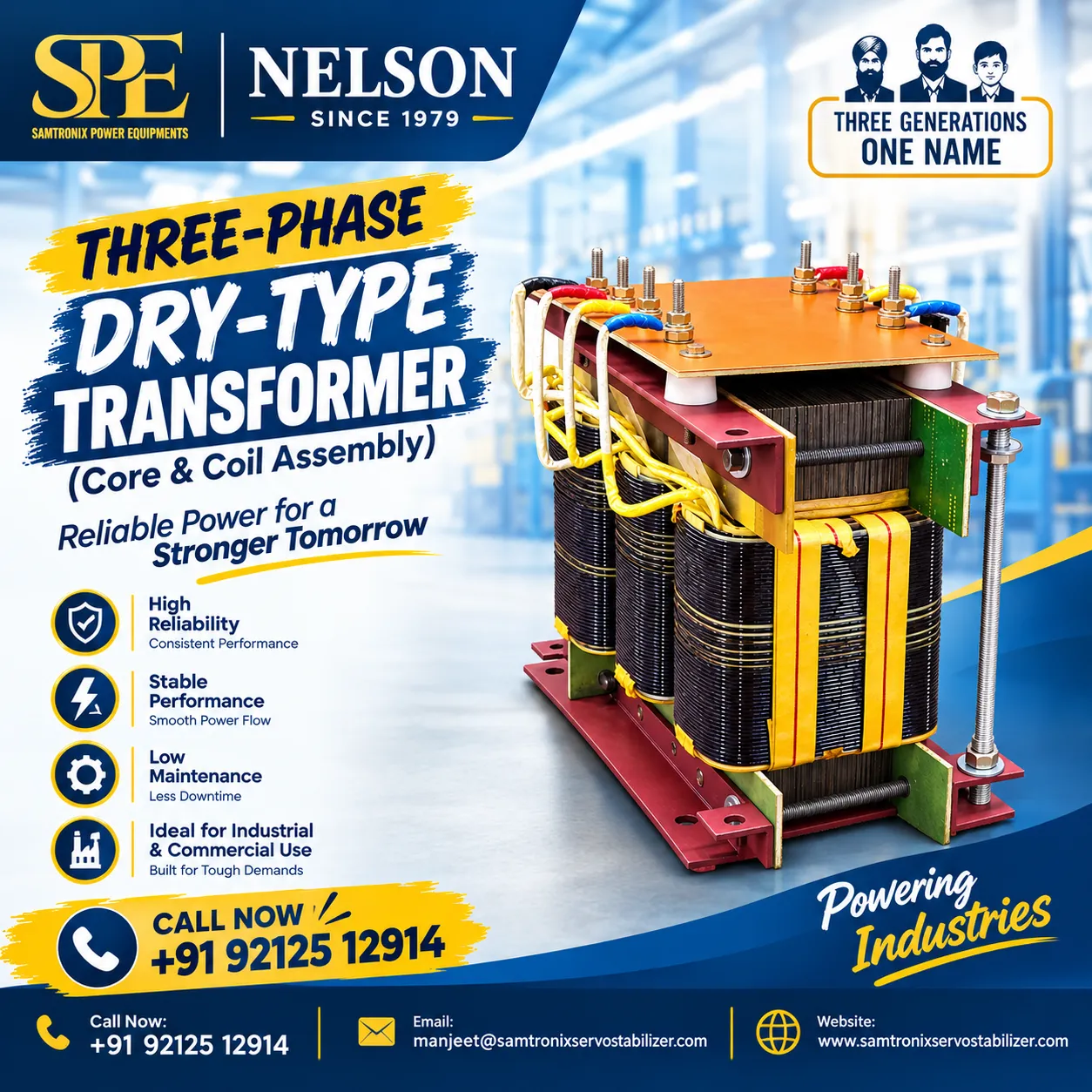

A transformer may look like a simple electrical unit from the outside, but inside it performs a carefully controlled process of transferring electrical energy from one voltage level to another.
In factories, workshops, commercial buildings and machinery installations, the transformer has to work reliably under the actual conditions of the electrical system. Load variation, heat, ventilation, electrical connections and installation environment can all affect its operation.
A three phase dry type transformer is designed for three-phase AC systems and uses air and solid insulation instead of transformer oil as the primary insulating medium.
Its construction brings together a magnetic core, windings, insulation, terminals and mechanical supports. These components work together to provide the required voltage transformation while maintaining electrical and mechanical stability.
For an industrial application, selecting the right transformer is therefore not simply about choosing a capacity. The complete electrical requirement needs to be understood.
What Is a Three Phase Dry Type Transformer?
A three phase dry type transformer is an electrical transformer used to transfer power between different voltage levels in a three-phase AC system.
The transfer takes place through electromagnetic induction.
When alternating voltage is applied to the primary winding, it produces a changing magnetic flux inside the core. This changing flux links with the secondary winding and induces voltage on the secondary side.
The primary and secondary windings do not directly transfer electrical energy through a physical electrical connection. Instead, the magnetic field created in the core transfers the energy between them.
A typical three phase dry type transformer contains:
- Magnetic core
- Primary winding
- Secondary winding
- Insulation system
- Terminals
- Clamping arrangement
- Mechanical support
- Cooling arrangement
Each component has a specific function. The core manages the magnetic path, the windings carry electrical energy, insulation separates electrical sections, and the supporting structure maintains the physical arrangement.
This is why the complete construction needs to be considered during transformer manufacturing.
The Core and Coil Assembly
The core and coil assembly can be considered the central working section of a three phase dry type transformer.
The core provides the path for magnetic flux, while the coils contain the windings required for voltage transformation.
The core is generally made using laminated magnetic material. The laminated construction helps control unwanted electrical losses.
However, the material is only one part of the process.
Core sections need to be assembled correctly and supported mechanically. Poor alignment, loose sections or unsuitable pressure can contribute to vibration, noise and unnecessary losses.
The coils are then arranged around the core according to the required electrical design.
Their position, insulation, conductor arrangement and mechanical support all influence how the transformer performs during operation.
The result is a complete core and coil assembly in which the magnetic and electrical sections work together.
How Does It Work?
The working principle is based on electromagnetic induction.
The process can be understood in a few simple steps:
- AC voltage enters the primary winding.
- The primary winding creates a changing magnetic field.
- Magnetic flux travels through the core.
- The changing flux links with the secondary winding.
- Voltage is induced in the secondary winding.
- The output voltage depends on the winding arrangement and number of turns.
The main components can be understood as follows:
| Component | Function |
|---|---|
| Magnetic core | Provides the magnetic path |
| Primary winding | Receives the input supply |
| Secondary winding | Provides the transformed voltage |
| Insulation | Separates electrical sections |
| Terminals | Connect the transformer to the electrical system |
| Clamping structure | Provides mechanical support |
| Cooling arrangement | Helps manage operating heat |
In a three-phase system, all three phases must be correctly designed and connected.
This is particularly important in industrial applications where motors, drives, machinery and control systems may operate continuously.
Why Does Core Design Matter?
The core controls the magnetic path inside the transformer.
Its construction can influence several operating characteristics, including:
- Core losses
- Temperature rise
- Vibration
- Noise
- Overall efficiency
The core sections therefore need proper dimensions and accurate assembly.
A loose or poorly supported core can create vibration during operation. Continuous vibration can contribute to mechanical stress and unwanted noise.
For industrial applications, the core should therefore be manufactured and assembled with suitable mechanical support and controlled construction.
Samtronix Power Equipments focuses on the core and coil assembly as a complete engineered unit for practical transformer applications.
Coil Winding: More Than Just Turns
The winding is another major part of the transformer.
At first glance, winding may appear to be simply wrapping a conductor around the core. In practice, the winding arrangement needs to satisfy several electrical and mechanical requirements.
Important factors include:
- Conductor selection
- Number of turns
- Insulation
- Winding arrangement
- Spacing
- Mechanical strength
- Heat dissipation
The winding also needs to remain mechanically stable during abnormal electrical conditions, when electromagnetic forces can increase.
Heat is another consideration. Current flowing through the conductors produces heat, so the winding arrangement should support effective heat transfer.
A properly designed winding contributes to consistent transformer performance during normal operation.
What Makes It a Dry Type Transformer?
The defining feature is the absence of transformer oil as the primary insulating medium.
A three phase dry type transformer uses solid insulation and air-based heat dissipation instead of relying on liquid insulation.
This construction can be suitable for industrial and commercial locations where dry construction is preferred.
But “dry type” does not mean “maintenance-free.”
The transformer still needs:
- Adequate ventilation
- Suitable electrical clearances
- Regular inspection
- Cleaning
- Correct protection
- Sufficient installation space
The environment is also important.
A transformer operating in a clean electrical room may experience very different conditions from one installed inside a dusty manufacturing facility.
Where Is a Three Phase Dry Type Transformer Used?
Three-phase dry type transformers can be integrated into different electrical systems where voltage transformation is required.
| Application Area | Typical Requirement |
|---|---|
| Manufacturing plants | Power distribution for production equipment |
| Industrial machinery | Required supply voltage |
| Workshops | Motors and heavy electrical loads |
| Commercial buildings | Internal power distribution |
| Automation facilities | Electrical supply for equipment |
| Control systems | Voltage transformation |
| Electrical panels | Distribution-side conversion |
| Infrastructure projects | Project-specific electrical distribution |
The transformer should be selected according to the actual application.
For example, a transformer installed close to production machinery may experience more heat, dust and changing loads than a unit installed inside a controlled electrical room.
The installation environment should therefore be considered before finalising the transformer.
Heat Management: An Important Consideration
Heat is naturally produced when a transformer operates.
The windings generate heat because of electrical resistance, while the magnetic core also produces losses during operation.
A dry type transformer relies on its construction and surrounding air to dissipate this heat.
If airflow is restricted, the operating temperature can increase.
This is why sufficient clearance around the transformer is important. Walls, machinery and stored materials should not unnecessarily block the available airflow.
The electrical area should also be kept reasonably clean.
Dust accumulation can affect heat dissipation and contaminate insulation surfaces, particularly in industrial environments.
Regular inspection can help identify these conditions before they develop into larger operating problems.
Common Problems and What to Check
When a transformer starts behaving differently, the cause may not always be inside the transformer.
The electrical load, ventilation, connections and installation environment should also be checked.
| Problem | Possible Area to Check |
|---|---|
| Excessive heating | Load and ventilation |
| Unusual noise | Core and mechanical mounting |
| Output voltage issue | Supply and connections |
| Repeated tripping | Protection and connected load |
| Dust accumulation | Installation environment |
| Loose connection | Terminals |
| Phase imbalance | Phase currents and load distribution |
These checks should be carried out by qualified electrical personnel.
A transformer should never be opened or worked on while energised.
How to Select the Right Transformer
The selection of a three phase dry type transformer should start with the actual electrical requirement.
Before finalising the transformer, important details should be identified:
- Input voltage
- Output voltage
- Frequency
- Required capacity
- Connected load
- Load pattern
- Installation location
- Ambient conditions
- Available space
- Protection requirements
Industrial loads are not always constant.
Motors can create starting conditions, machinery can switch frequently, and production requirements can change the electrical demand during the day.
A proper load assessment therefore provides a better starting point than selecting transformer capacity only from the size of the machinery.
Samtronix Power Equipments can assist with application-focused transformer requirements by considering the electrical system, core and coil configuration and installation conditions.
Installation: Getting the Basics Right
A well-manufactured transformer still needs proper installation.
The installation area should have sufficient ventilation, working space and electrical clearance.
The foundation or mounting arrangement should be suitable for the transformer's weight and mechanical structure.
Cable routing also matters. Incorrectly supported cables can place unnecessary mechanical stress on transformer terminals.
Before energising the transformer, qualified technicians should verify:
- Electrical connections
- Insulation condition
- Grounding
- Protection system
- Terminal connections
- Installation requirements
Correct installation helps create suitable conditions for reliable operation.
Maintenance of a Three Phase Dry Type Transformer
Dry construction can simplify certain maintenance requirements, but regular inspection is still important.
Maintenance should include checking:
- Physical condition
- Electrical connections
- Insulation
- Operating temperature
- Dust accumulation
- Mechanical supports
The inspection frequency should depend on the operating environment.
A transformer installed in a clean electrical room may require a different maintenance schedule from one operating in a dusty manufacturing facility.
Changes such as unusual noise, increasing temperature or loose connections should not be ignored.
These can be early signs that further inspection is required.
Technical Details Required Before Manufacturing
Before manufacturing a three phase dry type transformer, complete technical information should be provided.
| Technical Requirement | Why It Matters |
|---|---|
| Input voltage | Primary-side design |
| Output voltage | Secondary-side design |
| Capacity | Power-handling requirement |
| Frequency | Operating design |
| Phase | Three-phase configuration |
| Installation location | Cooling and enclosure requirements |
| Load type | Operating conditions |
| Ambient conditions | Thermal design |
| Connection requirement | Winding and terminal arrangement |
| Protection requirement | System protection |
Providing complete information at the beginning can make the manufacturing process more precise and reduce confusion during installation.
Samtronix Power Equipments for Industrial Transformer Requirements
Samtronix Power Equipments develops electrical equipment solutions with attention to practical industrial applications, including transformer core and coil assembly and application-focused requirements.
Businesses searching for a three phase dry type transformer manufacturer, dry transformer manufacturer, industrial transformer manufacturer or transformer supplier in India should first discuss their actual electrical requirement.
The transformer should be developed around the available electrical supply, expected load, installation environment and operating conditions.
Samtronix Power Equipments can assist customers looking for a three phase dry type transformer for industrial and commercial electrical systems.
The external appearance of the transformer is only one part of the complete equipment. The core, windings, insulation, mechanical structure and electrical connections all contribute to its operation.
Short Google Search Keywords
| Keyword | Search Intent |
|---|---|
| dry type transformer | Product search |
| 3 phase transformer | Product search |
| dry transformer | General product search |
| transformer manufacturer | Manufacturer search |
| transformer supplier | Supplier search |
| industrial transformer | Industrial requirement |
| dry type transformer India | Local manufacturer search |
| 3 phase transformer India | Local product search |
| transformer manufacturer India | Manufacturer search |
| dry transformer manufacturer | Manufacturer search |
| transformer core coil | Technical search |
| industrial transformer India | Industrial search |
| transformer for industry | Application search |
These keywords can be used naturally across website pages, product content, service pages and enquiry-focused campaigns.
FAQs About Three Phase Dry Type Transformer
1. Why does a dry transformer overheat?
Check the load and airflow.
2. Can dust affect the transformer?
Yes, it can affect cooling and insulation.
3. Why is the transformer making noise?
Check the core and mechanical supports.
4. Does it require ventilation?
Yes, proper airflow is important.
5. How is transformer capacity selected?
It starts with the actual electrical load.
6. Why is the output voltage unstable?
Check the supply, connections and load.
7. What details are needed for selection?
Voltage, capacity, frequency, load and installation conditions.

























Sign in to leave a comment.