
Ask any parent who has navigated traditional lazy eye treatment, and you will hear a nearly identical story of frustration. Daily routines quickly descend into tears before school, sticky adhesive patches torn off on the playground, and exhausting negotiations that strain family harmony. For young children, having their good eye covered can cause disorientation, visual confusion, and painful social self-consciousness among peers.
For decades, families endured this emotional battle because medical dogma claimed that physical occlusion was the only viable pathway to improve a weaker eye. Parents carried the immense guilt of missed patching hours, worrying that every skipped session compromised their child's visual future. Fortunately, modern pediatric optometry has entered a compassionate, highly effective era of amblyopia treatment, with newer approaches that may offer alternatives to traditional patching depending on a child's specific visual needs.
The Science of Play: Why Games Drive Neural Adaptation
Children learn, explore, and develop new cognitive abilities through active play. When sensory therapy is structured as an interactive game rather than a restrictive physical barrier, compliance skyrockets and emotional resistance disappears.
However, moving toward gamified amblyopia treatment is grounded in deep neurobiological science rather than entertainment alone. When a child plays an engaging video game, the brain releases neurotransmitters such as dopamine and acetylcholine. These neurochemicals heighten cortical arousal, promote synaptic plasticity, and accelerate the formation of new neural connections in the visual cortex.
By combining active cognitive engagement with precise dichoptic stimulation, interactive video games stimulate visual recovery far more efficiently than passive patching ever could. Children eagerly participate in their daily visual sessions, turning what used to be a frustrating struggle into a rewarding family milestone.
The Neurological Flaw in Traditional Patching
To understand why gamified therapy represents such a profound leap forward, it helps to examine the core limitation of monocular occlusion. Traditional patching operates on an outdated model: it assumes that forcing the weaker eye to work in isolation will permanently correct the visual deficit.
While patching can improve basic letter-chart clarity in the amblyopic eye under forced conditions, it fails to teach the two eyes how to work together as a synchronized team. The moment the adhesive patch is removed, the visual cortex frequently returns to its established habit of suppressing the non-dominant eye. Consequently, clinical studies demonstrate that up to a quarter of patched children experience visual regression after treatment ends.
Furthermore, patching never stimulates true binocular depth perception. A child may learn to read smaller letters with their weaker eye, yet they still navigate the physical world without stereoscopic three-dimensional sight, leaving them vulnerable to clumsiness, poor spatial coordination, and sports difficulties.
How Dichoptic Video Games Retrain Both Eyes
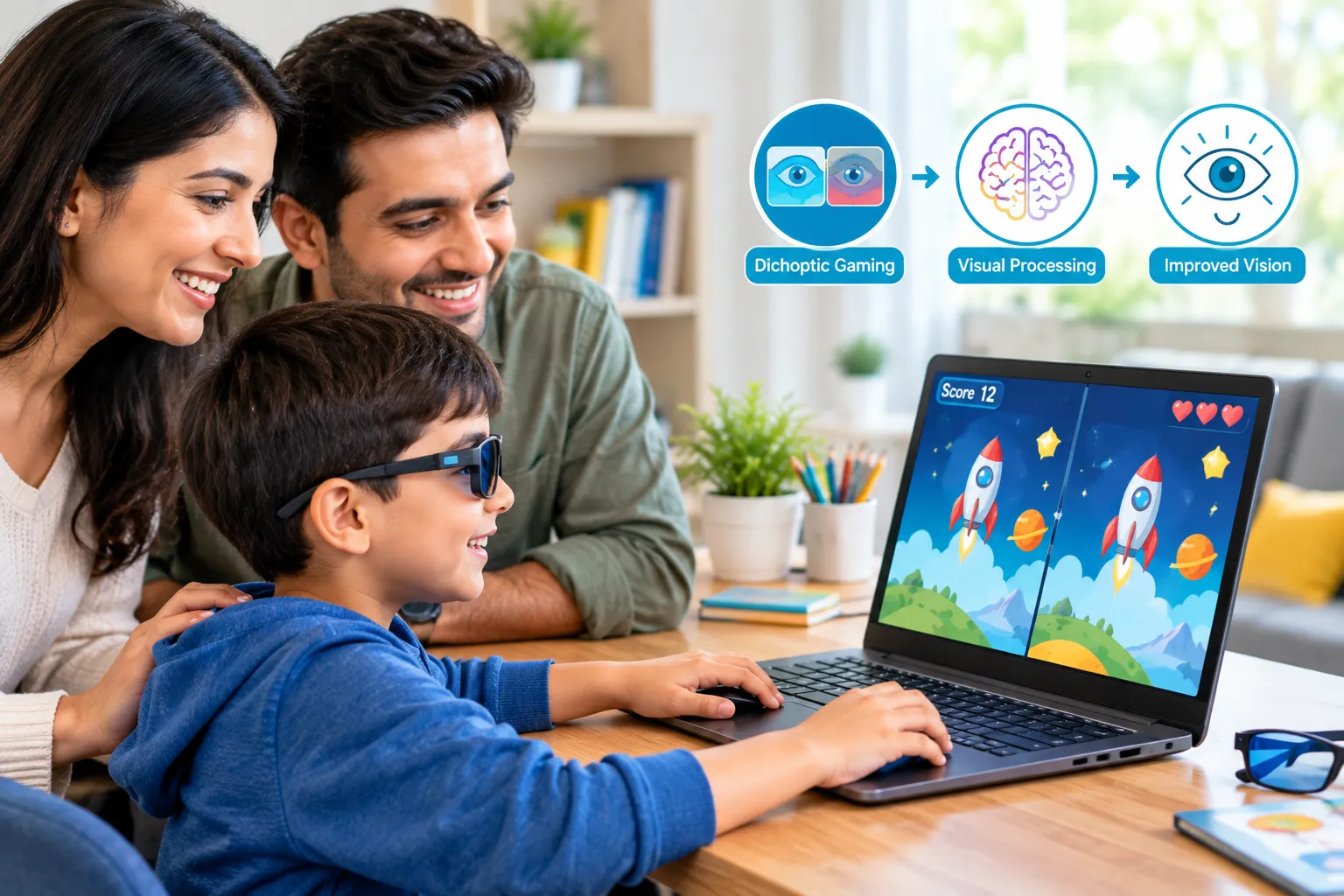
Modern software platforms overcome these limitations by utilizing the proven dichoptic principle. In a dichoptic video game, both eyes participate simultaneously, but each eye sees distinct, complementary graphic elements on the screen through specialized glasses.
In a space-themed game, for example, the dominant eye might see stationary obstacles rendered in lower contrast, while the amblyopic eye sees moving target spacecraft rendered in high contrast. To successfully navigate the game and score points, the child's visual cortex must combine the visual signals from both eyes in real time. Through this playful challenge, modern amblyopia treatment actively dismantles cortical suppression, encouraging the brain to embrace inputs from both eyes simultaneously.
Because the software continuously monitors gameplay accuracy and response times, algorithms automatically adapt contrast levels as the child's visual abilities improve. The child enjoys an exciting gaming experience, while the visual system undergoes sophisticated, clinically supervised neurological retraining.
Clinical Comparison: Traditional Eye Patching vs. Interactive Gamified Therapy
Understanding the clinical and practical differences between traditional patching and modern interactive gaming therapy helps parents make the best choice for their child:
Core Treatment Modality: Traditional patching forces monocular acuity through sensory deprivation of the healthy eye. Interactive gaming therapy trains binocular cortical integration with both eyes actively open.
Patient Compliance and Experience: Patching frequently causes skin tears, tears, and social stigma. Interactive games turn therapy into a fun, twenty-minute daily session that children willingly complete.
Depth Perception and Stereopsis: Monocular patching does not stimulate binocular depth perception. Interactive therapy actively trains the visual cortex to combine images, restoring genuine 3D stereopsis.
Durability and Regression Risk: Patching carries higher regression rates because cortical suppression is left unaddressed. Gamified dichoptic retraining rewires binocular neural networks for permanent functional stability.
Clinical Monitoring and Oversight: Patching relies on parental guesswork and compliance logs. Cloud-based gaming software provides objective, real-time performance tracking for ophthalmologists and optometrists.
Restoring Childhood Confidence and Daily Coordination
The benefits of interactive gaming therapy extend far beyond the eye doctor's testing chart. When children regain balanced binocular vision, their physical confidence and academic performance transform dramatically.
Parents frequently notice that their children become significantly more coordinated in sports, catch balls with ease, descend staircases confidently, and experience less fatigue when reading classroom books. Most importantly, eliminating the daily patching battle restores peace and happiness to family life, allowing children to focus on growing, learning, and playing with total visual freedom.
Conclusion
Helping your child achieve clear, healthy vision should never feel like an exhausting daily punishment. By embracing modern, gamified visual therapies, families can leave adhesive patches in the past and look forward to a joyful, scientifically proven path toward balanced sight. Discover the power of interactive vision therapy today and watch your child thrive with renewed clarity and confidence.
Frequently Asked Questions
At what age can a child begin using interactive vision therapy games?
Children as young as four or five years old who can comfortably engage with simple laptop games and wear lightweight glasses can successfully participate in therapy.
How much time each day does a child need to play the therapy games?
Most interactive digital programs require only twenty to thirty minutes per day, four to five days per week, under the supervision of an eye care specialist.
Can gamified therapy help older children and teenagers who previously failed patching?
Yes. Because interactive software harnesses neuroplasticity rather than simple occlusion, older children and teens frequently achieve outstanding visual recovery.
Do children need to wear an eye patch while playing the video games?
No. Both eyes remain completely open during gameplay, wearing specialized polarized or color-filtered glasses that present tailored visual stimuli to each eye.
How do eye care specialists track progress during at-home gaming sessions?
The cloud-based software records gameplay performance, contrast thresholds, and visual response times, allowing clinicians to review objective recovery data remotely.























Sign in to leave a comment.