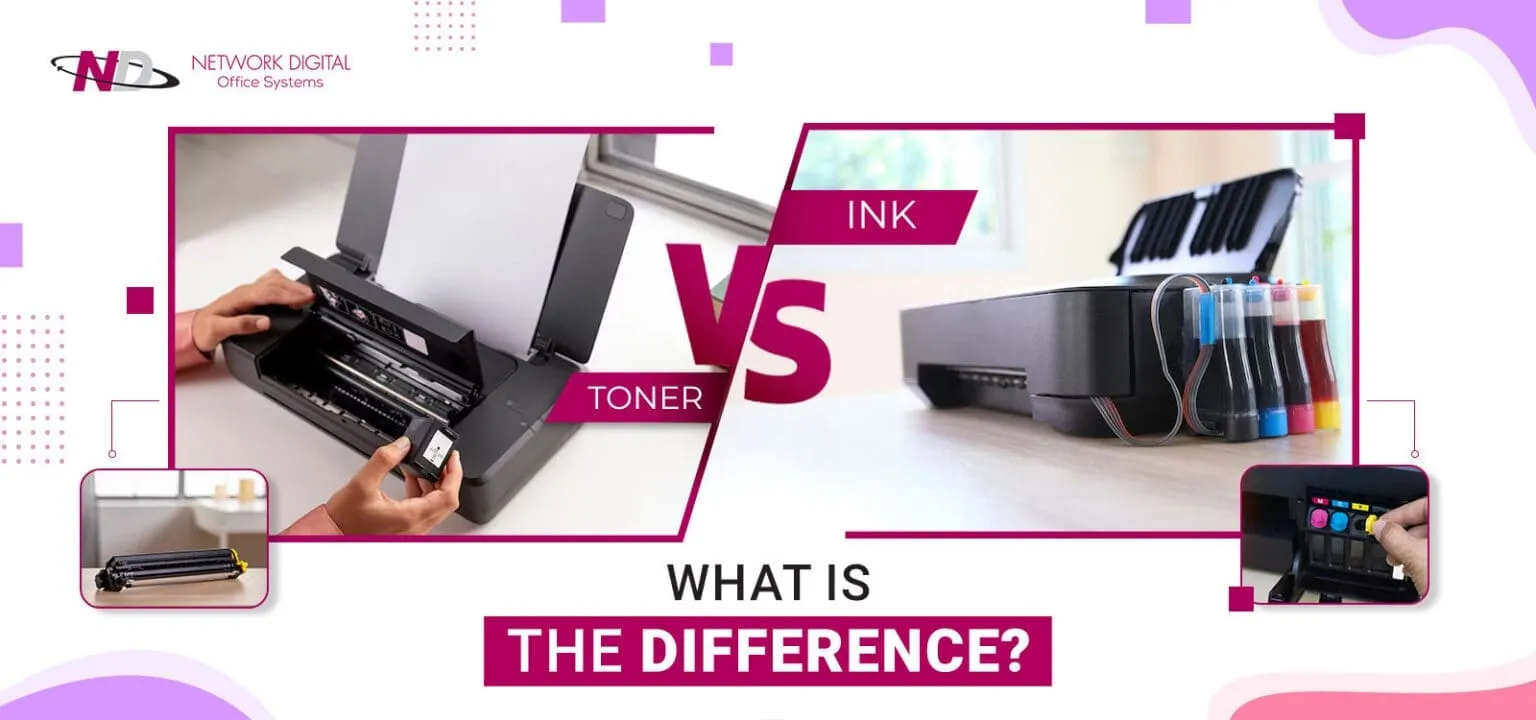

When choosing a printer for your home or business, one of the most important decisions is whether to use an inkjet printer with ink cartridges or a laser printer with toner cartridges.
While both technologies produce printed documents, they work in very different ways and are designed for different printing needs.
Understanding the difference between toner and ink can help you choose the right printer, reduce printing costs, and avoid buying equipment that does not match your everyday workload.
What Is Printer Ink?
Printer ink is a liquid used by inkjet printers. An inkjet printer uses tiny nozzles to spray microscopic droplets of liquid ink onto paper to create text, images, and graphics.
Inkjet printers are particularly useful for printing:
- Photos
- Color images
- Marketing materials
- Graphics and illustrations
- School and home documents
- Occasional color documents
One of the biggest advantages of ink is its ability to produce detailed colors and smooth transitions. This makes inkjet printers a popular option for users who regularly print photographs or other image-heavy materials.
However, ink cartridges can dry out when a printer remains unused for an extended period. Inkjet printers may also require more frequent cartridge replacement when used for larger print volumes.
What Is Printer Toner?
Toner is a fine powder used by laser printers and some multifunction printers. Unlike liquid ink, toner is transferred to the page and fused to the paper using heat.
Toner is designed for fast and efficient printing, making it well suited for businesses and other environments that print large quantities of documents.
Toner is commonly used for:
- Business documents
- Reports
- Invoices
- Contracts
- Forms
- Spreadsheets
- Black-and-white documents
- High-volume office printing
Toner cartridges generally have a higher upfront price than many ink cartridges, but they can produce a large number of pages. For organizations with consistent printing needs, the cost per page can therefore be an important consideration.
Toner vs. Ink: What Is the Difference?
The main difference between toner and ink is the material they use and the way they print.
| Feature | Ink | Toner |
|---|---|---|
| Material | Liquid | Fine powder |
| Printer Type | Inkjet | Laser |
| Best For | Photos and detailed color | Text and high-volume documents |
| Print Speed | Generally slower | Generally faster |
| Cartridge Yield | Generally lower | Generally higher |
| Drying | Can dry out when unused | Does not dry out like liquid ink |
| Initial Cartridge Cost | Often lower | Often higher |
| High-Volume Printing | Less suitable for many workloads | Well suited |
The right option depends on what you print, how frequently you print, and how much you are willing to spend over the life of the printer.
Which Is Cheaper: Toner or Ink?
Looking only at the price of a cartridge can be misleading.
Ink cartridges may have a lower purchase price, but they can require more frequent replacement depending on your printing volume. Toner cartridges can cost more initially while producing significantly more pages.
For this reason, businesses should consider cost per page rather than simply comparing cartridge prices.
When evaluating a printer, consider:
- Cartridge or toner price
- Expected page yield
- Average monthly print volume
- Black-and-white versus color printing
- Printer maintenance requirements
- Replacement frequency
- Total cost of ownership
For a business that prints hundreds or thousands of pages regularly, a laser printer and toner-based system may make more sense. For a home user who prints occasionally, an inkjet printer may provide the features needed without requiring a larger initial investment.
Which Provides Better Print Quality?
There is no single answer because print quality depends on what you are printing.
Ink Is Often Better for Photos and Detailed Images
Inkjet printers are well suited to photographs, illustrations, and other graphics that require detailed color reproduction. Liquid ink can create smooth color transitions and detailed images.
If your primary printing needs include:
- Family photos
- Professional photography
- Artwork
- Detailed graphics
- Color-heavy creative projects
an inkjet printer may be a suitable choice.
Toner Is Well Suited to Text Documents
Laser printers are designed for fast, consistent document printing. Toner can produce sharp text and is particularly useful for business documents.
Toner-based printers are commonly used for:
- Contracts
- Reports
- Invoices
- Business correspondence
- Forms
- Internal documents
- Spreadsheets
For offices where most printing consists of text and business documents, laser printing can provide the speed and consistency required for everyday work.
Toner vs. Ink for Home Use
Home printing needs vary considerably.
If you print occasionally and need to print photos, school projects, recipes, or colorful documents, an inkjet printer may be a practical option.
If your home printing primarily consists of forms, documents, homework, or other text-heavy materials, a laser printer may be worth considering.
The important thing is to think about your actual printing habits instead of choosing a printer based only on its purchase price.
Toner vs. Ink for Office Use
Businesses typically have different printing requirements than individual home users.
A busy office may need to print documents throughout the day across multiple employees. In this environment, printer speed, cartridge yield, reliability, and cost per page become increasingly important.
Laser printers can be a strong option for offices that need:
- Fast document printing
- High-volume output
- Consistent text quality
- Lower printing costs over time
- Fewer cartridge replacements
Businesses with significant printing requirements may also benefit from managed print services, which can help organizations monitor usage, manage supplies, and select equipment based on their actual printing needs.
Can You Use Toner in an Inkjet Printer?
No. Toner and ink cartridges are designed for different printer technologies and are not interchangeable.
An inkjet printer requires the appropriate ink cartridges, while a laser printer requires compatible toner cartridges.
Using the wrong cartridge can prevent the printer from operating correctly and may cause damage. Always check your printer model before purchasing replacement ink or toner.
How Long Does Toner Last Compared With Ink?
Toner and ink have different storage and usage characteristics.
Liquid ink can dry out when cartridges are left unused for extended periods. This can be a concern for people who only print occasionally.
Toner is a dry powder, so it does not dry out in the same way as liquid ink. This makes toner-based systems particularly useful for offices that need reliable printing after periods of limited use.
Actual cartridge life depends on factors such as printer model, page coverage, document type, and how frequently the printer is used.
Which Should You Choose: Toner or Ink?
The best choice depends on your printing requirements.
Choose ink if you:
- Print photographs regularly
- Need detailed color images
- Have relatively light printing needs
- Use your printer primarily at home
- Need strong color and image reproduction
Choose toner if you:
- Print large quantities of documents
- Need fast printing
- Primarily print text and business documents
- Want high cartridge page yields
- Operate a busy office or shared printing environment
There is no universal solution. The right printer is the one that matches your print volume, document types, budget, and workflow.
How to Reduce Your Printing Costs
Choosing the correct printing technology is only one part of controlling printing expenses. You can also reduce costs by monitoring how your organization uses its printers.
Consider:
- Track your monthly print volume
Understanding how much you actually print makes it easier to select the right equipment. - Compare cost per page
Look beyond the purchase price of cartridges and consider their expected page yield. - Choose equipment based on workload
A printer designed for occasional home printing may not be appropriate for a busy office. - Use the correct supplies
Always select compatible ink or toner for your specific printer model. - Consider print management
Businesses with multiple printers may benefit from professional print management solutions that help control equipment, supplies, and printing costs.
Get the Right Printing Solution for Your Needs
The difference between toner and ink comes down to more than liquid versus powder. Each technology is designed to serve different printing requirements.
Inkjet printers can be an excellent option for photos, graphics, and lighter printing needs, while laser printers and toner are often better suited to fast, high-volume document printing.
For businesses, choosing the right printer can have a meaningful impact on productivity and long-term printing expenses. Network Digital can help businesses evaluate their printing requirements and identify printer, copier, toner, and print management solutions that fit their workflow.
Whether you need equipment for a small office or a high-volume business environment, choosing the right printing technology starts with understanding how you actually print.
Contact Network Digital to discuss your office printing and document management needs.
























Sign in to leave a comment.