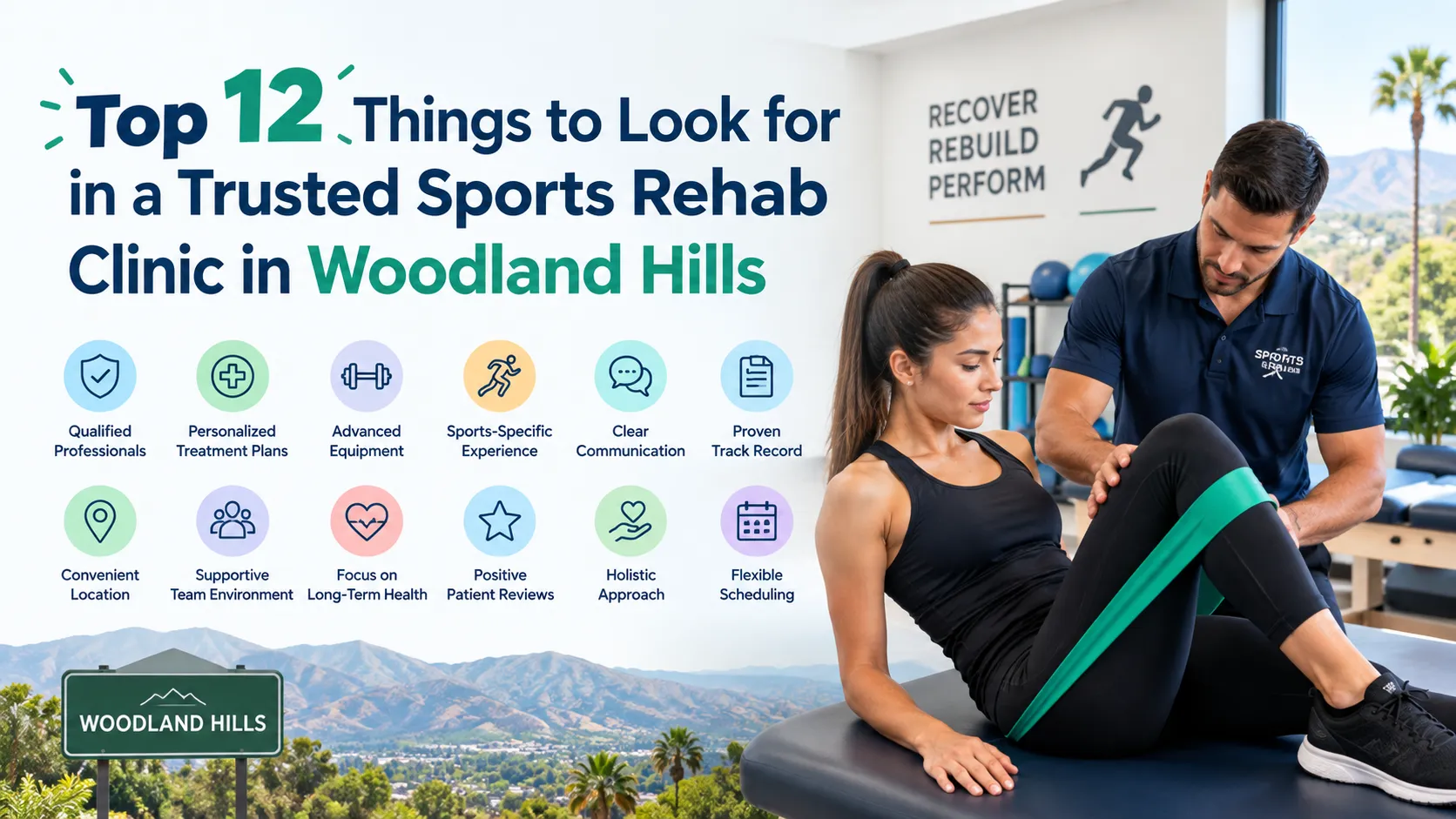


Choosing the right rehabilitation provider can make a meaningful difference after a sports injury. A trusted clinic should offer more than basic exercises; it should understand how your injury affects movement, performance, confidence, and daily activities. Quality sports injury rehabilitation in Woodland Hills should be based on an individual assessment rather than a routine program used for everyone. Whether you are recovering from a sprain, muscle strain, ligament injury, or surgery, the right team should explain each stage clearly. Before starting treatment, consider the clinic’s experience, assessment process, communication, exercise selection, progress tracking, and approach to helping you return safely to the activities you value most.
1. Look for a Thorough Initial Assessment
A strong rehabilitation program begins with understanding the problem. A qualified therapist should evaluate more than the location of your pain.
The assessment may include:
- Joint mobility and flexibility
- Muscle strength and endurance
- Balance and coordination
- Walking, running, or sport-specific movement
- Previous injuries and treatment history
- Activities that increase or reduce symptoms
This information helps establish a practical starting point. It also allows the therapist to identify movement limitations that may not be obvious during everyday activities.
2. Check for Individualized Treatment Plans
Two athletes can have similar injuries but require very different rehabilitation strategies. Age, training level, previous injuries, physical demands, goals, and recovery progress all influence treatment.
A personalized plan should explain what you are working toward and why particular exercises have been selected. The program may be adjusted as strength, mobility, control, and confidence improve.
Avoid clinics that promise the same recovery process for every patient. Rehabilitation should evolve rather than remain fixed from the first appointment to the last.
3. Consider Sports-Specific Experience

Returning to normal walking is not necessarily the same as returning to competitive sports. A runner, tennis player, basketball athlete, and recreational cyclist place different demands on the body.
When evaluating a sports rehab clinic in Woodland Hills, ask whether the rehabilitation process can address the movements and physical requirements associated with your activity.
Sport-specific rehabilitation may eventually include:
- Acceleration and deceleration
- Direction changes
- Jumping and landing
- Rotational movements
- Agility drills
- Gradual increases in training load
The goal is not simply to make symptoms disappear. Functional capacity should also be rebuilt.
4. Evaluate the Clinic's Approach to Injury Prevention
Effective rehabilitation should consider what happens after the current injury improves. If contributing movement or strength issues are ignored, an athlete may remain vulnerable to another problem.
A good injury prevention physical therapy in Woodland Hills program can examine factors such as muscle imbalances, poor movement control, limited mobility, training errors, and insufficient recovery.
Prevention strategies can include strengthening weaker areas, improving movement mechanics, teaching proper warm-up techniques, and introducing exercises that match an athlete's activities.
5. Ask How Progress Is Measured
Recovery should not depend entirely on whether you say that you feel better. Pain is important, but it is only one part of the picture.
A quality clinic may use measurable indicators such as:
- Range-of-motion changes
- Strength improvements
- Balance performance
- Functional movement tests
- Exercise tolerance
- Sport-specific drills
Regular reassessment helps determine whether the current program is working. If progress slows, treatment can be modified instead of continuing with an ineffective approach.
6. Look for Clear Communication
Good communication is an essential part of rehabilitation. You should understand what your therapist is doing, what you can safely do at home, and which activities should temporarily be limited.
A trustworthy provider should be willing to answer questions without making the process unnecessarily complicated. Instructions should be practical and realistic.
You should also know what changes deserve attention. For example, a sudden increase in swelling, significant loss of function, or worsening symptoms may require reassessment rather than simply adding more exercises.
7. Examine the Exercise Progression
Exercises should generally become more challenging as your physical capacity improves. However, progression needs to be appropriate for your condition.
Early rehabilitation might focus on restoring comfortable movement and basic muscle activation. Later stages can emphasize strength, endurance, coordination, power, and sport-specific performance.
This gradual approach is particularly important after ligament injuries, fractures, tendon problems, and surgery. Progression should be based on demonstrated ability rather than an arbitrary timeline alone.
8. Make Sure Home Exercises Are Practical
Rehabilitation does not end when you leave the clinic. A well-designed home program can help reinforce the work performed during appointments.
The best programs are usually realistic enough to fit into your routine. Exercises should come with clear instructions regarding technique, repetitions, frequency, and progression when appropriate.
If an exercise consistently causes unexpected or increasing symptoms, communication with the treating professional is important. Simply doing more repetitions is not always the answer.
9. Consider the Clinic's Return-to-Sport Strategy
One of the most important questions for an athlete is, "When can I safely return?"
A responsible therapist should avoid guaranteeing a specific recovery date without considering the individual circumstances. Instead, return-to-sport decisions can be guided by functional performance, strength, movement quality, symptom response, and readiness for increasing physical demands.
For athletes participating in high-intensity activities, sports physical therapy in Woodland Hills should ideally include a progression from controlled exercises toward movements that resemble real sporting situations.
Returning gradually can help the athlete regain confidence while allowing physical capacity to catch up with expectations.
10. Check Whether Treatment Addresses the Whole Athlete
A sports injury can affect more than one body part. For example, reduced ankle mobility can alter lower-limb mechanics, while weakness around the hip may influence how an athlete lands or changes direction.
A broader evaluation can reveal contributing factors outside the painful area.
A comprehensive approach may consider:
- Strength throughout the kinetic chain
- Mobility restrictions
- Balance and proprioception
- Movement patterns
- Training volume
- Recovery habits
- Previous injury history
This wider perspective can make rehabilitation more purposeful and reduce the risk of overlooking an important contributor.
11. Pay Attention to the Clinic Environment
The physical environment can influence how comfortable and engaged you feel during rehabilitation. Look for a setting where equipment is appropriate for your goals and where exercises can be performed safely.
Organization and cleanliness also matter. Staff should communicate professionally, appointments should be handled efficiently, and treatment areas should allow patients to focus on their exercises.
Most importantly, you should feel that your concerns are taken seriously. A positive therapeutic relationship can encourage consistency throughout a rehabilitation program.
12. Choose a Clinic That Focuses on Long-Term Function
The final stage of rehabilitation should not simply be about ending appointments. Ideally, you should leave with a better understanding of how to maintain your strength, mobility, and physical capacity.
A well-planned sports injury rehabilitation in Woodland Hills program should gradually prepare you for the demands you expect to face after treatment. Depending on the injury and activity, that may mean returning to work, recreational exercise, competitive sport, or normal daily movement.
Long-term success is supported when patients understand how to continue strengthening, manage training loads, recognize warning signs, and maintain healthy movement habits.
Questions to Ask Before Starting Sports Rehabilitation
Before selecting a clinic, consider asking:
- How will my condition be assessed?
- How will my treatment plan be customized?
- How will you measure my progress?
- What will my home exercise program involve?
- How will treatment progress toward my specific activity?
- What factors will determine when I can return to sport?
- How will the program address future injury risk?
The answers can reveal whether the provider is focused on individualized care or simply following a predetermined routine.
Making a More Informed Choice
Finding a suitable sports rehab clinic in Woodland Hills is ultimately about matching the provider's approach with your recovery needs. Experience is valuable, but it should be combined with careful assessment, measurable goals, appropriate progression, clear communication, and attention to your individual activity.
Athletes should also remember that rehabilitation is a process. Some injuries improve relatively quickly, while others require months of structured strengthening and functional retraining. Patience can be just as important as exercise selection.
A clinic that combines clinical reasoning with practical, progressive treatment can help you understand your recovery rather than leaving you to guess what comes next.
What Quality Rehabilitation Should Feel Like
Good rehabilitation should provide direction without making unrealistic promises. You should know what you are working on, how the exercises relate to your goals, and how progress will be evaluated.
For people searching for injury prevention physical therapy in Woodland Hills, the same principle applies: prevention should be based on an individual's movement needs and risk factors rather than a generic list of exercises.
Ultimately, choosing the right provider is an informed decision. Look for a rehabilitation process that respects your current abilities while preparing you for the demands of the activities you want to resume.
FAQs
1. How soon should I start sports rehabilitation after an injury?
The appropriate timing depends on the injury, its severity, medical recommendations, and current symptoms. Some conditions benefit from early guided movement, while others may initially require protection and further evaluation. A qualified professional can help determine an appropriate starting point.
2. Is physical therapy useful even when my sports injury is not painful anymore?
It can be. Pain may decrease before strength, coordination, mobility, or movement control have fully recovered. Functional testing and progressive exercises can help identify remaining limitations before you return to demanding activity.
3. How can I tell whether a rehabilitation program is progressing too quickly?
Unexpectedly increasing pain, swelling, loss of function, or a noticeable decline in performance can indicate that the current workload needs reassessment. Progress should challenge you without repeatedly exceeding your ability to recover.
4. Can rehabilitation help athletes who want to prevent future injuries?
Yes. A prevention-focused program can identify modifiable factors such as weakness, limited mobility, balance deficits, movement-control problems, and training-related issues. Exercises can then be selected around the athlete's specific activities and needs.
5. What makes a sports rehabilitation program different from general exercise?
Rehabilitation is designed around a person's injury, functional limitations, recovery stage, and goals. General exercise can improve fitness, but rehabilitation typically uses progressive assessment and targeted exercises to address specific impairments and prepare the individual for required activities.






















Sign in to leave a comment.