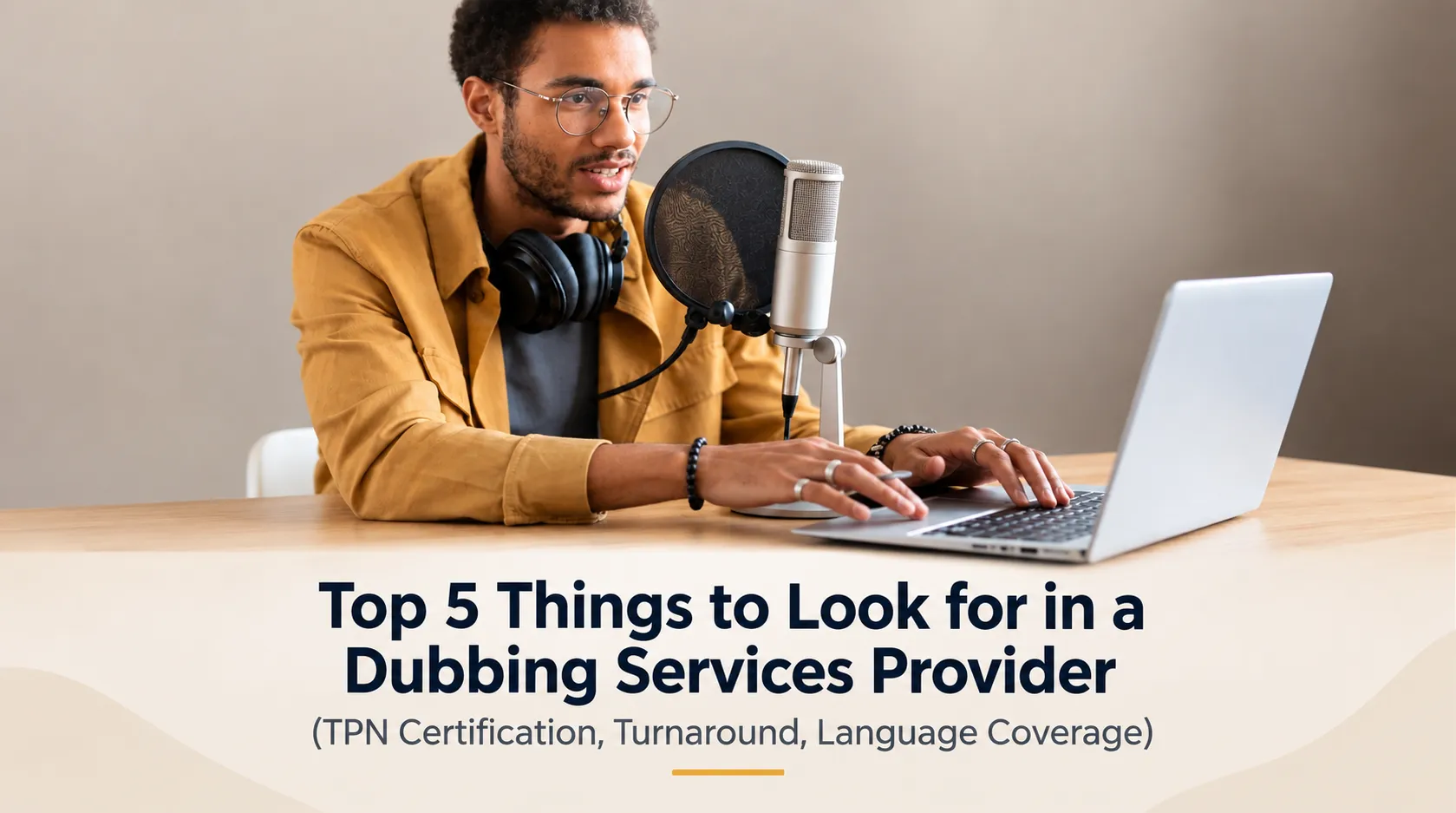


Ever watched a scene where the lips don't match the words? It's distracting. It pulls you right out of the story. That's what happens when dubbing services are done poorly. We've seen the fallout from bad vendor choices firsthand: mismatched sync, inconsistent voices between episodes, and deliverables that miss the platform's spec. "They do dubbing" isn't the same as "they do dubbing well." Before you sign a contract, here's what to actually check.
What Actually Separates Good Dubbing Services From the Rest
Not every dubbing company works the same way. Some outsource the whole job to freelancers spread across time zones. Others keep everything in-house. That one difference explains most of the quality gaps you'll see. Here are the five things worth checking first.
1. An In-House Pipeline, Not a Patchwork of Freelancers
Ask a simple question. Who actually touches your content? And where?
Many "dubbing studios" are really just brokers. They handscript adaptation to one freelancer. Recording goes to a different studio. Mixing goes to whoever's free that week. That's how you end up with inconsistent terms between episode 3 and episode 4. Or a voice actor who sounds slightly different after a mid-season swap nobody flagged.
A studio that keeps everything in-house can be held accountable end to end. Script adaptation, casting, recording, mixing, and quality control are the same team, start to finish. No finger-pointing when something goes wrong. Consistency across a long series gets a lot easier to manage.
2. TPN Certification: Not Optional for OTT or Studio Work
Working with a streaming platform? Handling unreleased studio footage? Ask for TPN certification early. Don't wait for legal to ask first.
A TPN certified studio has passed an independent audit. It covers restricted file access, watermarked review copies, and a clear record of who opened what file, and when. This isn't a formality. We've seen productions lose weeks scrambling to fix security gaps after a platform's compliance team flagged a vendor mid-project. If a provider can't show you their TPN certificate on request, that tells you something.
3. Real Language Coverage, Not Just a List on a Website
Most dubbing services pages list an impressive number of languages. The real question is depth, not count.
Anyone can claim "90+ languages." Can they actually cast native talent for Hindi dubbing services with real regional awareness? Or do they default to one generic accent that sounds off to a Mumbai or a Lucknow audience?
Regional language dubbing lives or dies on casting accuracy. A voice that nails Bengali but flattens every Marathi line into the same tone isn't real multilingual capability. It's a gap waiting to show up in your reviews. Ask for sample reels in your specific target languages. Not a generic showreel; the actual languages you need. And if you're targeting Indian short-form or drama audiences, ask how they handle Hinglish or code-mixed dialogue. It's a different skill than straight translation.
4. Turnaround Time That Holds Up at Scale
Lots of providers can quote a fast turnaround for one episode. Fewer can hold that speed once volume kicks in.
This matters a lot for OTT dubbing. Platforms often greenlight a full season and expect simultaneous delivery across languages. It matters even more for micro drama dubbing. That format is built around bulk output of dozens or hundreds of short episodes, often on a weekly release schedule.
Ask a vendor how they've handled a real bulk order. Not a hypothetical, but an actual delivered example. A studio that's shipped 200 episodes across five languages in a month has systems built for that kind of workload. One that's only handled single features before will hit a wall the moment volume scales up. Get the number in writing. And ask what happens to quality control when multiple language tracks run at once. That's usually where corners get cut.
5. Genre-Specific Expertise
Dubbing an anime series and dubbing a corporate video are not the same job. Both fall under "voice replacement," technically. But the craft is different.
Anime dubbing needs voice actors who can match exaggerated emotion, fast comedic timing, and lip flaps that don't always line up with natural speech. It's a specialized casting job. Good studios usually keep a dedicated roster for it.
Documentary or corporate content is different. It usually calls for voice-over, not tight lip-sync. Clarity and tone matter more than frame-accurate mouth matching. If a provider treats every project the same way, that's a sign of a one-size-fits-all process. Ask what their casting and direction look like for your specific genre before you assume "we do dubbing" covers it.
A Quick Way to Vet Before You Sign
Run through this checklist before committing to a budget:
- Can they show a TPN certificate, not just claim compliance?
- Do they handle script adaptation, casting, recording, and mixing in-house?
- Can they share sample reels in your specific target languages?
- Have they delivered at your required volume before, with proof?
- Do they have casting experience for your specific genre?
If a provider hesitates on any of these, take note.
Where This Leaves You
Dubbing isn't just swapping one language's audio for another. It's the difference between content that lands with a new audience and content that gets skipped after ten seconds because something feels off. An in-house pipeline. TPN certification. Real language depth. Turnaround that holds at scale. Genre-specific casting. These aren't nice-to-haves. They're the baseline for anyone shipping content to OTT platforms or global audiences.
Evaluating vendors right now? Ask for evidence, not promises, on each of these points before you commit a season's budget.
























Sign in to leave a comment.