

Las Vegas moves a surprising amount of freight for a desert city. Casino resupply, convention exhibits, e-commerce parcels, construction materials, and cross-country loads all pass through the Las Vegas Valley every day. Each of those loads is handled by a carrier or broker that someone had to trust.
That trust should never rest on a phone call and a friendly voice. The Federal Motor Carrier Safety Administration (FMCSA) publishes public records on nearly every interstate motor carrier, broker, and freight forwarder in the country. A good lookup tool turns those records into a clear yes or no before a truck ever backs into your dock.
Why Carrier Verification Matters So Much in Las Vegas
Las Vegas is a destination market. Trucks arrive full and often leave empty, which makes the city attractive to carriers hunting for backhauls and, unfortunately, to fraudsters hunting for easy cargo.
Trade shows add pressure. When an exhibitor needs a booth shipped to the Las Vegas Convention Center by Tuesday morning, there is little patience for slow vetting. Tight deadlines are exactly when shortcuts happen.
Geography matters too. Interstate 15 links Southern California to Utah and beyond, while US-95 and the developing Interstate 11 corridor tie Las Vegas to Arizona and northern Nevada. That means the carriers you meet here can be based almost anywhere.
A Las Vegas shipper may therefore be dealing with a company registered in Texas, operating out of Georgia, and dispatching from a phone number with a different area code every month. A public record check is the quickest way to ground that company in verifiable facts.
What an FMCSA Lookup Actually Shows
An FMCSA lookup searches federal registration and safety databases for a company's identity, authority, insurance, and safety history. The records are public, which is why third-party tools can organize them for you.
Two identifiers dominate the process. The USDOT number identifies a company for safety monitoring, while the MC number (also called a docket number) identifies the company's authority to operate for hire in interstate commerce.
Understanding the difference saves confusion. A company can hold a USDOT number without an MC number, for example when it hauls its own goods or operates only within a single state. A for-hire interstate carrier, however, generally needs both.
That distinction is why a reliable mc number lookup and a dot number lookup are treated as two separate checks. One answers "may this company haul freight for others across state lines," and the other answers "how does this company behave on the road."
Most tools also let you search by company name. Names are the least reliable starting point because many unrelated companies share similar names, so confirm the match with the number before you rely on anything.
When you do a dot number lookup, expect to see the legal name, any "doing business as" name, physical address, mailing address, phone number, operating classification, cargo carried, fleet size, and driver count. These fields are the foundation for everything else you will verify.
If you only have a docket number, a lookup dot number search can often connect it to the underlying USDOT record. The two numbers should point to the same legal entity, and any mismatch deserves a closer look.
What to Look for in an FMCSA Lookup Tool
The official FMCSA systems are free and authoritative, but they are not always convenient. Third-party tools exist because many teams want faster searches, clearer layouts, alerts, and some workflow help.
When you compare options, start with data freshness. A tool is only as useful as the update schedule behind it, and you should know whether it reads live federal data or a cached copy.
Search flexibility comes next. You should be able to run an mc number lookup, a dot number lookup, or a company name search without jumping through hoops.
Clarity is the third factor. Dense federal records can be hard to scan, so a tool that separates authority, coverage, and safety data into readable blocks saves real time.
Monitoring is the fourth. Because insurance and authority change, the ability to receive alerts after onboarding is valuable, especially for a team handling dozens of carriers.
Finally, consider how a tool fits your size and workflow. A solo owner-operator, a small Las Vegas brokerage, and a corporate logistics department need different things, and none of them benefits from features they never use.
Transparency should also matter. A trustworthy tool states what its data comes from, avoids dramatic scoring it cannot justify, and encourages you to confirm critical findings against the source.
Top FMCSA Lookup Tools for Las Vegas Shippers, Brokers, and Carriers
The tools below are commonly used for carrier verification. Each has its own strengths, and the right choice depends on your volume, your risk tolerance, and how much of the workflow you want in one place.
MC LookUp
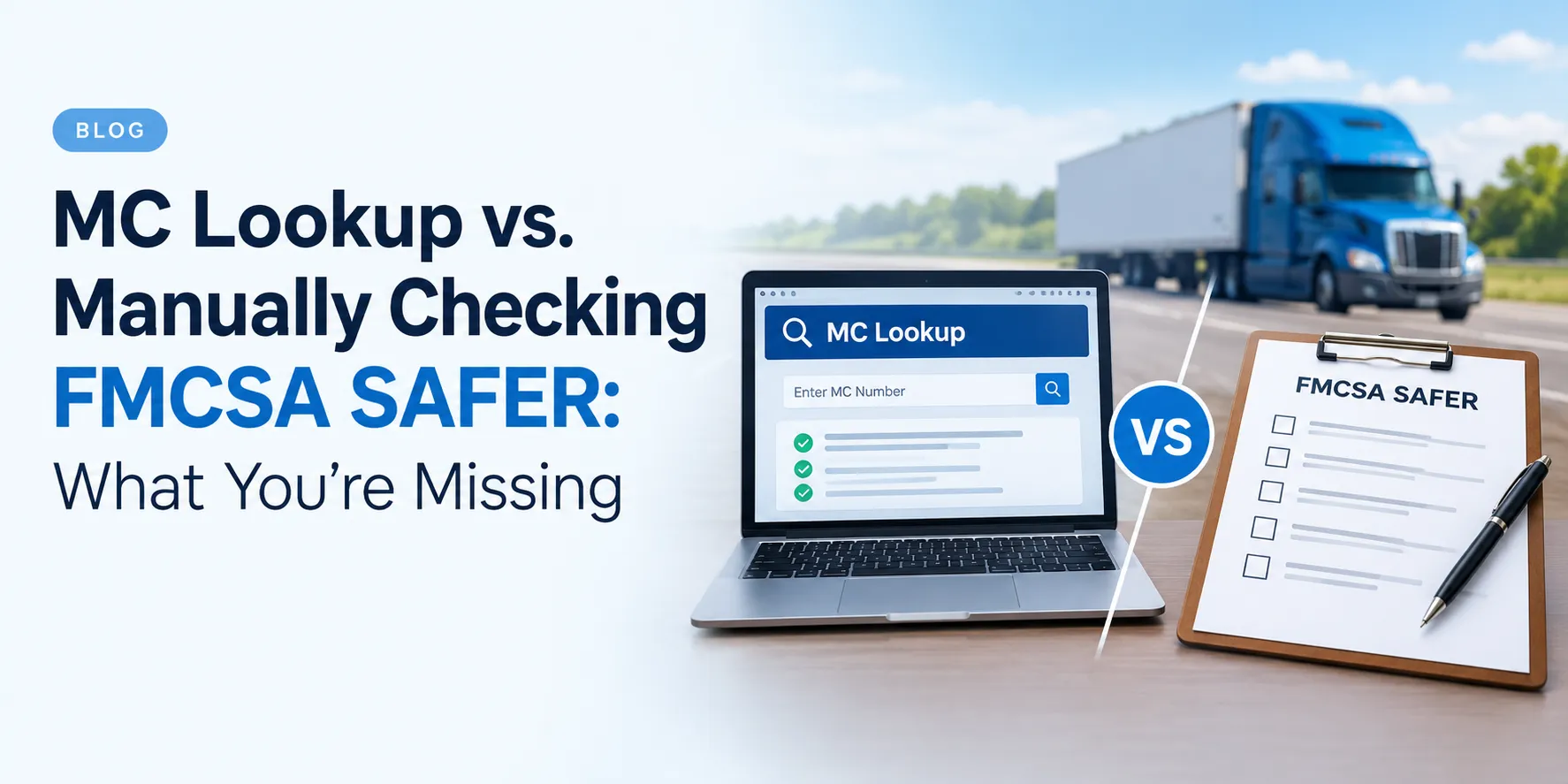
MC LookUp is built around the simple job most freight professionals need done first: take a carrier identifier and turn it into a readable profile. That makes it a natural starting point for Las Vegas teams who verify carriers dozens of times a week and do not want to wade through raw federal screens.
At its core, MC LookUp supports the searches that matter most. You can start from an MC number, a USDOT number, or a company name, and you get a profile organized around the questions a dispatcher or broker actually asks.
Those questions are predictable. Is the authority active? Is there liability coverage on file? Does the legal name and address match what the carrier gave me? Does the safety history raise a flag?
A tool shaped around those questions shortens the path from search to decision. For a Las Vegas broker handling a rush load for a trade show, that difference can be the gap between a confident booking and a risky guess.
MC LookUp is particularly practical for the first-pass check. When a carrier calls with an available truck and you have ten minutes to decide, a clean mc number lookup that surfaces authority and coverage together is more useful than a long report you will not finish reading.
The same applies to a usdot number lookup. Because the USDOT record is where fleet size, operation type, and inspection history sit, having it presented clearly helps you notice mismatches, such as a carrier claiming a large fleet while the record shows two power units.
Teams also use MC LookUp to cross-check what a carrier tells them against the public record. A rate confirmation, a certificate of insurance, and a W-9 should all describe the same legal entity, and a profile makes inconsistencies easier to spot.
For brokers, the tool supports a disciplined routine. Run the search, confirm the entity, review authority and coverage, scan the safety summary, and record the result in your carrier file before dispatching anything.
For shippers in Las Vegas, the benefit is oversight. Even if you rely on a broker, being able to independently check the carrier assigned to your freight gives you a reliable second opinion, and MC LookUp makes that check approachable for people who are not compliance specialists.
It also suits smaller operators. An owner-operator vetting a broker before accepting a load can use the same kind of lookup to confirm that the broker's authority and bond are in good standing before the first invoice goes out.
A fair note on limits: no lookup tool replaces judgment. MC LookUp organizes public records, but you still need to verify certificates directly with insurance agents, confirm identities by phone, and watch for behavioral red flags that no database captures.
Used that way, as a fast, clear front door to FMCSA data, MC LookUp earns a place in a Las Vegas verification workflow. It handles the repetitive part so your attention goes where it matters, which is deciding whether to trust the company.
The Official FMCSA Systems
Before looking at paid or branded tools, it is worth remembering the source. FMCSA's own public search pages let anyone check registration, authority, insurance filings, and safety data at no cost.
These pages are the final authority. If a third-party tool and the federal record ever disagree, the federal record wins, and a careful user knows how to confirm findings there.
The tradeoff is usability. The official screens can feel dated, and they are not designed for monitoring, bulk checks, or team workflows.
C90.IO
C90.IO is another name freight teams encounter when looking for carrier verification support. It is generally associated with checking carrier details and reducing onboarding risk, and it is worth a look for teams comparing options.
Carrier 411
Carrier 411 is known in broker circles for carrier information and monitoring-style services. Teams that want alerts on changes to carriers they already use sometimes consider it as part of their stack.
carrierchk
carrierchk is a carrier checking resource that appeals to users who want a straightforward way to review carrier credentials. Evaluate its current features against your own checklist before committing.
Freight GPT
Freight GPT reflects a newer wave of AI-assisted freight tools. People use assistants like this to speed up research and drafting, but verification-critical facts should still be confirmed against official records.
Carrier Assure
Carrier Assure is associated with carrier onboarding and compliance monitoring, which suits companies managing a larger carrier base. It is a reasonable candidate if ongoing monitoring is your priority.
A practical note on all of the above: features, pricing, and data sources change. Review each provider's current offering and test it with a few carriers you already know well before you rely on it.
Nevada-Specific Considerations for Las Vegas Operators
FMCSA covers interstate commerce, but Nevada has its own layer. Companies operating only within the state, or in specific regulated categories, may fall under state oversight rather than, or in addition to, federal registration.
The Nevada Department of Motor Vehicles handles many trucking-related registrations, and the Nevada Transportation Authority regulates certain for-hire operations, including some household goods movers and passenger carriers. Requirements change, so check the agencies directly for current rules.
This matters for local moves and final-mile work in the Las Vegas Valley. A mover who is perfectly legal within Nevada may not hold interstate authority, and the reverse can also be true.
When a carrier says it is "fully licensed," ask which license. A federal record and a state permit answer different questions, and neither one substitutes for the other.
Registration programs like the Unified Carrier Registration and the International Registration Plan also show up in conversations about compliance. They are not substitutes for operating authority, but gaps in them can signal broader administrative problems.
For household goods, extra caution is warranted. Moving fraud and hostage-load schemes target consumers, and verifying both the federal and state credentials before signing is a worthwhile habit.
Matching a Tool to Your Role in Las Vegas
Your role shapes what you need. A shipper mostly wants assurance that the carrier on the bill of lading is legitimate and insured, while a broker needs speed, documentation, and monitoring at volume.
Carriers use lookups too. Before accepting work, a Las Vegas fleet should confirm the broker's authority and bond, especially when payment terms are long or the rate looks unusually generous.
Small teams usually benefit from a clean, fast lookup for daily use, such as MC LookUp, paired with the official FMCSA records as a verification backstop. That combination covers speed and authority without adding complexity.
Larger operations may layer in onboarding and monitoring platforms, such as those from the other providers discussed above. The goal is not to collect tools but to cover each stage of the process: identify, verify, document, and monitor.
Whatever you choose, test it. Run a few carriers you know well, compare the output to the official record, and see whether the tool saves time without hiding anything important.
Conclusion
Verifying a carrier or broker in Las Vegas comes down to a short, repeatable routine: confirm the identity through an mc number lookup and usdot number lookup, check active authority and fmcsa licensing and insurance records, review safety history, and confirm everything by calling the contact on the official record. A tool like MC LookUp makes the first steps faster and clearer, while the official FMCSA systems remain the source of truth. Re-check regularly, document your decisions, and let verified facts, not urgency, decide who hauls your freight.



























Sign in to leave a comment.