

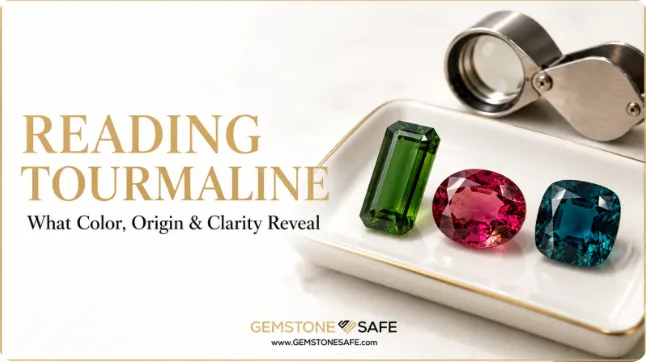
A pink gemstone, a deep green crystal, and a slice with a pink center surrounded by green can all be tourmaline. That diversity makes choosing one a personal experience: the first question is often which appearance draws you in.
Yet color is only the beginning. Understanding tourmaline’s identity, formation, symbolism, and care helps you turn an attractive first impression into a considered jewelry choice.
One name, a remarkable color range
Tourmaline is a group of related minerals, not a single mineral species. Differences in chemistry help explain its extraordinary range of appearances. Elbaite accounts for much of the tourmaline used as a gemstone.
Trade names describe some familiar colors. Rubellite generally refers to red or pinkish red material, although usage varies. Indicolite describes blue tourmaline. Watermelon tourmaline has a pink center surrounded by green, a pattern often displayed in crystal slices.
These names are useful descriptions, but they do not replace identification. Ask what a seller means by a particular label, especially when that name influences the price.

How tourmaline forms and where it comes from
Many gem tourmalines grow in pegmatites: exceptionally coarse-grained igneous rocks that can contain pockets of well-developed crystals. Different pockets within one deposit may produce different colors. Other tourmaline species occur in metamorphic settings, where existing rocks have been transformed by heat and pressure.
Color zoning can record changes in the crystal’s growth environment, including changes in the concentration of trace elements. A multicolored tourmaline therefore offers a visible glimpse of its growth history.
Brazil is an important source, alongside countries including Afghanistan, Pakistan, Madagascar, and Mozambique. California and Maine also have historic tourmaline-producing localities.
For buyers, origin adds context rather than guaranteeing quality. Evaluate the individual stone and request supporting evidence when a geographic claim affects your decision.

Meaning, history, and October traditions
Tourmaline shares October’s birthstone role with opal. Its broad palette offers birthday-gift possibilities well beyond a single traditional color.
Its history also includes mistaken identities. GIA describes green Brazilian tourmalines being confused with emeralds and a red tourmaline jewel historically identified as a ruby. Such examples show why appearance alone cannot establish gemstone identity.
GIA’s October birthstone guide records symbolic associations between pink tourmaline and love, and between black tourmaline and protection. These belong to belief and personal symbolism, not scientifically established effects.
You can appreciate those associations without treating them as promises. A pink tourmaline might represent affection because of the occasion it marks; a green stone might simply be someone’s favorite color.
What to look for before buying
Start with color, then consider how clearly and attractively the stone displays it. Strong saturation can be desirable, but an excessively dark appearance may conceal much of the visual detail you enjoy.
Clarity expectations differ. Visible inclusions are more readily accepted in some pink and red tourmalines than in green examples. Their position and effect on appearance matter alongside their presence.
Cut also influences the result. Tourmaline’s directional color differences make orientation important when shaping a gem. Compare its appearance face-up, then watch it move under consistent lighting.
Ask for dimensions as well as carat weight, and consider the intended setting. Request photographs on a neutral background and a clear video. A descriptive color name should help you understand the stone, not substitute for seeing it.
Treatments and documentation
Some tourmalines undergo heating or irradiation to modify color. Treatment detection has limitations, so an attractive appearance does not establish that a stone is untreated. Certain irradiation-induced colors may fade under heat or strong light.
Ask for written treatment disclosure and clarification of any laboratory report. GIA identifies tourmaline and reports detectable treatments but does not assign it an overall quality grade. A report supports identification; it does not make the purchasing decision for you.
For an important purchase, also confirm the inspection period, return arrangements, and whether the description matches the individual stone offered.
Jewelry suitability and care
Tourmaline measures 7–7.5 on the Mohs hardness scale, but its toughness is rated fair. Scratch resistance should not be confused with resistance to chipping or breakage.
GIA recommends warm, soapy water and advises against ultrasonic and steam cleaning. Heat and sudden temperature changes can also damage tourmaline. Its care guide provides further detail.
Discuss protective settings for rings and choose a design suited to your routine. Pendants and earrings are alternatives when avoiding frequent knocks is a priority.
Before choosing a loose gem, include setting costs in your budget. If buying a gift, consider the recipient’s preferred shapes and willingness to follow care instructions. An unusual color combination is most rewarding when it also suits the wearer.

Find your tourmaline with GEMSTONESAFE
Tourmaline invites you to choose through both curiosity and personal taste. Explore gemstone education with GEMSTONESAFE, or enquire about tourmaline options by sharing your preferred color, budget, and intended jewelry use.
Ask about the individual stone’s condition, treatment, and documentation before deciding. The right choice is one whose appearance you love and whose practical requirements you understand.
























Sign in to leave a comment.