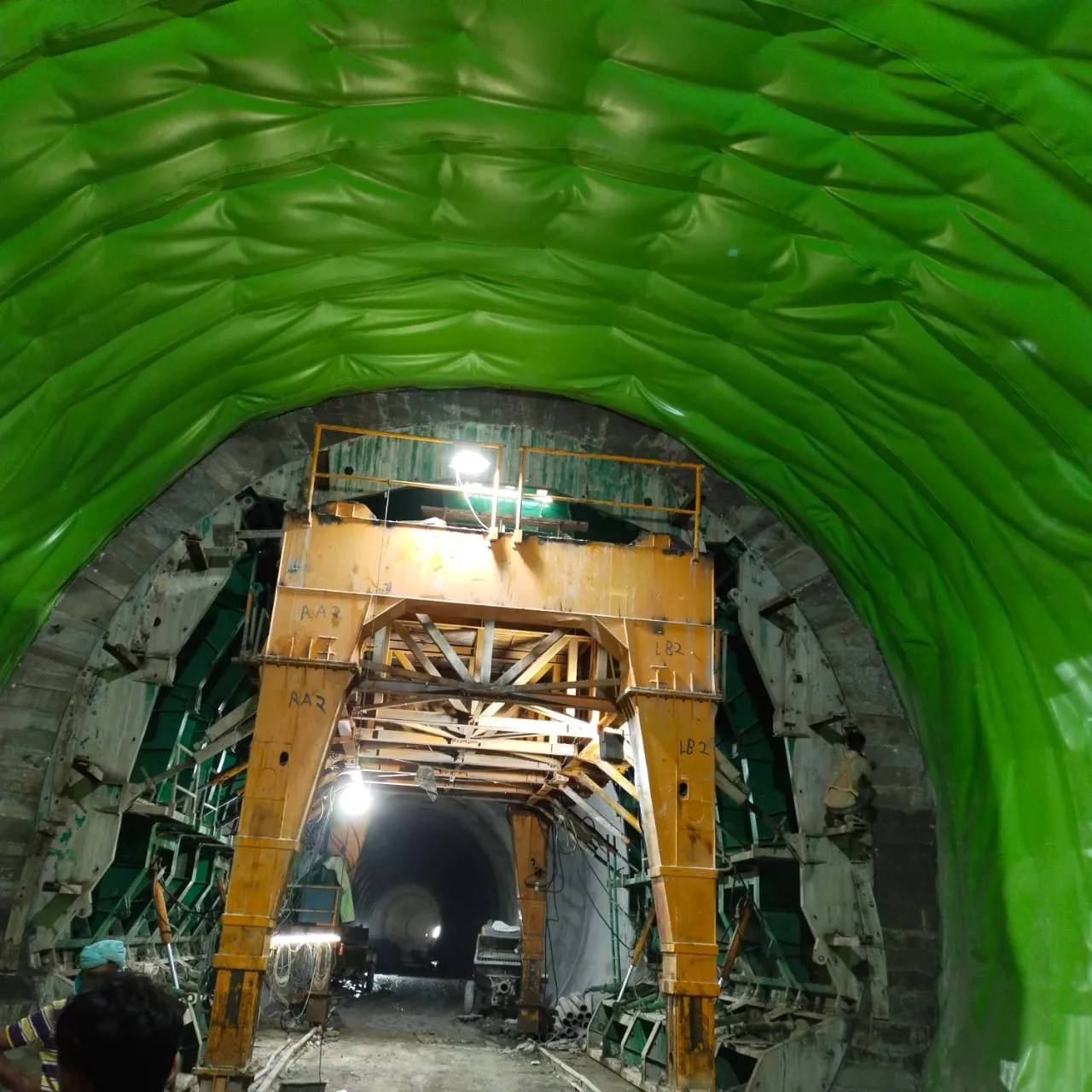

Tunnel construction plays an important role in modern infrastructure, supporting metro systems, highways, railways, water conveyance networks, underground passages, and other large-scale development projects. Because tunnels are built below ground level, they are continuously exposed to groundwater, soil moisture, hydrostatic pressure, and changing environmental conditions. Without an effective waterproofing system, water infiltration can affect structural durability, create maintenance problems, and reduce the service life of the tunnel.
Tunnel Waterproofing is therefore a critical part of tunnel design and construction. A properly selected waterproofing membrane creates a continuous barrier against water penetration and helps protect concrete structures, reinforcement, joints, and internal tunnel spaces. Among the solutions used for demanding underground applications, PVC geomembrane systems are widely considered for their flexibility, durability, and controlled installation through heat-welded seams.
Why Tunnel Waterproofing Is Essential
Water is one of the most persistent challenges faced by underground structures. Groundwater can enter through concrete pores, construction joints, cracks, expansion joints, penetrations, and other vulnerable areas. Over time, uncontrolled seepage can lead to dampness, staining, corrosion-related concerns, concrete deterioration, and repeated repair requirements.
An effective Waterproofing geomembrane system helps create a protective separation between the surrounding ground and the tunnel structure. When properly designed and installed, the membrane can reduce the movement of groundwater toward the finished tunnel lining and provide an additional layer of protection for the structure.
The waterproofing design should be developed according to tunnel geometry, groundwater conditions, construction methodology, expected water pressure, surrounding geology, and project specifications. Material selection alone cannot guarantee waterproofing performance; installation quality, seam welding, substrate preparation, drainage, and inspection are equally important.
Understanding PVC Geomembrane for Tunnel Applications
A PVC geomembrane is a flexible polymeric membrane that can be used as a waterproofing barrier in underground construction. PVC membranes are particularly useful in tunnel environments because their flexibility allows them to accommodate the geometry of curved and irregular surfaces when the system is correctly designed.
A Pvc geomembrane sheet can be installed over a prepared substrate and joined using appropriate heat-welding equipment. Properly welded seams form a continuous membrane system, reducing the number of potential pathways through which water can penetrate.
Depending on the project requirements, membrane thickness, formulation, reinforcement or support system, installation method, and testing requirements may vary. Engineers and contractors should select the membrane according to the project's technical specifications rather than choosing thickness solely on price.
How a Tunnel Waterproofing System Works
A tunnel waterproofing system normally functions as part of a broader underground protection assembly. The surrounding ground is first evaluated, and the tunnel surface is prepared to create a suitable installation environment. Sharp projections and irregularities that could damage the membrane are addressed before waterproofing installation begins.
Where required, Geotextile layers may be incorporated as part of the protection and drainage arrangement. The geotextile can provide separation and cushioning between the substrate and membrane, depending on the project design.
The geomembrane for tunnels is then positioned over the prepared surface and secured using suitable fixing or anchoring arrangements. Adjacent membrane sheets are overlapped and heat-welded using controlled equipment. The completed seams are inspected and tested according to the project quality-control requirements.
A final protective or structural layer can then be installed over the waterproofing system according to the tunnel's construction methodology.
Importance of Surface Preparation
Even a high-quality membrane can perform poorly if the underlying surface is unsuitable. Surface preparation is therefore one of the most important stages of Tunnel waterproofing.
The substrate should be checked for sharp edges, protruding reinforcement, loose material, excessive irregularities, and other conditions that could damage the membrane. Water management should also be considered before membrane installation. Active water flows may require appropriate drainage or temporary water-control measures so that installation can be completed safely and correctly.
Proper preparation reduces the risk of punctures, folds, excessive stress, and installation defects. It also makes welding and inspection more consistent.
The Role of Geotextile in Tunnel Waterproofing
Geotextile can play an important role in a tunnel waterproofing assembly, particularly where protection and drainage are required. Installed between the substrate and membrane where specified, it can help reduce direct contact between the waterproofing layer and potentially abrasive surfaces.
The appropriate geotextile specification depends on the tunnel design and site conditions. Factors such as mass per unit area, tensile properties, puncture resistance, drainage requirements, and installation conditions should be considered.
The combination of Geotextile and PVC geomembrane can provide a practical multilayer waterproofing arrangement when engineered and installed according to project requirements.
Waterproofing for Different Tunnel Types
Tunnel waterproofing requirements can differ significantly according to the purpose and construction method of the tunnel. Road tunnels may experience groundwater pressure and environmental exposure associated with transportation infrastructure. Railway and metro tunnels can have strict requirements concerning water ingress because internal systems, electrical installations, finishes, and passenger areas must remain protected.
Water conveyance tunnels have another set of requirements because the structure may be designed to contain or control water rather than simply exclude groundwater. Utility tunnels, underpasses, underground pedestrian passages, and other below-ground structures may also require specialized waterproofing arrangements.
For this reason, geomembrane for tunnels should be selected and installed according to the specific design conditions and applicable project specifications.
Seam Welding and Quality Control
The performance of a membrane system depends heavily on the quality of its seams. Even when the membrane itself has excellent physical properties, poorly executed welds can become vulnerable points in the waterproofing system.
Heat-welding equipment should be operated under controlled conditions appropriate to the membrane material and site environment. Welding parameters need to be monitored, and completed seams should undergo the inspections and tests specified by the project quality plan.
Quality documentation can include material certificates, batch information, welding records, inspection reports, test results, and installation records. These documents can be particularly valuable for major infrastructure projects where long-term traceability is important.
Choosing the Right Membrane Thickness
There is no universal membrane thickness that is suitable for every tunnel. The correct thickness should be determined from the project specification, groundwater conditions, installation method, substrate characteristics, expected mechanical stresses, and required durability.
Dr. Millars states that its PVC geomembrane products are commonly available in thicknesses such as 1.5 mm and 2.00 mm, while tailor-made specifications can be considered for large infrastructure requirements.
For procurement teams, comparing only the price per square metre may not provide a complete picture. Material quality, physical properties, welding performance, testing, technical support, documentation, installation capability, and project-specific requirements should also be evaluated.
Tunnel Waterproofing and Long-Term Structural Protection
The objective of Tunnel Waterproofing is not simply to stop visible water leakage. A well-designed system forms part of the tunnel's long-term durability strategy.
Reducing water infiltration can help protect internal finishes and structural components from persistent moisture exposure. It can also reduce the frequency of corrective waterproofing work after the tunnel becomes operational.
For major infrastructure projects, waterproofing should therefore be considered during the planning and design stage rather than treated only as a finishing activity.
Why Choose an Experienced Geomembrane Manufacturer?
Working with an experienced geomembrane manufacturer can simplify technical coordination between material selection, fabrication, quality control, and installation. Large tunnel projects often require consistent material supply, technical documentation, customized dimensions or specifications, and installation support.
Experienced geomembrane manufacturers India can also support projects that require locally manufactured products and project-specific technical coordination.
Before final procurement, contractors and consultants should review the manufacturer's technical data, applicable standards, test reports, quality-control procedures, installation methodology, and previous relevant experience.
Dr. Millars for Tunnel Waterproofing Solutions
D L MILLAR AND COMPANY LIMITED, operating under the Dr. Millars brand, has been established since 1929 and provides geomembrane solutions for infrastructure and waterproofing applications.
Dr. Millars manufactures PVC geomembrane products in India and states that its membranes are used for applications including tunnels, underpasses, foundations, basements, reservoirs, canals, roads, dams, roofs, and other structures where waterproofing and seepage control are required.
The company also provides turnkey supply and installation support for PVC geomembrane applications. For large infrastructure projects, Dr. Millars states that tailor-made membrane specifications can be developed according to project requirements.
Its product and testing information references applicable ASTM, EN, and BIS requirements. Where a project specifically requires a BIS approved geomembrane or formal certification, buyers should verify the current certificate or licence applicable to the exact product and project specification before procurement.
Applications Beyond Tunnels
Although Tunnel waterproofing is a major application, geomembrane technology can be used across several other infrastructure sectors. Geomembrane for dams can help address seepage-control requirements, while geomembrane for canal lining can be used in water-management infrastructure.
A geomembrane pond liner can provide a waterproof barrier for selected water-storage applications. Similarly, Landfill geomembrane systems are designed for waste-containment applications where protection against liquid migration is an important design consideration.
These applications demonstrate why material selection should always be linked to the actual service environment rather than treating all geomembranes as interchangeable products.
Frequently Asked Questions About Tunnel Waterproofing
What is Tunnel Waterproofing?
Tunnel Waterproofing is the process of protecting underground tunnel structures from groundwater and moisture penetration. Membrane systems such as PVC geomembranes can be incorporated into a complete waterproofing assembly designed according to the tunnel's construction and environmental conditions.
Which geomembrane is commonly used for tunnels?
PVC geomembrane is one option used for tunnel waterproofing applications. The appropriate membrane should be selected according to the project's technical specifications, groundwater conditions, installation methodology, required physical properties, and applicable standards.
Why is geotextile used with tunnel geomembranes?
Geotextile can provide separation, cushioning, and protection for the membrane where specified. Its use depends on the substrate, drainage arrangement, tunnel design, and project requirements.
How are geomembrane seams joined in tunnels?
Adjacent membrane sheets are commonly joined using controlled heat-welding techniques. Seam inspection and testing should be performed according to the project's quality-control plan to identify potential installation defects.
Can PVC geomembrane be customized for large tunnel projects?
Yes. Depending on the manufacturer and project requirements, membrane specifications can be tailored to the application. Dr. Millars states that it can provide tailor-made PVC membrane specifications for large infrastructure projects.
Contact Dr. Millars
For Tunnel Waterproofing, PVC geomembrane, and infrastructure waterproofing requirements, contact D L MILLAR AND COMPANY LIMITED.
D L MILLAR AND COMPANY LIMITED
Flat No. 303, 3rd Floor, Elite House-36, Community Center, Zamroodpur, New Delhi-110048, India
Phone: +91 8700518400
Email: [email protected]
Website: https://drmillars.co.in/
Conclusion
A reliable Tunnel Waterproofing system is an important component of durable underground infrastructure. From substrate preparation and geotextile protection to PVC geomembrane installation, seam welding, inspection, and quality documentation, every stage contributes to the overall performance of the waterproofing system.
For infrastructure developers, EPC contractors, consultants, and procurement teams, choosing the appropriate geomembrane manufacturer and establishing a clear installation and quality-control process can help create a more dependable waterproofing solution. With its experience in infrastructure waterproofing and PVC geomembrane applications, Dr. Millars provides solutions for tunnel and other demanding construction environments.






















Sign in to leave a comment.