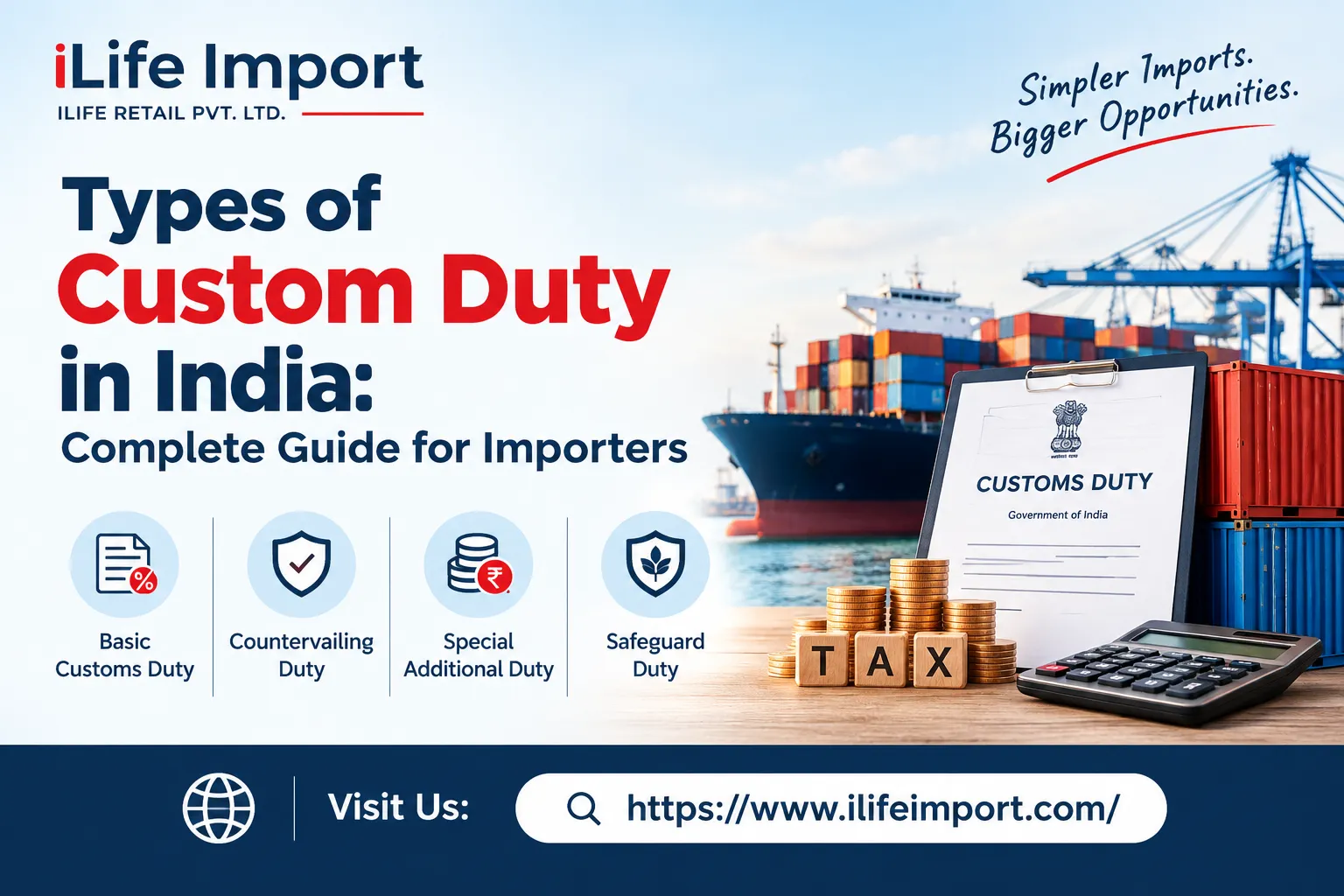

Importing products into India involves more than buying goods from an overseas supplier and arranging shipping. Importers also need to understand customs duty, IGST, surcharges, trade-remedy duties, product classification, customs valuation, and applicable exemptions.
For businesses importing goods from China, understanding these costs is particularly important because customs-related charges can significantly affect the final landed cost, selling price, and profit margin.
This guide explains the major types of customs duty in India, how import duty calculation in India works, which additional levies may apply, and what importers should check before shipping goods to India.
Important: Customs rates are product-specific and can change through tariff notifications, exemptions, and trade-remedy measures. The examples in this guide are illustrative and should not be treated as a universal duty rate.
What Is Customs Duty in India?
Customs duty is a statutory charge imposed on goods imported into or, where applicable, exported from India. Under Section 12 of the Customs Act, 1962, customs duties are levied at rates specified under the Customs Tariff Act, 1975 or another applicable law.
For an importer, however, the total amount payable at import is not necessarily just Basic Customs Duty.
Depending on the product, an import shipment may involve:
- Basic Customs Duty (BCD)
- Social Welfare Surcharge (SWS)
- IGST on imports
- National Calamity Contingent Duty (NCCD), where applicable
- Anti-Dumping Duty
- Countervailing Duty
- Safeguard Duty
- Product-specific cesses or other statutory charges
The exact combination depends on the product's classification, customs valuation, country of origin, applicable notifications and whether any trade-remedy measure is in force.
Why Understanding Customs Duty Matters for Importers
Many new importers calculate profitability using only the supplier's quotation.
For example:
Product cost = ₹500 per unit
That does not mean the importer has a ₹500-cost product in India.
The actual landed cost may also include international freight, insurance where applicable, customs duties, IGST, customs clearance, inland transportation, warehousing and other costs.
A better approach is:
Supplier cost → Freight → Customs valuation → Duties & taxes → Customs clearance → Local logistics → Final landed cost
This calculation helps importers determine whether a product remains commercially viable after reaching India.
Types of Customs Duty in India
1. Basic Customs Duty (BCD)
Basic Customs Duty (BCD) is the principal customs duty imposed on imported goods under the applicable tariff classification.
The applicable rate depends on the product's classification in the Customs Tariff and any relevant notifications or exemptions. There is no single BCD rate that applies to every imported product.
For example, two different products imported from the same country may have completely different BCD rates because they fall under different tariff headings.
Why BCD matters
Before importing, businesses should identify the correct HS/CTH classification for the product and verify the applicable BCD rate for the relevant date of import.
A wrong classification can affect:
- Duty calculation
- Customs documentation
- Regulatory compliance
- Import cost
- Potential disputes with customs authorities
2. Social Welfare Surcharge (SWS)
The Social Welfare Surcharge is an important component of India's customs structure.
It was introduced in 2018 and replaced Education Cess for this purpose. CBIC states that SWS is generally calculated at 10% of the specified aggregate of applicable duties, taxes and cesses, subject to statutory exclusions and exemptions.
A useful point for importers is that SWS is not simply another 10% tax on the invoice value.
Its calculation is based on the statutory duty components specified under the law, and certain duties—including specified anti-dumping, countervailing and safeguard duties—are excluded from its base.
What about Education Cess?
Education Cess should not be added as a separate current customs component merely because an older import-duty calculation includes it.
Social Welfare Surcharge was introduced in place of Education Cess for customs purposes.
3. IGST on Imported Goods
Imported goods can also attract Integrated Goods and Services Tax (IGST).
Under the IGST framework, IGST on imported goods is levied and collected through the customs mechanism.
The applicable IGST rate depends on the product and its GST classification.
Importers should understand that IGST on imports is different from Basic Customs Duty.
In many taxable imports, the IGST calculation uses a value that includes the customs-assessed value and applicable customs duties or additions prescribed by law.
For this reason, simply multiplying the supplier invoice value by the GST rate may not give the correct import IGST.
4. National Calamity Contingent Duty (NCCD)
National Calamity Contingent Duty (NCCD) is a statutory levy that applies to specified goods, rather than to every import.
Importers should therefore not automatically include NCCD in every import duty calculation.
Whether it applies depends on the particular product and the relevant tariff provisions.
For products that are subject to NCCD, the applicable rate and calculation should be verified using the current customs tariff and notifications.
5. Anti-Dumping Duty
Anti-Dumping Duty is a trade-remedy measure designed to address imports that are being dumped into India and causing injury to the domestic industry.
It is different from ordinary BCD because its purpose is to correct an identified trade distortion.
Anti-dumping measures can be product-specific and may depend on the country of origin or export and, in some cases, exporter-specific conditions.
For businesses importing from China, this is particularly important because certain products may be covered by active anti-dumping measures.
What importers should check
Before placing a large order, verify whether the product is subject to an active anti-dumping measure and whether the measure covers:
- The product
- Country of origin
- Country of export
- Particular exporters or manufacturers
- Applicable tariff classification
Ignoring an applicable anti-dumping measure can significantly change the expected landed cost.
6. Countervailing Duty
Countervailing Duty (CVD) is a trade-remedy measure associated with subsidized imports.
Where the relevant legal conditions are satisfied and a countervailing measure is imposed, it can affect the cost of the imported goods.
Importers should distinguish this from ordinary BCD because CVD is connected with counteracting actionable subsidization, rather than being a standard tariff applied uniformly to all products.
The applicability needs to be checked for the specific product and current measure.
7. Safeguard Duty
Safeguard Duty is another trade-remedy mechanism.
It can be imposed when a significant increase in imports causes or threatens to cause serious injury to a domestic industry.
Unlike anti-dumping duty, safeguard measures are not based primarily on proving that a particular foreign supplier is selling goods below normal value. They address the impact of increased imports on domestic industry.
Again, safeguard duty is not a blanket charge applicable to all imports.
It applies only where a relevant safeguard measure covers the product.
Customs Duty vs Other Import Charges
One of the most important concepts for new importers is that customs duty and total import taxes are not always the same thing.
| Component | What It Does |
| Basic Customs Duty (BCD) | Main tariff duty applicable according to product classification |
| Social Welfare Surcharge (SWS) | Surcharge calculated on the specified applicable duty base |
| IGST on imports | GST applicable to imported taxable goods |
| NCCD | Product-specific statutory levy where applicable |
| Anti-Dumping Duty | Trade-remedy measure against specified dumping |
| Countervailing Duty | Trade-remedy measure against specified subsidization |
| Safeguard Duty | Trade-remedy measure addressing specified import surges |
Not every shipment attracts every component.
How to Calculate Import Duty in India
A common mistake is to search for one fixed percentage for all imported products.
There is no universal import duty calculation in India percentage.
The calculation depends on:
- Product classification
- Customs valuation
- Applicable BCD rate
- Applicable exemptions or notifications
- Social Welfare Surcharge
- IGST rate
- Product-specific levies
- Anti-dumping, CVD or safeguard measures, where applicable
Step 1: Determine the Customs Value
Under Section 14 of the Customs Act, the value of imported goods is generally based on the transaction value, subject to the statutory conditions and valuation rules.
The customs valuation framework can also take into account specified costs and services such as transportation, insurance, loading, unloading, handling and other prescribed elements.
Therefore, the value used by customs may differ from simply looking at the supplier's product price.
Step 2: Calculate Basic Customs Duty
A simplified illustration:
Assessable value = ₹1,00,000
Assume, purely for illustration, that the applicable BCD is 10%.
BCD = ₹1,00,000 × 10% = ₹10,000
The actual BCD rate must be verified for the specific product.
Step 3: Calculate Applicable Social Welfare Surcharge
Suppose the applicable SWS base in this illustration is ₹10,000 and SWS is 10%.
SWS = ₹10,000 × 10% = ₹1,000
The actual SWS calculation must follow the applicable statutory base and exemptions.
Step 4: Calculate IGST
Assume, purely for illustration, that the applicable IGST rate is 18%.
The taxable value for import IGST is determined under the applicable customs provisions and can include the customs-assessed value plus applicable customs duties and additions prescribed by law.
This means the simplified formula:
Invoice Value × GST Rate
is not necessarily the correct import IGST calculation.
Step 5: Add Any Applicable Special Duties
Check whether the product is subject to:
- NCCD
- Anti-Dumping Duty
- Countervailing Duty
- Safeguard Duty
- Other product-specific duties or cesses
Only the measures applicable to the particular product should be included.
Example of Import Duty Calculation
Consider a hypothetical shipment with:
Customs-assessed value: ₹1,00,000
Illustrative BCD: 10%
Illustrative SWS: 10% of the relevant BCD base
Illustrative IGST: 18%
BCD
₹1,00,000 × 10% = ₹10,000
SWS
₹10,000 × 10% = ₹1,000
Illustrative IGST base
For illustration:
₹1,00,000 + ₹10,000 + ₹1,000 = ₹1,11,000
Illustrative IGST
₹1,11,000 × 18% = ₹19,980
Total of the illustrated duties and tax
₹10,000 + ₹1,000 + ₹19,980 = ₹30,980
This is only an educational example. Actual import duty calculation can differ because of the product's tariff classification, customs valuation, exemptions, applicable notifications, tariff values and additional duties.
What Determines Customs Duty on an Imported Product?
1. HS/CTH Classification
The first step is correctly identifying the product under the applicable tariff classification.
2. Customs Valuation
The customs value is determined according to the applicable customs valuation provisions.
3. Country of Origin
The origin of the product can matter for preferential treatment and certain trade-remedy measures.
4. Current Government Notifications
Duty rates, exemptions and conditions can change.
Importers should therefore check current customs notifications instead of relying on an old blog, supplier quotation, or previously imported shipment.
5. Trade-Remedy Measures
A product can be subject to anti-dumping, CVD or safeguard measures in addition to its ordinary customs treatment.
6. Product-Specific Regulations
Certain products may require additional approvals, certifications, labeling or testing before they can be legally sold in India.
Customs Duty on Products Imported From China
For businesses importing from China, one of the most important misconceptions is:
“Chinese products have one standard customs-duty rate.”
They do not.
The applicable duty depends on the individual product and its classification, rather than simply the fact that the goods come from China.
For example, iLife Import businesses may source categories such as:
- Electrical Products
- Mobile Accessories
- Computer Accessories
- Hardware Products
- Kitchen Items
- Footwear
- Furniture
- Garments & Accessories
- Plastic Products
- Stationery Items
- Machinery & Machinery Items
- Handbags
- Photography Goods
- Stainless Steel Tumbler & Bottle
- Iron & Steel Products
Each category can have different tariff treatment and compliance requirements.
That is why the right approach is to calculate the landed cost for the specific product, rather than using a generic China import duty percentage.
8 Common Customs Duty Mistakes Importers Should Avoid
1. Using the Supplier Price as the Final Cost
The supplier quotation is only one component of your landed cost.
2. Using the Wrong Product Classification
An incorrect HS classification can affect the applicable duty and documentation.
3. Assuming All Imports Have the Same Duty Rate
Duty rates vary by product.
4. Ignoring SWS
SWS is an important component of the customs calculation where applicable.
5. Adding Education Cess Separately
Education Cess should not be treated as a separate current customs component simply because older duty calculations mention it. SWS was introduced in its place for customs purposes.
6. Ignoring Trade-Remedy Duties
Anti-dumping, CVD or safeguard measures can materially affect the landed cost of specified products.
7. Using Outdated Duty Information
Government notifications and exemptions can change, so current information should always be verified.
8. Calculating Profit Before Knowing Landed Cost
A product can look highly profitable at the factory price and become much less attractive after freight, duties, taxes, customs clearance, and local logistics.
Customs Duty and Landed Cost: Why the Difference Matters
Suppose an importer purchases a product from China at a relatively low supplier price.
The business may initially think:
Supplier price = profit opportunity
But the real calculation is:
Product Cost
- China-side charges
- International Freight
- Insurance, where applicable
- Customs Duty
- SWS
- IGST and applicable levies
- Customs Clearance
- Local Transportation
- Warehousing/handling
= Actual Landed Cost
Only after calculating this figure should an importer decide the expected selling price and margin.
How iLife Import Can Help With Importing From China
Understanding customs duty is only one part of the China-to-India import process.
An importer may also need support with:
- Product sourcing
- Supplier identification
- Supplier verification
- Quality inspection
- Air freight
- Sea freight
- Container booking
- Customs clearance
- Logistics coordination
iLife Import provides China sourcing and import support designed to connect these activities into a broader import process.
For businesses evaluating products from China, this can help them consider not just supplier price but also product quality, freight, customs clearance and overall landed cost before placing a commercial order.
FAQs About Types of Custom Duty in India
What are the main types of customs duty in India?
The main customs-related components importers commonly need to understand include Basic Customs Duty, Social Welfare Surcharge, IGST on imports, NCCD where applicable, Anti-Dumping Duty, Countervailing Duty and Safeguard Duty.
Not every type applies to every product.
What is Basic Customs Duty?
Basic Customs Duty is the principal tariff duty applicable to imported goods based on their classification and the prevailing customs tariff and notifications.
Is Education Cess still applicable on imports?
Education Cess is not a separate current customs component in the way it was historically. Social Welfare Surcharge was introduced in 2018 in its place for customs purposes.
Is NCCD applicable to all imports?
No. NCCD is a product-specific levy and should only be included when applicable to the imported goods under the current tariff provisions.
Is IGST included in customs duty?
IGST on imports is different from Basic Customs Duty, but it is collected on imported goods through the customs mechanism under the applicable provisions.
How can I calculate import duty in India?
Start by determining the correct HS/CTH classification and customs value. Then verify the applicable BCD, SWS, IGST on imports, and any product-specific duties, exemptions or trade-remedy measures.
Is customs duty the same for products imported from China?
No. The duty depends on the specific product, classification, customs valuation, applicable notifications and any trade-remedy measures.
Final Takeaway
Understanding the types of customs duty in India is essential before importing products commercially.
For most importers, the calculation begins with the product's customs classification and assessable value, followed by the applicable Basic Customs Duty and other relevant components such as SWS and IGST. Additional measures such as NCCD, anti-dumping duty, countervailing duty and safeguard duty may apply only to specific products or situations.
For China-to-India imports, do not rely on a generic “customs duty percentage.” Calculate the costs for the exact product you plan to import and verify the current tariff, notifications, exemptions and trade-remedy measures.
Most importantly, calculate the complete landed cost before deciding whether an imported product is genuinely profitable.
For businesses that want support with China sourcing, customs clearance, freight and end-to-end import services, iLife Import can help coordinate the broader China-to-India import process.




























Sign in to leave a comment.