
Worldwide Tyre Pyrolysis Plant Market: Strategic Trends and Commercial Opportunities
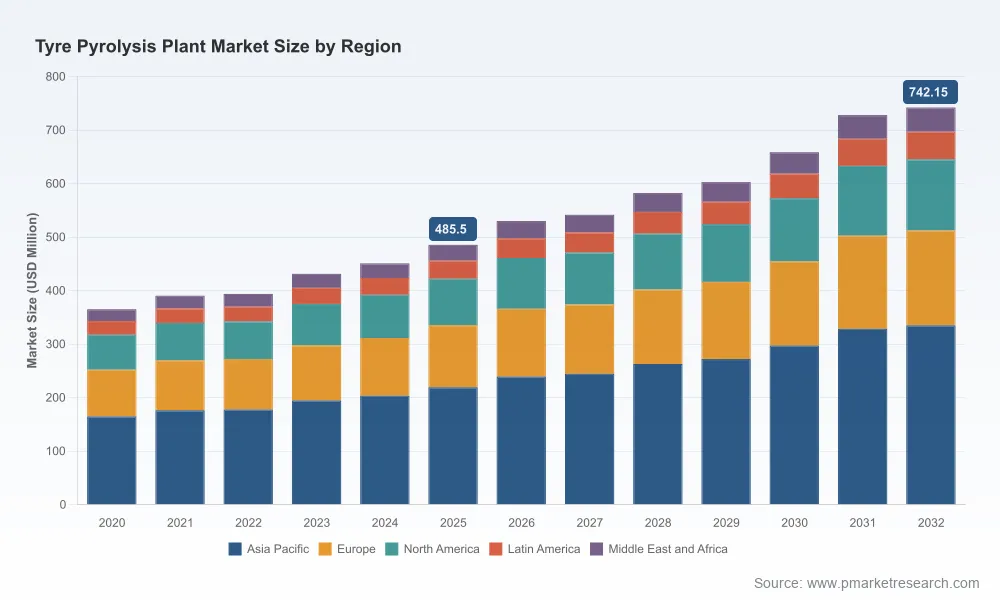
The global tyre pyrolysis plant market has reached a inflection point. Valued at approximately $365 million in 2020, the industry has expanded to an estimated $485.5 million by 2025, representing a compound annual growth rate of 6.25 percent through the forecast period ending in 2032. At first glance, this trajectory signals steady demand. A closer examination reveals a market undergoing structural transformation—shifting from fragmented, batch-oriented operations toward integrated, continuous-processing facilities driven by circular economy mandates, regulatory reclassification, and downstream material integration. For executives, capital allocators, and procurement teams, the opportunity lies not merely in riding volume growth, but in aligning with the technological, regulatory, and supply-chain dynamics that will separate scalable operators from commodity recyclers.
Tyre Pyrolysis Oil Market
Market Landscape and Structural Challenges
The market's midpoint valuation of just under half a billion dollars masks significant operational divergence. Capacity deployment has increasingly favored large-scale installations and continuous pyrolysis configurations, while smaller, batch-based assets face mounting pressure from feedstock logistics, emission compliance, and product standardization. Regionally, Asia Pacific commands the largest share of installed capacity and new project announcements, reflecting both tyre disposal volumes and aggressive industrial policy. Europe and North America follow, though their growth trajectories are increasingly shaped by differentiated regulatory frameworks and downstream demand for circular feedstocks rather than sheer disposal capacity.
1. The Continuous-Batch Divide and Capital Efficiency
The shift toward continuous pyrolysis is not simply a technological preference; it is a capital and operational efficiency imperative. Batch systems offer lower upfront capital and operational flexibility, but they struggle to achieve consistent throughput, standardized product quality, and the economies of scale required to compete with virgin material pricing. Continuous plants, by contrast, enable higher utilization rates, better heat integration, and more predictable output streams. Yet the challenge remains: continuous assets demand skilled operations, rigorous feedstock pre-processing, and robust downstream upgrading to convert pyrolysis oil and recovered carbon black into commercially viable inputs. Operators that fail to bridge the gap between thermal conversion and material specification risk falling into the low-margin disposal category.
2. Regulatory Ambiguity and Classification Pathways
Policy environments are moving faster than technology in several key markets. In the European Union, the Circular Economy Action Plan has set a recycling target of 85 percent for used tyres by 2030, while classifying pyrolysis-derived recovered carbon black as a highly sustainable material. Each ton of recovered carbon black replacing virgin carbon black can reduce CO₂ emissions by approximately 3.1 tons, a figure that increasingly shapes procurement incentives and sustainability reporting. Meanwhile, more than 24 U.S. states have enacted advanced recycling laws that reclassify pyrolysis processes as manufacturing rather than waste disposal, with the EPA advancing clarification to exclude pyrolysis from incineration definitions. These regulatory shifts lower permitting friction and unlock financing channels, but they also introduce compliance variability across jurisdictions. Companies operating across multiple regions must navigate divergent definitions, emission thresholds, and product-recognition rules.
3. Feedstock Logistics and Output Quality Gaps
Tyre supply is geographically dispersed and seasonally variable, while pyrolysis output quality depends heavily on feedstock consistency, reactor design, and post-processing. Recovered carbon black from pyrolysis currently faces a gap between crude char production and finished material specifications required by tire and rubber manufacturers. Industry projections indicate global recovered carbon black supply from tyre pyrolysis could exceed 500,000 tons per year as new facilities come online, though finished-product output remains constrained relative to raw char volumes. This gap is both a challenge and a commercial opening: businesses that invest in grinding, filtration, surface treatment, and certification pathways can capture margin that purely thermal operators leave on the table.
Key Drivers Reshaping the Market
1. Technological Innovation: Continuous Processing and Process Integration
Thermal technology is evolving from standalone recycling units to integrated resource-recovery platforms. Next-generation continuous pyrolysis systems are designed for higher throughput, automated feedstock handling, and better thermal efficiency. At the same time, the strategic focus is broadening beyond reactor hardware. Leading operators are pairing pyrolysis lines with downstream separation, oil upgrading, and carbon black refinement to produce outputs that compete directly with virgin benchmarks. The result is a shift in value creation: the pyrolysis step becomes the front end of a materials business rather than the end point of a disposal process. This integration is increasingly visible in multi-company partnerships, where thermal conversion expertise is combined with downstream distribution, chemical upgrading, or end-user certification capabilities.
2. Policy and Regulatory Tailwinds: Circular Economy Mandates and Advanced Recycling Classification
Regulation is accelerating commercial adoption in two distinct ways. First, circular economy targets and extended producer responsibility frameworks are increasing the economic cost of landfilling and exporting end-of-life tyres, improving the relative economics of pyrolysis-based recovery. Second, advanced recycling legislation in North America is reframing pyrolysis as manufacturing, which not only reduces regulatory friction but also improves eligibility for industrial incentives, financing structures, and offtake confidence. In parallel, aviation fuel blending mandates such as EU ReFuelEU Aviation, which begins with a 2 percent sustainable aviation fuel requirement from 2025, are opening demand pathways for upgraded tyre-derived pyrolysis oil in chemical recycling and fuel applications. Together, these policies are expanding both the supply and demand sides of the market.
Worldwide Fully Continuous Waste Plastic Pyrolysis Plant Market
3. Demand-Side Change: OEMs and Material Buyers Seeking Scope 3 Reductions
Tire and rubber manufacturers face intensifying pressure to reduce embodied carbon and increase recycled content. Recovered carbon black offers a direct lever for Scope 3 emissions reduction while maintaining feedstock relevance in rubber compounding. Supply agreements between pyrolysis operators and large carbon black producers signal that the market is moving from pilot curiosity to commercial procurement. Rather than treating pyrolysis output as a bulk industrial fuel, downstream buyers are seeking certified, specification-aligned recovered materials with traceable sustainability benefits. This demand evolution is reshaping product strategy: operators that can deliver consistent quality, transparent lifecycle data, and contractual reliability are gaining preferential access to premium offtake channels.
4. Supply Chain and Cost Structure: Regional Capacity Build-Out and Feedstock Strategy
Cost structures are being redefined by regional capacity expansion and feedstock concentration. New large-scale facilities are being developed in markets where tyre collection infrastructure, energy costs, and industrial land availability align. At the same time, the economics of pyrolysis are increasingly tied to the value of co-products rather than any single output stream. Pyrolysis oil remains the dominant product segment and can serve as industrial fuel or refinery feedstock substitute, but steel wire recovery, gas recycling for process heat, and upgraded carbon black are becoming essential contributors to project economics. Operators are therefore re-evaluating location strategy, feedstock sourcing contracts, and product routing to optimize blended revenue per ton of tyre input.
Competitive Landscape and Strategic Positioning
The competitive field spans equipment manufacturers, project developers, and operators running commercial continuous plants. The market remains relatively fragmented, with the top three players holding a combined share near 18.5 percent and the top five near 29 percent. This concentration suggests room for consolidation, but also highlights the importance of differentiation in technology, offtake, and end-market positioning.
Differentiated Corporate Strategies
Several patterns emerge when comparing how leading players are positioning themselves:
- Continuous-technology operators are leaning into commercial-scale production and material certification. Companies running large continuous lines are increasingly positioning pyrolysis as a circular materials business, with recovered carbon black and pyrolysis oil directed toward tire, rubber, and chemical downstream markets rather than bulk fuel disposal.
- Turnkey equipment suppliers continue to serve a broad international footprint, offering both batch and fully continuous configurations with varying degrees of automation. Their value proposition centers on deployment speed, localized service, and flexibility across feedstock conditions, making them relevant for regions where project development cycles are shorter or capital constraints are tighter.
- Engineering and industrial technology firms with minerals, kiln, or process heritage are entering or expanding in tyre pyrolysis by leveraging rotary kiln designs, high-temperature process expertise, and global project execution capabilities. Their differentiation often lies in process robustness and integration with broader industrial asset portfolios.
- Strategic partnerships are becoming a key competitive lever. Alliances linking pyrolysis technology providers with downstream distributors, chemical recyclers, or large material producers are helping to de-risk offtake and accelerate commercialization. These arrangements reflect a market where standalone capacity deployment is increasingly insufficient without anchored demand.
Recent Moves that Signal Direction
Recent project activity illustrates how companies are translating strategy into capacity and commercial anchoring. In early 2026, a major European facility in Delfzijl was inaugurated with an initial capacity of 50,000 tonnes per year of waste tyres, with plans to expand toward 200,000 tonnes per year, positioning it among the largest tyre pyrolysis installations in Europe and linking output to circular petrochemical feedstock and renewable fuel pathways. Around the same period, a Chinese equipment provider broke ground on a 100,000 TPY expansion that lifted total subsidiary processing capacity from 60,000 TPY to 160,000 TPY using next-generation continuous intelligent pyrolysis equipment, underscoring the speed at which large-scale continuous capacity is being added in select regions. In late 2025, a global cooperation agreement was signed to license and deploy continuous tyre pyrolysis technology for conversion into pyrolysis oil, gas, carbon black, and steel with downstream integration, reflecting a growing emphasis on technology diffusion and commercialization partnerships. Earlier in 2025, a long-term supply agreement was established between a major carbon black producer and a continuous pyrolysis operator for tyre pyrolysis oil to produce circular carbon black for tyre and rubber manufacturers, signaling that offtake anchoring is moving from concept to contract.
Market Evolution Trajectories
The competitive landscape appears to be evolving along three directions. First, differentiation is intensifying between operators that treat pyrolysis as a disposal-adjacent service and those that build circular materials businesses with downstream integration. Second, geographic concentration is shifting as large continuous plants come online in both Asia and Europe, while North American activity is shaped by state-level advanced recycling frameworks and evolving federal clarification. Third, partnerships and offtake agreements are likely to become more central to project bankability, especially where product certification and consistent quality remain critical to securing premium demand. New entrants with strong engineering, feedstock logistics, or downstream material expertise can still gain share, but they will need to compete on integration rather than reactor configuration alone.
Forward Outlook: Trends and Commercial Implications
1. Scale, Continuity, and Margin Discipline
Over the next three to five years, the market is likely to consolidate around larger, continuous, and more integrated facilities. This does not mean batch technology will disappear, but its addressable segment will increasingly be defined by niche feedstock conditions, regional constraints, or early-stage deployment pathways. For commercial strategy, the implication is clear: scale without integration is vulnerable, while integration without scale is difficult to defend. Projects that combine throughput discipline with value-added upgrading and anchored offtake are better positioned to withstand feedstock price volatility and regulatory oscillation.
2. Product Specification and Certification as Competitive Moats
As tyre pyrolysis output moves into tire, rubber, and chemical value chains, specification consistency and sustainability certification will matter as much as reactor performance. Recovered carbon black and upgraded pyrolysis oil will face increasing scrutiny on contaminant levels, batch reproducibility, and verifiable emissions benefits. Operators that invest early in quality control, testing infrastructure, and documentation aligned with customer requirements will gain preferential access to higher-value markets. Conversely, undifferentiated bulk output will face commoditization pressure, particularly where multiple regional facilities supply similar industrial fuel channels.
3. Regional Divergence in Policy and Demand Pathways
Regulatory direction will continue to diverge across regions, creating uneven opportunities. Europe’s circular economy framework and aviation fuel blending mandates are generating demand pull for circular feedstocks and advanced recycling outputs. North America’s state-level reclassification of pyrolysis as manufacturing is reducing one layer of regulatory friction, while federal clarification could further influence permitting and financing. In Asia Pacific, scale and feedstock availability are primary drivers, but product upgrading and export-oriented value chains may determine which projects capture durable margin. Decision-makers should therefore avoid assuming a uniform global market trajectory; regional strategy will increasingly depend on local regulation, downstream buyer readiness, and feedstock logistics.
These trends carry inherent uncertainty. Feedstock supply reliability, energy costs, and the pace of downstream adoption can shift project economics quickly. Certification standards for recovered materials may evolve, and competition from alternative recycling routes or virgin material price swings could compress margins in certain segments. The operators that navigate this uncertainty most effectively will be those that treat flexibility, quality, and commercial anchoring as core design parameters rather than afterthoughts.
Strategic Implications for Decision-Makers
For Plant Developers and Equipment Providers
- Design for integration, not just conversion. Continuous technology decisions should be paired with downstream separation, upgrading, and quality-control capabilities that enable access to specification-driven markets.
- Anchor offtake early. Commercial momentum is increasingly tied to supply agreements and downstream partnerships that reduce demand risk and support financing.
- Plan for regional regulatory variance. Projects should be evaluated against local classification rules, emission expectations, and product-recognition pathways rather than a single global template.
For Investors and Capital Allocators
- Prioritize bankability drivers beyond capacity headlines. Throughput scale is necessary but not sufficient; assess feedstock contracts, energy strategy, downstream offtake, and product certification readiness.
- Distinguish between thermal conversion exposure and circular materials exposure. Economics and risk profiles differ meaningfully between operators selling bulk fuel-like outputs and those supplying specification-aligned recovered materials.
- Watch partnership structures. Alliances linking pyrolysis technology with downstream distribution or material production often signal stronger commercialization pathways, but they also require diligence on contract durability and quality assurance.
For Procurement and Sustainability Leaders
- Evaluate recovered carbon black and pyrolysis oil as strategic inputs, not just alternative disposal streams. Specification consistency, traceability, and emissions-reduction claims should be weighed alongside price.
- Align procurement with Scope 3 targets. Long-term supply agreements can reduce volatility while supporting circular content goals, especially where certification and quality documentation are robust.
- Use regional regulatory clarity to guide sourcing. Markets where pyrolysis is classified as manufacturing and where circular economy incentives are strong may offer more stable procurement conditions and better-aligned sustainability reporting.
The tyre pyrolysis plant market is no longer defined solely by disposal volumes or reactor configurations. It is increasingly shaped by how effectively companies convert end-of-life tyres into specification-aligned, lower-carbon materials with anchored demand and defensible operating economics. For executives and investors, the most valuable actions will come from understanding where scale, integration, certification, and regulatory alignment intersect—and where they do not. As capacity expands and partnerships deepen, the differentiation between commoditized recycling and commercially resilient circular materials production will become sharper. Accessing detailed segmentation, regional dynamics, competitive benchmarking, and customized scenario analysis can materially improve the speed and quality of strategic decisions in a market where execution is rapidly outpacing general observation.
PW Consulting
For detailed analysis of this topic, please visit the official page: Worldwide Tyre Pyrolysis Plant Market
Lacy Lee
Senior Marketing Manager
[email protected]
PW Consulting: www.pmarketresearch.com































Sign in to leave a comment.