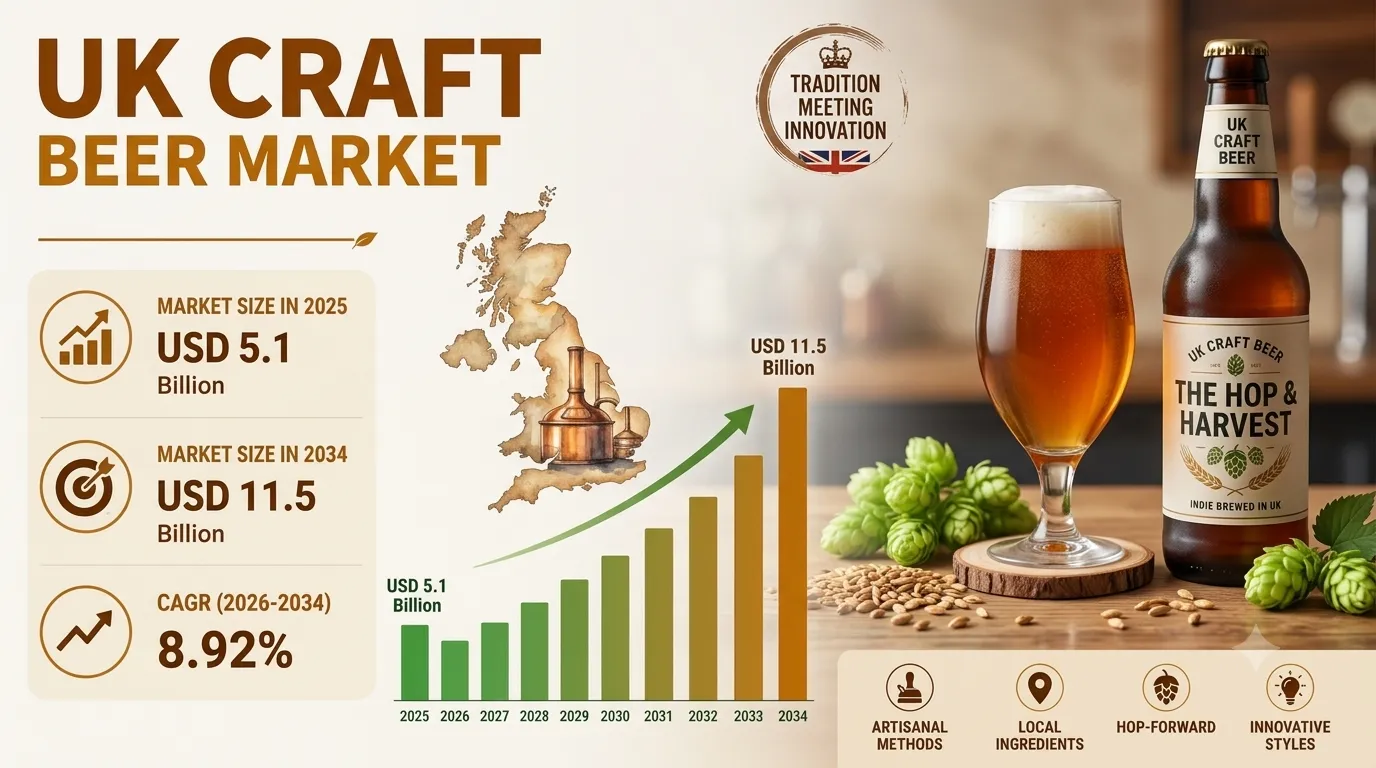

The UK craft beer market is witnessing steady growth, fueled by changing consumer tastes, an upsurge in artisanal brewing, and growing demand for distinctive flavour profiles. The market size reached USD 5.1 Billion in 2025 and is projected to reach USD 11.5 Billion by 2034, exhibiting a compound annual growth rate (CAGR) of 8.92% during 2026-2034. The younger population is most influential in shaping the market, with more enthusiasm for premium and locally made drinks. Retail and web channels of distribution are growing, providing greater access to wide varieties of craft beers. This market is strategically important to the UK economy as it directly supports the hospitality, retail, tourism, and brewing sectors.
The UK craft beer market is poised for sustained expansion, driven by flavor innovation, festival and taproom growth, and sustainability-focused brewing practices. With a projected CAGR of 8.92% through 2034, the market presents significant opportunities for established breweries and new entrants focused on artisanal, premium, and sustainable craft beer formulations.
UK CRAFT BEER MARKET SUMMARY
- The UK craft beer market encompasses a wide range of artisanal beer products designed for consumption across social, cultural, and recreational settings, including ales, lagers, and other craft beer varieties. The ecosystem includes craft breweries, ingredient suppliers (hops, malt, yeast), distributors, retailers, and end-use consumers. Major segments identified in the market include product type (ales, lagers, and others), age group (21–35 years old, 40–54 years old, and 55 years and above), and distribution channel (on-trade and off-trade). The ales segment is a dominant product type category, while the 21–35 years age group is the most influential consumer segment.
- The market is characterized by flavor and innovation reigniting craft identity. UK breweries are reigniting interest in traditional beer styles while infusing them with bold flavor innovations. Consumers increasingly value authenticity and creativity which includes a renewed focus on cask ales alongside experimentation with barrel-aged stouts and fruit-infused ales. Market insights from early 2024 show stout was the only segment to grow within craft beer, recording nearly double the volume sales compared to the previous year, demonstrating consumer appetite for richer, artisanal products. Taproom events and beer festivals serve as key channels for showcasing such creations, driving engagement through storytelling and ingredient exploration. Brewers are also expanding into blended styles that combine malt-forward bases with hops or fruit adjuncts, appealing to a sophisticated cohort of drinkers.
- The market is also benefiting from festival and taproom growth. The proliferation of craft beer festivals and taprooms across the UK has accelerated notably in 2024, signaling rising consumer enthusiasm and a maturing market landscape. Major events held in cities such as Manchester, Edinburgh, and Bristol have experienced significant attendance growth, underpinned by the wider cultural shift towards experiential consumption and community engagement. These festivals and taproom experiences provide vital platforms for breweries to showcase a wide variety of beer styles while educating attendees about brewing processes and flavor profiles. They also serve as interactive spaces for consumer feedback, enabling brewers to innovate in response.
- The market is increasingly prioritizing sustainability and wellness-focused innovation as key drivers shaping consumer preferences. A significant rise in the popularity of non-alcoholic and low-alcohol beers reflects a growing societal shift toward healthier lifestyle choices and mindful drinking habits. Alongside this, breweries are actively adopting environmentally responsible practices such as water recycling, the use of renewable energy sources, biodegradable packaging materials, and comprehensive waste reduction programs throughout their production processes. These efforts demonstrate a commitment to minimizing environmental impact while maintaining product quality.
- The market is segmented by region, with London, South East, North West, East of England, South West, Scotland, West Midlands, Yorkshire and The Humber, East Midlands, and Others representing the key regional markets. London remains the largest and most dynamic market, driven by its diverse population, thriving craft beer scene, and high concentration of taprooms and craft beer festivals.
PORTER'S FIVE FORCES ANALYSIS – UK CRAFT BEER MARKET
The competitive dynamics of the UK craft beer market can be analyzed using Porter's Five Forces framework.
Porter's Five Forces Analysis – UK Craft Beer Market
- Competitive Rivalry: High, with intense competition between established craft breweries and emerging microbreweries. Rivalry is driven by product innovation, flavor differentiation, brand loyalty, and distribution network strength. Business implication: Craft breweries must differentiate through unique flavor profiles, authentic storytelling, and strong community engagement to capture consumer attention and maintain market share.
- Supplier Power (Hop, Malt, and Ingredient Suppliers): Moderate. Suppliers of key ingredients such as hops, malt, yeast, and specialty adjuncts have moderate negotiating power due to the availability of substitutes and global sourcing options. However, specialty and premium ingredient suppliers may have greater influence. Business implication: Craft breweries should develop strategic partnerships with suppliers and explore local sourcing to ensure consistent quality and manage costs.
- Buyer Power (Consumers and Retailers): Increasing. Consumers and retailers have growing bargaining power as sophisticated purchasers with access to a wide range of craft beer choices, demanding lower prices, transparency, and unique products. Business implication: Craft breweries must demonstrate strong value propositions, align with consumer trends, and offer innovative products to attract and retain customers.
- Threat of Substitutes: High. Alternative beverages such as non-alcoholic beers, hard seltzers, spirits, wines, and other craft beverages pose significant substitution threats. Changing consumer preferences and health consciousness are driving demand for low and no-alcohol alternatives. Business implication: Craft breweries must innovate in the low and no-alcohol space and articulate clear value propositions relative to alternatives.
- Threat of New Entrants: Moderate. High barriers to entry exist for large-scale brewing (capital, distribution, brand recognition), but lower barriers for microbreweries and taproom-based craft producers. The UK's growing market attracts new domestic and international entrants. Business implication: Established players should build defensible positions through brand equity, distribution networks, and strong retailer relationships.
Competitive Rivalry – Moderate to High (Healthy)
- Multi-tier competition spans established craft breweries (BrewDog, Fuller's, Greene King), specialized players (regional microbreweries, taproom-based producers), and emerging craft beer brands – driving differentiation through product innovation, sustainability credentials, and community engagement rather than destructive price competition.
- In June 2025, BrewDog, the Scottish craft beer company headquartered in Ellon, Aberdeenshire, expanded its presence in Australia, increasing global revenues by £12 million. The UK government supported this growth by showcasing BrewDog's products at diplomatic events in Brisbane, Sydney, Melbourne, and Perth. This strategic collaboration highlights BrewDog's commitment to international expansion and the UK's support for its domestic businesses. The initiative underscores the growing demand for British craft beer in international markets. This success contributes to BrewDog's increasing global footprint.
Request for Sample Report:
https://www.imarcgroup.com/uk-craft-beer-market/requestsample
MARKET GROWTH DRIVERS:
Several key factors are propelling the expansion of the UK craft beer market. The flavor and innovation reigniting craft identity serves as a powerful demand driver for craft beer. UK breweries are reigniting interest in traditional beer styles while infusing them with bold flavor innovations. Consumers increasingly value authenticity and creativity which includes a renewed focus on cask ales alongside experimentation with barrel-aged stouts and fruit-infused ales.
Market insights from early 2024 show stout was the only segment to grow within craft beer, recording nearly double the volume sales compared to the previous year, demonstrating consumer appetite for richer, artisanal products. Taproom events and beer festivals serve as key channels for showcasing such creations, driving engagement through storytelling and ingredient exploration. Brewers are also expanding into blended styles that combine malt-forward bases with hops or fruit adjuncts, appealing to a sophisticated cohort of drinkers.
This dynamic reflects evolving UK craft beer market trends, where heritage and innovation converge. By celebrating traditional styles while embracing experimentation, the craft beer community is cultivating brand loyalty and ensuring relevance in a changing beer landscape. Additionally, the festival and taproom growth is fueling market expansion. The proliferation of craft beer festivals and taprooms across the UK has accelerated notably in 2024, signaling rising consumer enthusiasm and a maturing market landscape. Major events held in cities such as Manchester, Edinburgh, and Bristol have experienced significant attendance growth, underpinned by the wider cultural shift towards experiential consumption and community engagement.
These festivals and taproom experiences provide vital platforms for breweries to showcase a wide variety of beer styles while educating attendees about brewing processes and flavor profiles. They also serve as interactive spaces for consumer feedback, enabling brewers to innovate in response. Alongside festival growth, craft beer sales in on-trade venues, including specialist pubs and brewpubs, have seen a strong resurgence, helping microbrewers establish deeper connections with local communities. This upsurge in both festivals and taproom visibility directly supports UK craft beer market growth by expanding distribution channels and fostering a vibrant craft culture. The trend toward regional festival expansion further democratizes access to craft beer, encouraging inclusivity and sustaining the sector's long-term vitality.
MARKET GROWTH DRIVERS:
The UK craft beer market is also benefiting from sustainability and health-conscious brewing and evolving consumer demands. The 2025 UK craft beer market increasingly prioritizes sustainability and wellness-focused innovation as key drivers shaping consumer preferences. A significant rise in the popularity of non-alcoholic and low-alcohol beers reflects a growing societal shift toward healthier lifestyle choices and mindful drinking habits. Alongside this, breweries are actively adopting environmentally responsible practices such as water recycling, the use of renewable energy sources, biodegradable packaging materials, and comprehensive waste reduction programs throughout their production processes.
These efforts demonstrate a commitment to minimizing environmental impact while maintaining product quality. Additionally, digital innovations such as virtual tasting events, QR code-enabled traceability, and transparent storytelling about breweries' environmental and social initiatives are enhancing consumer trust and deepening brand engagement. These developments collectively embody a critical shift in the UK craft beer market, showcasing how the sector is evolving to meet increasing demands for ethical production and corporate social responsibility.
This convergence of craftsmanship, sustainability, and health-consciousness is positioning the industry for sustainable, long-term growth, while strengthening consumer loyalty through authenticity and shared values. Furthermore, the changing consumer tastes, upsurge in artisanal brewing, and growing demand for distinctive flavour profiles are contributing to market growth. The younger population is most influential in shaping the market, with more enthusiasm for premium and locally made drinks.
UK CRAFT BEER MARKET SEGMENTATION
Segmentation analysis provides a detailed view of the UK craft beer market by category:
- Product Type Insights: Ales, Lagers, Others.
- Age Group Insights: 21–35 Years Old, 40–54 Years Old, 55 Years and Above.
- Distribution Channel Insights: On-Trade, Off-Trade.
- Regional Insights: London, South East, North West, East of England, South West, Scotland, West Midlands, Yorkshire and The Humber, East Midlands, Others.
COMPETITIVE LANDSCAPE
The UK craft beer market features a moderately consolidated competitive landscape, with multi-tier competition spanning established craft breweries and emerging microbreweries. Key companies operating in the market include:
- BrewDog plc
- Fuller's Brewery
- Greene King
- Marston's PLC
- Young's Pubs
- Adnams plc
- Samuel Smith Brewery
- Timothy Taylor's
- Beavertown Brewery
- Tiny Rebel Brewing Co.
Strategic developments are shaping the competitive arena, notably BrewDog's expansion into Australia (June 2025), increasing global revenues by £12 million. The UK government supported this growth by showcasing BrewDog's products at diplomatic events in Brisbane, Sydney, Melbourne, and Perth. This strategic collaboration highlights BrewDog's commitment to international expansion and the UK's support for its domestic businesses. The initiative underscores the growing demand for British craft beer in international markets. This success contributes to BrewDog's increasing global footprint. Additionally, the growing popularity of non-alcoholic and low-alcohol craft beers, the adoption of sustainable brewing practices, and the expansion of taproom and festival culture are driving innovation across the market.
REGIONAL ANALYSIS:
Regional dynamics within the UK craft beer market are shaped by varying levels of consumer preferences, brewing heritage, and hospitality infrastructure. London emerges as a critical demand center, driven by its diverse population, thriving craft beer scene, and high concentration of taprooms and craft beer festivals.
The South East benefits from significant disposable incomes and a strong pub culture, while the North West sees demand from both urban centers and rural communities. The East of England and South West have strong agricultural and tourism bases, contributing to local craft beer consumption. Scotland is renowned for its brewing heritage and contributes significantly to the craft beer segment. The West Midlands, Yorkshire and The Humber, and East Midlands, though smaller in market share, are seeing growth from regional breweries, taprooms, and expanding retail networks.
RECENT INDUSTRY DEVELOPMENTS
June 2025: BrewDog, the Scottish craft beer company headquartered in Ellon, Aberdeenshire, has expanded its presence in Australia, increasing global revenues by £12 million. The UK government supported this growth by showcasing BrewDog's products at diplomatic events in Brisbane, Sydney, Melbourne, and Perth. This strategic collaboration highlights BrewDog's commitment to international expansion and the UK's support for its domestic businesses. The initiative underscores the growing demand for British craft beer in international markets. This success contributes to BrewDog's increasing global footprint.
2024: Stout was the only segment to grow within craft beer, recording nearly double the volume sales compared to the previous year, demonstrating consumer appetite for richer, artisanal products.
2024: The proliferation of craft beer festivals and taprooms across the UK accelerated notably, with major events held in cities such as Manchester, Edinburgh, and Bristol experiencing significant attendance growth.
2024: Craft beer sales in on-trade venues, including specialist pubs and brewpubs, have seen a strong resurgence, helping microbrewers establish deeper connections with local communities.
2025: The UK craft beer market increasingly prioritizes sustainability and wellness-focused innovation, with a significant rise in the popularity of non-alcoholic and low-alcohol beers and the adoption of environmentally responsible brewing practices.
Key Aspects Required for the UK Craft Beer Market
- Market Performance: USD 5.1 Billion in 2025, with a projected trajectory to USD 11.5 Billion by 2034.
- Market Outlook: An 8.92% CAGR through 2034 indicates robust growth across ales, lagers, and other craft beer segments.
- Growth Drivers: Changing consumer tastes; upsurge in artisanal brewing; growing demand for distinctive flavour profiles; flavor and innovation reigniting craft identity; festival and taproom growth; sustainability and health-conscious brewing; younger population enthusiasm for premium and locally made drinks.
- Competitive Landscape: A distinctive multi-tier structure with established craft breweries (BrewDog, Fuller's, Greene King) and regional microbreweries, with moderate concentration at the brand level.
- Value Chain Analysis: From raw material sourcing (hops, malt, yeast, specialty adjuncts) through brewing, quality control, distribution, retail, and on-trade consumption to consumer engagement and community building.
- Industry Trends: Flavor innovation and traditional beer styles; festival and taproom growth; sustainability and health-conscious brewing; non-alcoholic and low-alcohol craft beers; barrel-aged stouts and fruit-infused ales; digital innovations (virtual tasting events, QR code traceability); regional branding.
- Strategic Recommendations: Focus on flavor innovation and traditional beer styles, invest in sustainability and health-conscious brewing practices, expand festival and taproom presence, build strong relationships with retailers and on-trade partners, develop differentiated capabilities in artisanal brewing and community engagement, and leverage government support for international expansion.
Note: If you need any specific information that is not covered currently within the scope of the report, we will provide the same as a part of customization.
Write this before about us –
- Report Format, Delivery, and Customization Details
- Report Format Mode: PPT, PDF, and Excel
- Report Delivery Mode: Online Delivery, Physical Delivery
- Report Delivery Time: Report Delivered Over Email within 24 to 48 hours. If requested by the client, a physical copy will be delivered within three to ten days.
- Report Confirmation Mode: Yes via Email
- Report Customization Mode: Yes via Email / Call
- Report Table of Content: Yes
- Report List of Figures: Yes
- Report Methodology Mode: Yes
- Request For Sample Report: Yes


















Sign in to leave a comment.