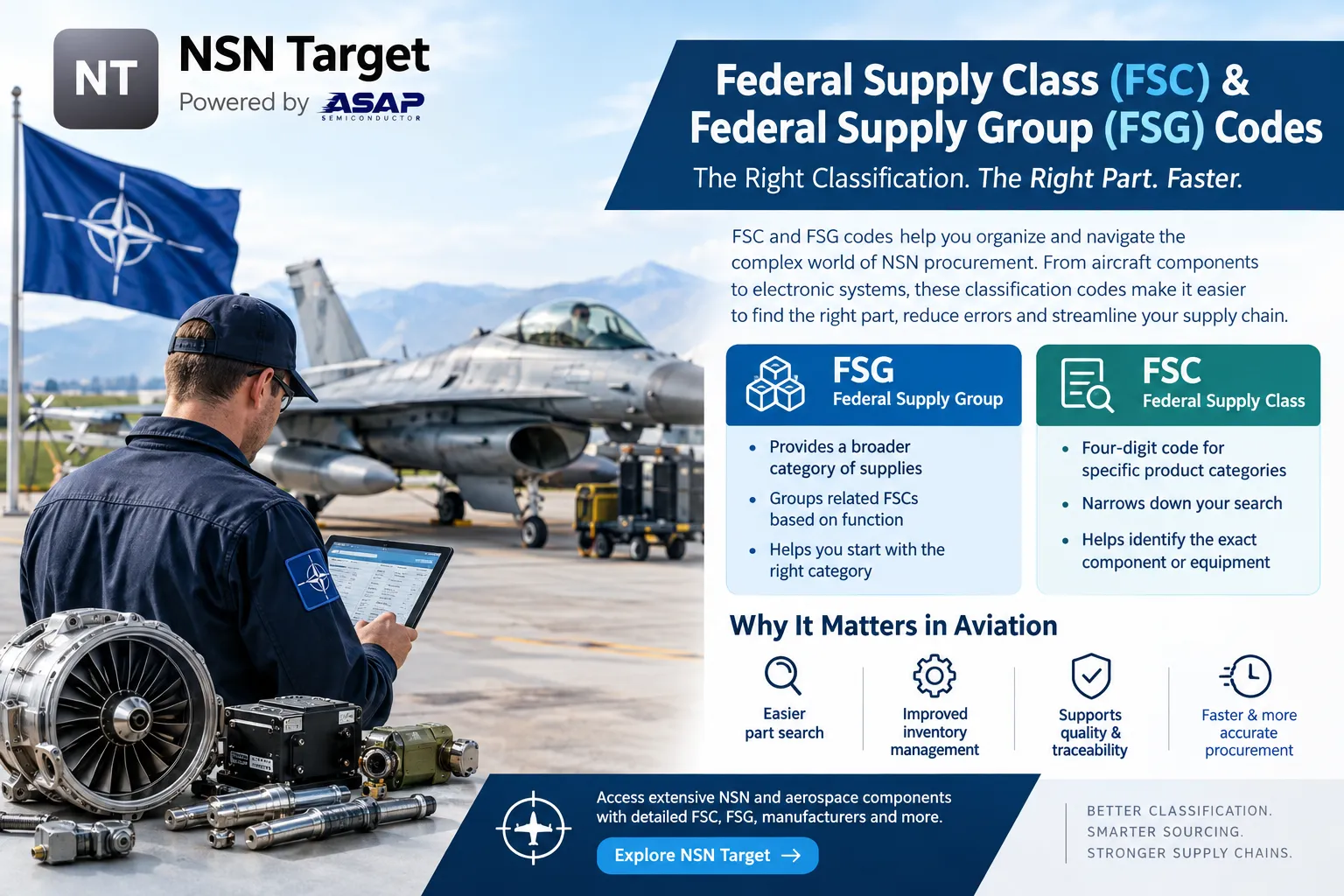

Efficient parts procurement depends on accurate identification, classification, and sourcing. In aviation, defense, and industrial supply chains, Federal Supply Class (FSC) and Federal Supply Group (FSG) codes provide an organized way to categorize equipment, components, and materials. Understanding these classification systems can help procurement professionals locate suitable NSN parts more efficiently and reduce errors during purchasing.
What Are Federal Supply Class Codes?
A Federal Supply Class, commonly abbreviated as FSC, is a four-digit classification used to group products with similar characteristics and functions. Each FSC represents a particular category of supplies or equipment.
For example, FSC 1620 covers aircraft landing gear components, while FSC 5961 covers semiconductor devices and associated hardware. NSN databases commonly display the FSC alongside an item's NSN, NIIN, part number, manufacturer, and item description.
Because FSC codes narrow down large inventories into logical categories, they can be particularly useful when researching replacement components, maintenance requirements, or alternative sourcing options.
Understanding Federal Supply Groups
Federal Supply Groups, or FSGs, provide a broader classification structure. An FSG brings together related Federal Supply Classes based on their general function or product category. In simple terms, an FSG provides the broader category, while an FSC offers a more specific classification within that category.
This hierarchy makes it easier for buyers and supply professionals to navigate extensive catalogs of standardized components. Instead of searching an enormous database without direction, users can begin with a relevant supply group and then narrow their search to a specific FSC.
Why FSC and FSG Codes Matter in Aviation
Aviation maintenance programs involve thousands of components, ranging from fasteners and electrical equipment to landing gear, engines, and electronic assemblies. Accurate classification can make the sourcing process more organized.
FSC information can help procurement teams:
- Identify relevant categories of replacement parts
- Narrow large NSN databases
- Research manufacturers and part numbers
- Compare related components
- Support inventory management
- Improve purchasing and sourcing workflows
For example, NSN Target's catalog presents individual FSC categories with associated part numbers, NSNs, manufacturers, quantities, and RFQ options, giving buyers a structured way to research available components.
FSC Codes and National Stock Numbers
FSC codes are an important part of NSN identification. An NSN is a 13-digit standardized identification number used to identify supply items, while the FSC represents the four-digit classification portion associated with the item. The NIIN forms the remaining identifying portion after the FSC.
When sourcing a component, procurement specialists should avoid relying on classification alone. The complete NSN, part number, manufacturer, technical specifications, condition, and applicable documentation should also be verified before an order is placed.
Supporting Better Procurement Decisions
Using FSC and FSG classifications alongside detailed NSN information can make aerospace and defense procurement more efficient. Buyers can use these classifications to discover relevant components while then validating the exact technical and sourcing requirements for a specific application.
NSN Target provides access to extensive NSN and aerospace component listings, including new and obsolete items, with RFQ support for sourcing requirements. The platform also highlights quality and traceability considerations for its supplied parts.
Conclusion
Federal Supply Groups and Federal Supply Classes provide an organized framework for navigating complex procurement catalogs. By understanding how FSG and FSC classifications relate to NSNs, procurement teams can improve parts research, inventory organization, supplier discovery, and purchasing efficiency. For aviation, defense, and industrial applications, combining classification data with complete part and manufacturer information is an effective approach to accurate component sourcing.

























Sign in to leave a comment.