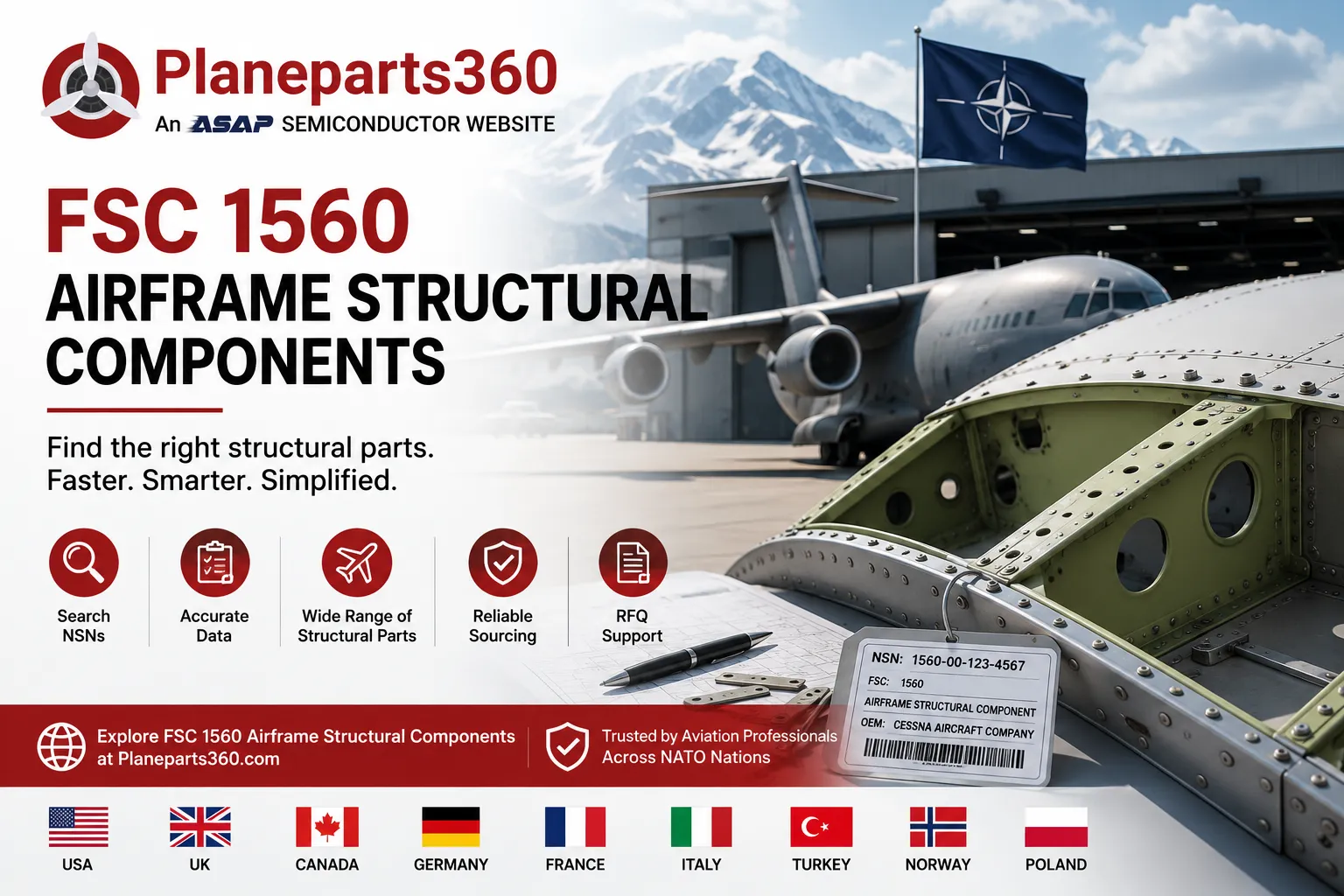

Aircraft structural integrity depends on thousands of precisely engineered components, from spars and ribs to flight-control surfaces, fairings, bulkheads, and structural plates. For aviation maintenance, repair, and procurement teams, identifying the correct part quickly is essential to maintaining aircraft reliability and minimizing downtime.
One of the most important classification categories for these requirements is Federal Supply Class (FSC) 1560 – Airframe Structural Components. Understanding this classification can make NSN research, parts identification, and procurement more efficient.
What Is FSC 1560?
FSC 1560 belongs to Federal Supply Group (FSG) 15 – Aerospace Craft and Structural Components. The U.S. Product and Service Codes Manual defines FSC 1560 as covering fabricated system parts that are permanently attached to, or specifically associated with, an aircraft's integral airframe. Examples include support structural components, spars, ribs, ailerons, stabilizers, and bulkheads.
The classification also includes flight-control surfaces, auxiliary fuel tanks, exhaust systems, pylons, and aircraft trim tabs.
This standardized system helps procurement professionals organize and locate aerospace components using consistent classification information.
Why NSN Classification Matters in Aviation
An National Stock Number (NSN) provides a standardized identification method for items used by government and defense supply systems. Instead of relying only on descriptions that can vary between manufacturers or suppliers, procurement teams can use an NSN together with a part number, manufacturer information, and other technical identifiers.
For structural aircraft components, this is particularly valuable because similar-looking parts can have different specifications, applications, or configurations. Accurate identification should therefore always be based on authoritative technical documentation and applicable maintenance requirements.
Common Components Found Under FSC 1560
FSC 1560 covers a broad range of airframe-related items. Depending on the specific aircraft and application, procurement searches can include:
- Aircraft structural plates and supports
- Spars, ribs, and bulkhead-related components
- Leading edges and aircraft tips
- Fairings and access covers
- Aileron-related assemblies and components
- Trim tabs and flight-control surfaces
- Structural repair components
- Aircraft pylons and other permanently installed structures
Current FSC 1560 catalogs demonstrate the breadth of this classification. For example, Plane Parts 360 listings include aircraft access covers, leading edges, aircraft tips, aileron actuator assemblies, structural plates, and structural supports associated with manufacturers such as Cessna Aircraft Company.
How to Find the Correct FSC 1560 Part
Effective aerospace procurement starts with accurate part identification. Before requesting a quotation, buyers should collect as much information as possible, including:
- NSN or NIIN – Use the complete stock number whenever available.
- Part number – Verify the exact manufacturer or OEM part number.
- Manufacturer – Confirm the manufacturer associated with the required component.
- CAGE Code – When available, use it to distinguish manufacturers and suppliers.
- Aircraft application – Confirm compatibility with the specific aircraft or system.
- Technical documentation – Cross-check applicable manuals, drawings, and approved maintenance information.
This approach reduces the risk of ordering an interchangeable-looking component that does not meet the required configuration.
Streamlining FSC 1560 Parts Procurement
For maintenance organizations, defense contractors, repair stations, and aviation procurement departments, searching a structured NSN database can significantly simplify parts research. Plane Parts 360 provides an online FSC database where users can explore aerospace supply classifications and related NSN information. Its dedicated FSC 1560 catalog organizes airframe structural components by part number, NSN, item description, manufacturer, availability, and RFQ options.
The catalog can be particularly useful when procurement teams need to research multiple structural components or submit requirements for quotation.
Conclusion
FSC 1560 provides an organized framework for identifying and sourcing airframe structural components used in aircraft maintenance and support. By combining FSC classification with NSNs, part numbers, manufacturer information, and technical documentation, aviation professionals can improve procurement accuracy and reduce unnecessary sourcing delays.
For organizations researching aerospace classifications or looking for specific FSC 1560 airframe structural components, a structured NSN catalog and detailed RFQ process can provide a practical starting point for identifying the right requirements.
























Sign in to leave a comment.