Understanding the True Operational Cost of Your Ecommerce Platform

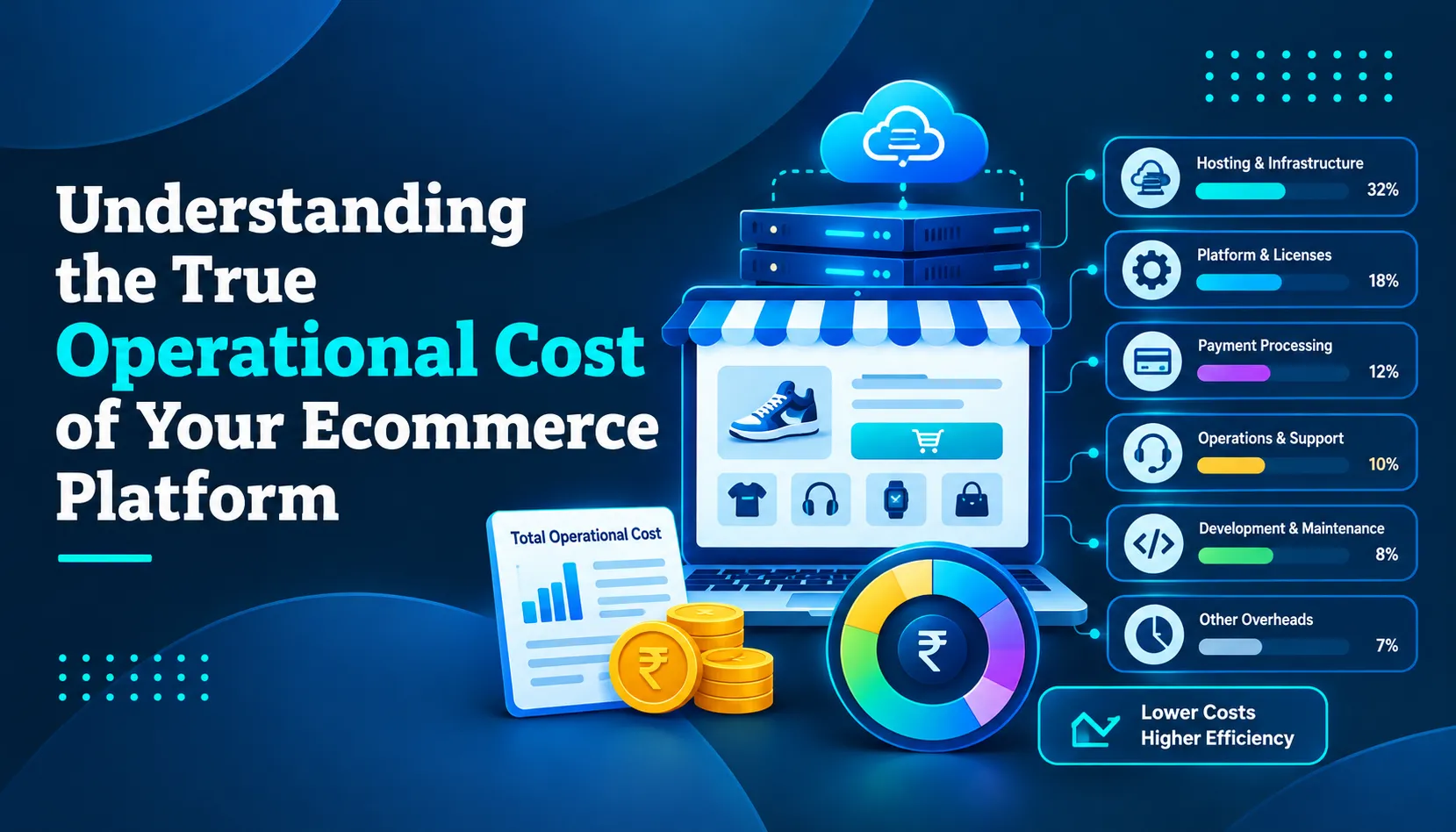
Ecommerce platform operational capacity is the metric that reveals whether a commerce platform is enabling business growth or consuming the resources needed to fund it. Most organizations track platform cost through licensing fees and hosting invoices. The engineering hours spent on patching, compatibility testing, infrastructure management, and incident response are harder to see, they distribute across teams, disappear into multiple budget lines, and rarely surface as a single number. When that distributed cost grows large enough, it becomes a direct constraint on what the business can actually build and deliver. This guide covers how to measure the real operational burden, what drives it, and when the numbers make a migration conversation necessary.
Platform Maintenance Is a Business Allocation Decision
Engineering capacity does not expand when platform demands increase. Every hour a team spends keeping a commerce platform secure, current, and operational is an hour unavailable for customer experience development, conversion optimization, automation, or new commercial capabilities. That is an allocation decision, and it compounds as customization depth, integration density, and technical debt accumulate over time.
A modern Adobe Commerce environment spans PHP, Composer, OpenSearch, MariaDB, RabbitMQ, ActiveMQ Artemis, and Valkey, each with independent version requirements, compatibility constraints, and security lifecycles. Managing that stack requires engineering ownership that extends significantly beyond the commerce application itself. The more useful question is not whether the platform can support the business, it is how much capacity running the platform actually consumes and whether that allocation remains commercially justified.
What Ecommerce Platform Operational Capacity Actually Covers
The operational burden of a self-managed commerce environment distributes across multiple teams and responsibility areas. The realistic footprint includes:
- Platform engineering covering version upgrades, configuration management, and custom code maintenance
- Security covering vulnerability remediation and patch deployment across the full stack
- Infrastructure covering hosting, databases, caching layers, search infrastructure, and message queues
- Release engineering covering dependency management and deployment coordination
- QA covering regression testing across all custom functionality after every platform change
- Integration management covering ERP, PIM, CRM, payment, and third-party system maintenance
- Performance covering monitoring, tuning, and readiness ahead of peak traffic events
- Incident response covering production troubleshooting and resolution
None of this is unnecessary, every commerce environment requires technical ownership. The problem is opportunity cost. Every hour allocated to platform operations is an hour unavailable for the capabilities that grow revenue and differentiate the business commercially.
Platform Complexity Is Not Determined by Feature Count
Two organizations running the same Magento release can face completely different operational demands. The difference is not the platform version, it is the number of technical relationships each organization must continuously validate and manage across application dependencies, custom modules, search and database behavior, caching and messaging services, external integrations, custom storefront logic, and deployment processes.
McKinsey research found that CIOs estimate technical debt at 20 to 40 percent of the value of their entire technology estate, and that 10 to 20 percent of budgets intended for new product development can be redirected toward addressing accumulated debt instead. A structured platform comparison helps organizations understand how different platforms distribute technical responsibility across infrastructure ownership, customization depth, and ongoing maintenance accountability.
Separating Run Capacity From Change Capacity
Dividing engineering work into two distinct categories makes the allocation visible and measurable rather than estimated.
Run capacity is the work required to keep the platform operational:
- Security patching and vulnerability remediation
- Version upgrades and compatibility testing
- Infrastructure management and monitoring
- Incident response and production troubleshooting
- Extension remediation after platform changes
- Performance tuning and peak-load readiness
- Release management and deployment coordination
Change capacity is the work that improves the business:
- New customer experiences and storefront capabilities
- Conversion rate optimization
- Automation, personalization, and analytics development
- New integrations and revenue-generating functionality
Every commerce environment needs some run capacity. The question is not whether to invest in it. It is whether the current allocation leaves enough change capacity for the business to execute its roadmap at the pace it actually requires.
Calculating the Platform Capacity Ratio
A simple formula makes the allocation visible:
Platform Capacity Ratio equals Platform Maintenance Hours divided by Total Available Engineering Hours multiplied by 100.
If an organization has 10,000 available engineering hours annually and spends 3,000 on platform maintenance, 30 percent of total engineering capacity goes to platform operations. Whether that is acceptable depends entirely on what the remaining 70 percent needs to accomplish, not on any industry benchmark.
Three Factors That Drive Platform Operational Overhead
Customization Depth
Custom functionality creates genuine business value when it supports processes competitors cannot easily replicate. The problem begins when customizations persist because they were historically built, not because they continue to serve a current commercial purpose. Each additional module introduces another component to test, maintain, and validate with every platform update, regardless of whether the underlying need still exists.
Integration Dependency
Commerce platforms rarely operate independently. ERP, PIM, CRM, payment, fulfillment, tax, and analytics systems all introduce dependencies that must be managed alongside every platform change. The tighter those connections to the core platform, the greater the disruption risk from updates and the greater the engineering effort required to manage releases safely. Integration density compounds operational overhead in ways that often only become fully visible during major version upgrades.
Infrastructure Ownership
Self-managed environments provide genuine architectural control, and that control can be strategically valuable when the business actually needs it. But control creates continuous responsibility. Teams managing databases, search infrastructure, caching layers, message queues, monitoring systems, and deployment pipelines carry that overhead alongside the commerce application on an ongoing basis. The strategic question is whether the business extracts sufficient value from that control to justify the capacity it consumes.
When Operational Overhead Justifies a Migration Conversation
Migration should start with an operating-model assessment, not a preferred destination platform. The assessment should establish what the current environment actually costs in engineering capacity before any alternatives are considered.
A thorough assessment covers:
- Maintenance measuring engineering hours spent keeping the platform current per quarter
- Customization identifying which custom capabilities remain genuinely essential
- Infrastructure quantifying how much infrastructure ownership the business actually requires
- Integrations mapping the number and criticality of connected systems
- Releases measuring testing and remediation effort per release cycle
- Incidents tracking frequency and engineering time consumed per production incident
- Innovation capacity calculating hours remaining for strategic development
- Total cost of ownership combining internal resources, support, and infrastructure costs
Research shows downtime can cost Fortune 1000 companies as much as one million dollars per hour, making platform reliability a direct revenue consideration. Some operational burden is unavoidable. A recurring compatibility problem driven by outdated custom code is a different and avoidable category of cost entirely.
A structured platform assessment establishes where current capacity is consumed before any migration decision is made, so the conversation is grounded in data rather than platform preferences or vendor claims.
Instead of saying “our platform requires too much maintenance,” leadership can say: “The platform consumes X engineering hours per quarter, representing Y percent of available capacity, while Z percent remains available for new commerce development.” That is a significantly stronger basis for evaluating whether the current operating model remains commercially justified.
Where Migration Services Fit in the Operating-Model Evaluation
When the assessment shows the platform consumes more capacity than the business can sustain, migration becomes a question of how things need to work differently, not simply where the storefront moves.
The evaluation should address architecture, catalog and customer data, integrations, SEO continuity, and existing customizations, determining which capabilities to retain, which to redesign, and which technical responsibilities the target platform can absorb.
For organizations evaluating a move from Magento to Shopify Plus, three resources frame the practical scope:
- The Magento to Shopify Plus migration checklist provides a structured framework for identifying technical dependencies before committing to scope
- The Magento to Shopify Plus migration cost guide covers the factors that influence project scope and investment at different complexity levels
- The complete Magento to Shopify Plus migration guide addresses the broader operating-model and market considerations driving migration decisions in 2026
Shopify Plus shifts significant infrastructure responsibility to the provider. Enterprise teams retain ownership of integrations, custom applications, business workflows, and data architecture. The meaningful difference is not platform complexity, it is where that complexity resides and who carries the ongoing responsibility for managing it.
The Real Cost of a Platform Is the Capacity It Consumes
Platform costs are visible in licensing, hosting, development, and support invoices. Engineering capacity is harder to see because it distributes across developers, DevOps teams, QA resources, infrastructure owners, and external partners, appearing across multiple budget lines rather than as a single measurable figure.
That distribution makes engineering capacity the most consistently underweighted component of ecommerce total cost of ownership, and the one with the greatest compounding impact on what the business can build and deliver over time.
The objective is not to minimize engineering involvement. Every serious commerce operation requires technical resources. The question is whether the capacity required to operate the platform remains proportional to the commercial value it provides in return.
Measure the hours. Separate mandatory maintenance from complexity driven by customization, integration density, and accumulated technical debt. Compare the operating burden against what the business genuinely needs from its engineering capacity going forward. When the existing platform consumes capacity the business needs elsewhere, migration becomes an operating-model decision grounded in commercial reality rather than a technology preference.
The complete analysis and framework are covered in the full guide to ecommerce platform operational capacity.
Ready to See What Your Platform Is Actually Costing the Business?
The right starting point is measuring the current burden accurately, not selecting a destination platform first.
At Krish, we help ecommerce businesses assess platform architecture, customizations, integrations, and technical requirements before determining whether migration is justified. Our team evaluates migration dependencies, technical scope, and the operating model required after replatforming, so decisions are grounded in actual capacity data rather than platform marketing.
If your platform is creating operational drag the business can no longer justify commercially, get in touch to explore what a more sustainable ecommerce architecture could look like for your specific environment and roadmap.






Sign in to leave a comment.