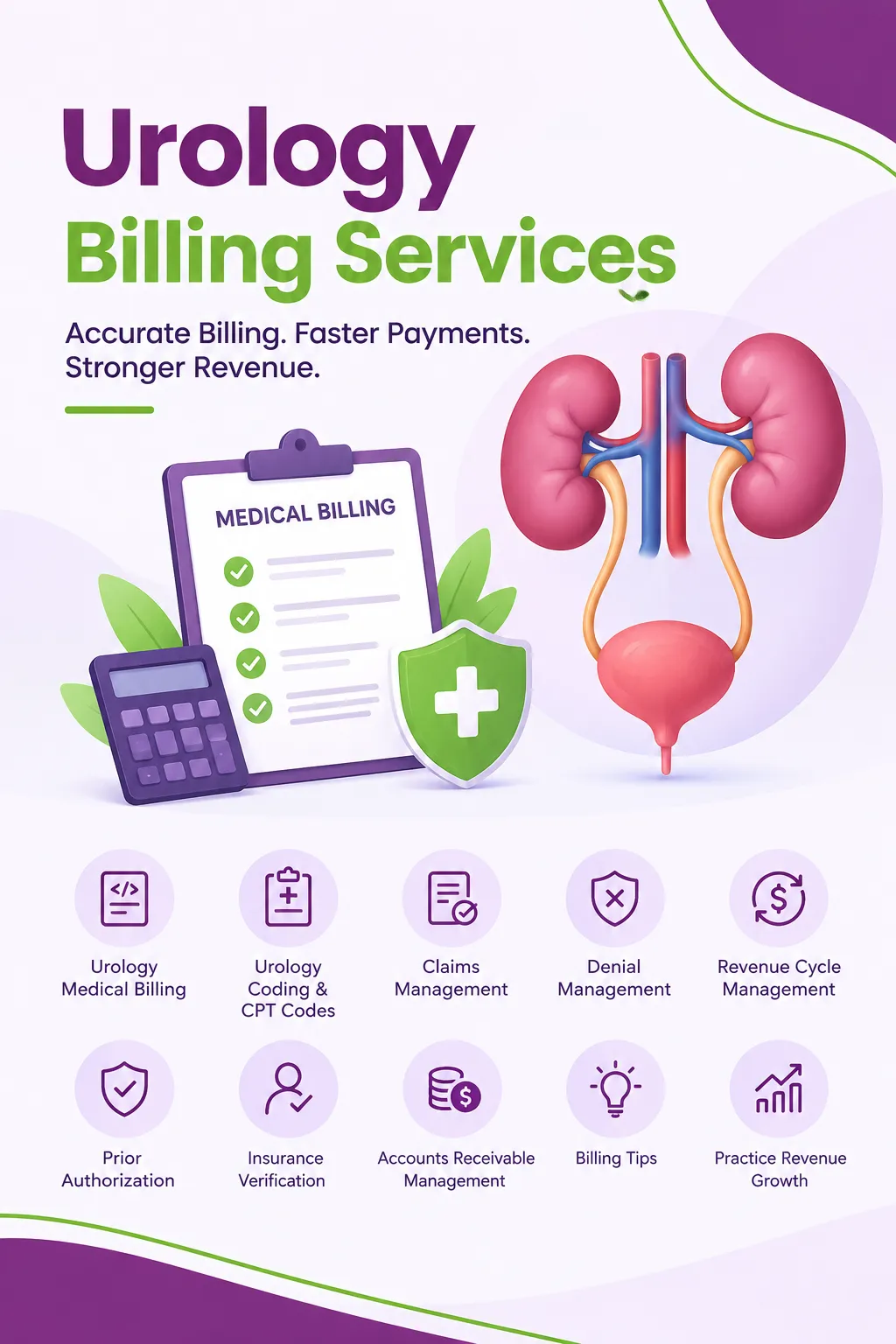

Urology billing involves far more than submitting claims for office visits and procedures. Urology practices manage complex coding combinations, surgical procedures, diagnostic testing, global surgical periods, modifiers, payer-specific policies, prior authorizations, and medical necessity requirements. A small coding or documentation error can result in claim denials, delayed reimbursement, incorrect patient responsibility, or lost revenue.
An effective urology billing workflow connects clinical documentation, coding, charge capture, claim submission, payment posting, denial management, and accounts receivable follow-up. Practices that maintain accurate billing processes can improve clean claim rates while reducing preventable revenue leakage.
What Is Urology Billing?
Urology billing is the process of translating urological services into compliant medical claims and submitting them to insurance companies for reimbursement. It includes professional and, when applicable, facility billing for services such as cystoscopy, prostate procedures, urinary tract evaluations, stone treatment, catheterization, biopsies, urodynamic testing, and other diagnostic and surgical services.
The billing process generally begins with patient registration and insurance verification. It continues through authorization, documentation review, CPT and ICD-10-CM coding, claim creation, payer adjudication, payment posting, denial resolution, and patient billing.
Because urology includes both evaluation and management services and highly specialized procedures, billing teams must understand the relationship between clinical documentation and coding requirements.
Key Components of Urology Billing
1. Patient Registration and Insurance Verification
Accurate demographic and insurance information is essential before a claim is submitted. Billing teams should verify the patient's coverage, eligibility, deductible, copayment, coinsurance, payer requirements, and authorization requirements.
Insurance verification is particularly important for procedures that may require prior authorization. Missing authorization can lead to avoidable denials even when the procedure itself is medically necessary.
2. CPT and HCPCS Coding
Urology billing relies heavily on accurate CPT coding because many services involve procedures rather than routine office visits.
Common urology services may include:
- Cystoscopy
- Urodynamic studies
- Prostate biopsy procedures
- Ureteroscopy
- Lithotripsy
- Ureteral stent procedures
- Transurethral procedures
- Catheterization
- Bladder procedures
- Imaging and diagnostic testing
Coders must select the code that accurately represents the documented service. They must also understand code-specific requirements, bundled services, add-on codes, and payer edits.
For example, certain endoscopic and surgical services can be subject to National Correct Coding Initiative edits. Reporting two codes together without verifying whether they can be separately reported may trigger a denial.
3. ICD-10-CM Diagnosis Coding
Diagnosis coding establishes the clinical reason for the service. Urology practices commonly report diagnoses related to kidney stones, hematuria, urinary retention, benign prostatic hyperplasia, urinary tract disorders, prostate conditions, bladder disorders, and male reproductive system conditions.
The diagnosis must be supported by the patient's medical record and should accurately reflect the condition evaluated or treated.
Specificity matters. Using an unspecified diagnosis when the documentation supports a more specific diagnosis can weaken the claim and may affect medical necessity adjudication.
4. Modifier Management
Modifiers are an important part of urology coding because many procedures have circumstances that affect how services should be reported.
Depending on the service and payer rules, urology claims may involve modifiers such as:
- Modifier 25: Significant, separately identifiable E/M service on the same day as another procedure or service
- Modifier 50: Bilateral procedure when applicable
- Modifier 51: Multiple procedures, when applicable under payer-specific rules
- Modifier 58: Staged or related procedure during the postoperative period
- Modifier 59: Distinct procedural service when documentation supports separate reporting
Modifiers should never be appended simply to bypass a payer edit. Documentation must support the circumstances represented by the modifier.
Common Urology Billing Challenges
NCCI and Bundling Edits
Urology procedures can involve multiple services performed during the same encounter. Payers may consider certain procedures bundled into another service.
Billing teams need to review NCCI edits and payer-specific policies before reporting multiple procedure codes. When services are separately reportable, appropriate documentation and modifiers may be necessary.
Global Surgical Periods
Many urological procedures have postoperative global periods. Billing another procedure or E/M service during a global period can create complications if the service is related to the original procedure.
The billing team should determine whether the subsequent service is included in the global package or represents a separately billable service.
Medical Necessity Denials
Payers may deny urology services when the diagnosis submitted does not establish medical necessity under the payer's coverage policy.
A strong workflow connects the clinical indication, diagnosis code, procedure code, documentation, and payer policy before claim submission.
Prior Authorization
Certain urological procedures, imaging services, medications, and advanced treatments may require authorization depending on the payer and patient's plan.
Authorization workflows should capture the authorization number, approved service, number of units or visits, validity dates, and other applicable requirements. A mismatch between the authorization and submitted claim can result in payment delays or denials.
How Technology Improves Urology Billing
Technology can improve billing accuracy by automating repetitive revenue cycle tasks and identifying potential errors before claims reach the payer.
Eligibility systems can verify active coverage and benefits. Automated claim-scrubbing tools can identify missing information, coding conflicts, demographic errors, and certain payer edits. Work queues can prioritize rejected and denied claims based on financial impact and filing deadlines.
Artificial intelligence can also assist billing teams by identifying patterns in historical denials, flagging documentation inconsistencies, and helping prioritize accounts for follow-up. However, automated systems should complement qualified billing and coding professionals rather than replace appropriate clinical and coding judgment.
Denial Management in Urology
Denial management should focus on identifying the underlying reason for nonpayment instead of repeatedly resubmitting the same claim.
Common denial categories include:
- Eligibility and coverage issues
- Missing or invalid authorization
- Coding errors
- Modifier errors
- NCCI or bundling edits
- Medical necessity
- Duplicate claims
- Incorrect patient information
- Timely filing
- Documentation deficiencies
A structured denial management process categorizes denials, identifies recurring causes, assigns responsibility, tracks appeal deadlines, and measures resolution rates.
For example, if a practice repeatedly receives modifier-related denials for a particular procedure combination, the billing team should review the coding workflow rather than treating each denial as an isolated account.
Accounts Receivable and Urology Revenue Cycle Management
Accounts receivable management is another critical component of urology billing. Unresolved claims can remain in A/R for weeks or months, creating cash-flow problems for the practice.
A/R teams should segment outstanding balances by payer, aging category, claim status, and dollar value. High-value claims approaching timely filing or appeal deadlines should receive appropriate priority.
Useful revenue cycle metrics include:
- Clean claim rate
- First-pass acceptance rate
- Initial denial rate
- Net collection rate
- Days in A/R
- A/R over 90 days
- Claim resolution time
- Appeal success rate
- Patient collection rate
Monitoring these metrics helps practices identify operational bottlenecks and determine whether billing problems originate in registration, coding, authorization, claim submission, or follow-up.
Why Specialized Urology Billing Services Matter
Urology practices often benefit from specialized billing expertise because the specialty involves complex procedure coding, payer edits, global surgical rules, authorization requirements, and frequent interactions between E/M and procedural services.
Professional Urology billing services can support practices across the revenue cycle, including eligibility verification, authorization management, charge entry, coding review, claim submission, denial management, payment posting, A/R follow-up, and reporting.
The objective is not simply to submit more claims. The goal is to submit accurate claims supported by appropriate documentation and coding while maintaining a consistent process for resolving unpaid accounts.
Conclusion
Urology billing requires specialized knowledge of CPT coding, ICD-10-CM diagnosis reporting, modifiers, NCCI edits, global surgical periods, payer policies, prior authorization, medical necessity, and accounts receivable management.
A technically structured billing workflow helps identify errors before claims are submitted and provides a systematic approach to resolving denials and aging accounts. By combining accurate coding, strong documentation, automated claim checks, proactive denial management, and detailed revenue cycle reporting, urology practices can create a more efficient billing operation and maintain greater control over reimbursement.























Sign in to leave a comment.