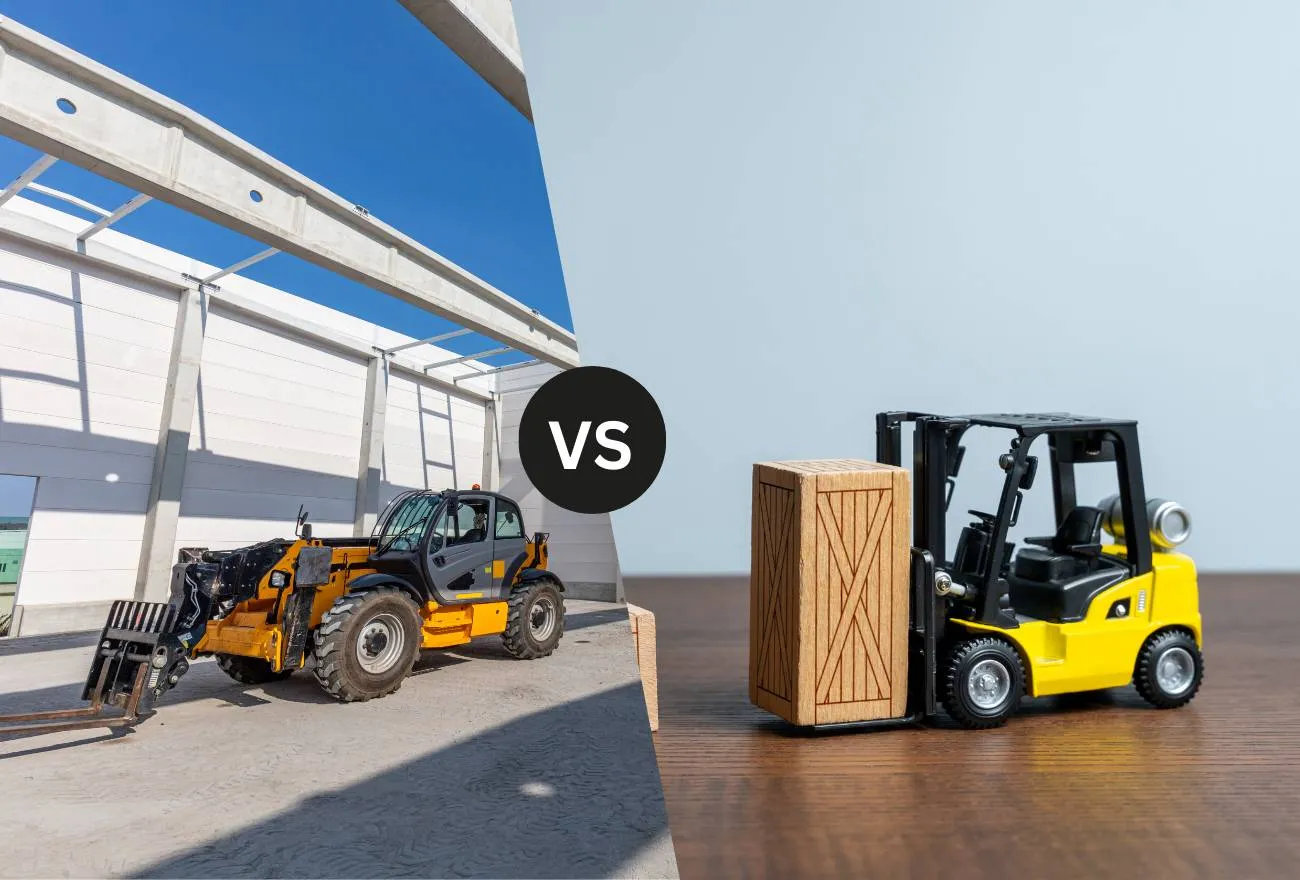
When it comes to moving, lifting, and placing heavy materials, choosing the right equipment can make a significant difference in productivity and workplace safety. Telehandlers and forklifts are both widely used for material-handling tasks, but they are designed with different capabilities in mind. Understanding their key differences can help businesses select the right machine for specific job requirements.
Visit Us:- Variations Between a Telehandlers and a Forklift: What You Need to Know
What Is a Telehandler?
A telehandler, also known as a telescopic handler, is a versatile lifting machine equipped with a telescopic boom. The boom can extend forward and upward, allowing operators to reach areas that conventional lifting equipment may struggle to access.
Telehandlers are commonly used on construction sites, farms, warehouses, and industrial projects. Depending on the attachment fitted to the boom, a telehandler can handle different types of work. Fork attachments can be used to move pallets, while buckets, lifting hooks, and other accessories can expand the machine's functionality.
One of the main advantages of a telehandler is its extended reach. It can lift materials to elevated locations and position loads at a distance from the machine. This makes it particularly useful for construction projects involving uneven terrain or elevated work areas.
What Is a Forklift?
A forklift is a dedicated material-handling vehicle primarily designed to lift, transport, and stack loads over relatively short distances. It normally uses vertical lifting forks mounted on a mast at the front of the machine.
Forklifts are especially common in warehouses, factories, distribution centers, and loading areas. Their compact design and tight turning radius make them suitable for navigating aisles and confined indoor spaces.
Unlike a telehandler, a standard forklift generally focuses on vertical lifting and horizontal transportation rather than long-distance reach. Different forklift models are available for various load capacities, operating environments, and applications.
Key Differences Between the Two
The most noticeable difference is the boom design. A telehandler uses an extendable boom that provides forward and upward reach, whereas a forklift typically uses a vertical mast for lifting loads.
Their operating environments can also differ. Telehandlers are often selected for outdoor construction, agriculture, and rough-terrain applications. Forklifts are frequently preferred for warehouses and industrial facilities where smooth surfaces and narrow working spaces are common.
Another important difference is versatility. A telehandler can accommodate multiple attachments, allowing it to perform several types of tasks. A conventional forklift is generally more specialized for pallet handling, stacking, and transporting materials.
Stability and load capacity also vary between machines and models. Operators must consider load weight, height, reach, ground conditions, and the manufacturer's rated capacity before using either type of equipment.
Which Equipment Fits Your Needs?
The choice between a telehandler and a forklift depends largely on the working conditions and the task involved. If your project requires significant reach, elevated placement, and flexibility across outdoor terrain, a telehandler may be appropriate. For repetitive pallet movement, warehouse operations, and stacking in confined spaces, a forklift may be more suitable.
Ultimately, both machines have important roles in material handling. By evaluating reach, load requirements, terrain, workspace, attachments, and operating conditions, businesses can choose equipment that aligns with their specific needs while supporting efficient and safe operations.




























Sign in to leave a comment.