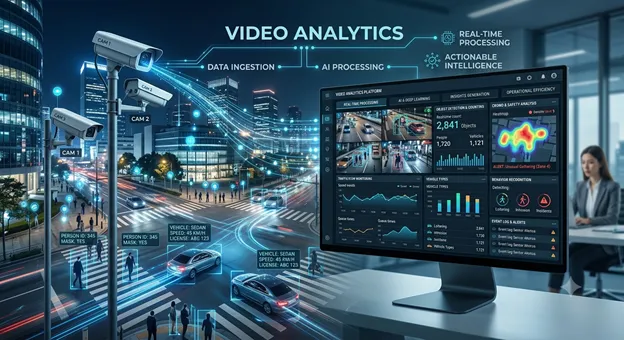

Video Analytics is transforming how facilities across the Kingdom detect and respond to fire and smoke hazards long before they escalate into disasters. As industrial plants, logistics hubs, and smart cities expand rapidly under Vision 2030, safety teams are replacing outdated detection methods with intelligent, camera-based systems that recognize danger the instant it appears — not minutes later. This guide explores how modern fire and smoke detection technology is reshaping industrial and commercial safety standards throughout Saudi Arabia, and why forward-thinking organizations are investing in it today.
Understanding Fire and Smoke Hazards in Saudi Arabia's Industrial Landscape
Saudi Arabia's industrial base — from the petrochemical complexes of Jubail and Yanbu to the logistics corridors of Dammam and the warehousing zones surrounding Riyadh — operates under conditions that make fire risk a constant concern. Extreme ambient heat, dense electrical infrastructure, flammable storage, and continuous heavy machinery use all raise the probability of ignition. Traditional point-type smoke detectors and heat sensors, while still useful, often react only after smoke has accumulated in a confined space, leaving little time for evacuation or containment. In open warehouses, high-ceiling facilities, and outdoor storage yards common across the Kingdom, these conventional systems frequently fail to trigger in time. This gap has pushed facility managers, Civil Defense consultants, and EHS teams toward camera-based early-warning technology that can visually confirm flame or smoke the moment it forms, regardless of ceiling height or airflow patterns.
What Is AI-Powered Video Analytics?
AI-Powered Video Analytics refers to intelligent software layered on top of existing or new CCTV infrastructure, using computer vision and deep learning to interpret what a camera sees in real time. Instead of simply recording footage for later review, the system continuously analyzes video frames for the visual signatures of flame flicker, smoke density, colour gradients, and particulate movement. Neural network models, trained on thousands of real fire and smoke scenarios, distinguish genuine hazards from steam, dust, fog, or reflected light — a level of contextual understanding legacy sensors cannot achieve. Because the analysis happens at the edge or on a local server, alerts are generated within seconds of ignition, giving on-site teams the earliest possible warning window before a small flare escalates into an uncontrollable fire.
How Video Analytics Software Powers Modern Fire Detection
Video Analytics Software works by continuously scanning live camera feeds against pre-trained fire and smoke recognition models, layered with rule-based logic for specific zones — loading docks, server rooms, tank farms, or production lines. Each frame is processed for pixel-level changes consistent with combustion: rising smoke columns, flame colour temperature, and rapid brightness fluctuation. When a match is confirmed across multiple consecutive frames, reducing the chance of a one-off glitch, the platform instantly triggers an alert through SMS, email, control-room dashboards, or integration with existing fire alarm panels. Many deployments also connect to PA systems, sprinkler controls, and access-control gates, allowing the software to not just detect but actively participate in the facility's emergency protocol. This layer can typically be added to existing IP camera networks, meaning organisations do not need to replace current CCTV investments to gain fire-grade detection capability.
Video Analytics Solutions Built for Saudi Industries
Every industry carries a different fire risk profile, which is why effective Video Analytics Solutions are configured around the specific hazards of each sector — oil and gas terminals, food and beverage plants, data centres, malls, hospitals, and residential towers. In Saudi Arabia, deployments are increasingly tailored to match Civil Defense and SASO safety requirements, combining thermal cameras for high-heat zones with standard IP cameras for general premises monitoring. Providers typically begin with a site risk assessment, mapping blind spots, flammable material storage, and evacuation routes before recommending camera placement and detection sensitivity thresholds. Organisations exploring a proven video analytics system for fire and smoke safety can review real deployment models already active across Saudi Arabia, Qatar, and Oman, giving decision-makers a clear picture of implementation timelines and expected outcomes before committing budget.
Why Choose an Experienced Video Analytics Partner in Saudi Arabia
Selecting the right technology partner matters as much as the technology itself. Look for a provider with hands-on deployment experience across the GCC, engineers who understand both computer-vision model tuning and Civil Defense compliance requirements, and a track record of supporting oil and gas, logistics, and commercial clients through full project lifecycles — from site survey to 24/7 post-installation support. Providers who have already delivered a proven video analytics system across Saudi Arabia, Qatar, and Oman bring practical, region-specific lessons that generic international vendors often lack, including familiarity with desert-climate hardware tolerances, Arabic-language dashboard requirements, and local regulatory documentation. Data security, model accuracy validated against real regional footage, and responsive local support are the three proof points worth verifying before signing any contract.
Conclusion
Video Analytics is no longer an optional upgrade — it is fast becoming the baseline standard for fire and smoke safety across Saudi Arabia's industrial and commercial landscape. From Real-Time Hazard Detection to Automated Emergency Response, Reduced False Alarms, and Detailed Incident Reporting, this technology closes the gaps that traditional sensors leave open. Whether deployed as part of Video Analytics KSA initiatives or Video Analytics Riyadh building upgrades, the right Video Analytics Solutions protect people, assets, and business continuity. Organisations that invest now in reliable Video Analytics Software gain a measurable safety and compliance advantage over those that wait. The path forward is clear: detect earlier, respond faster, and report smarter.





























Sign in to leave a comment.