

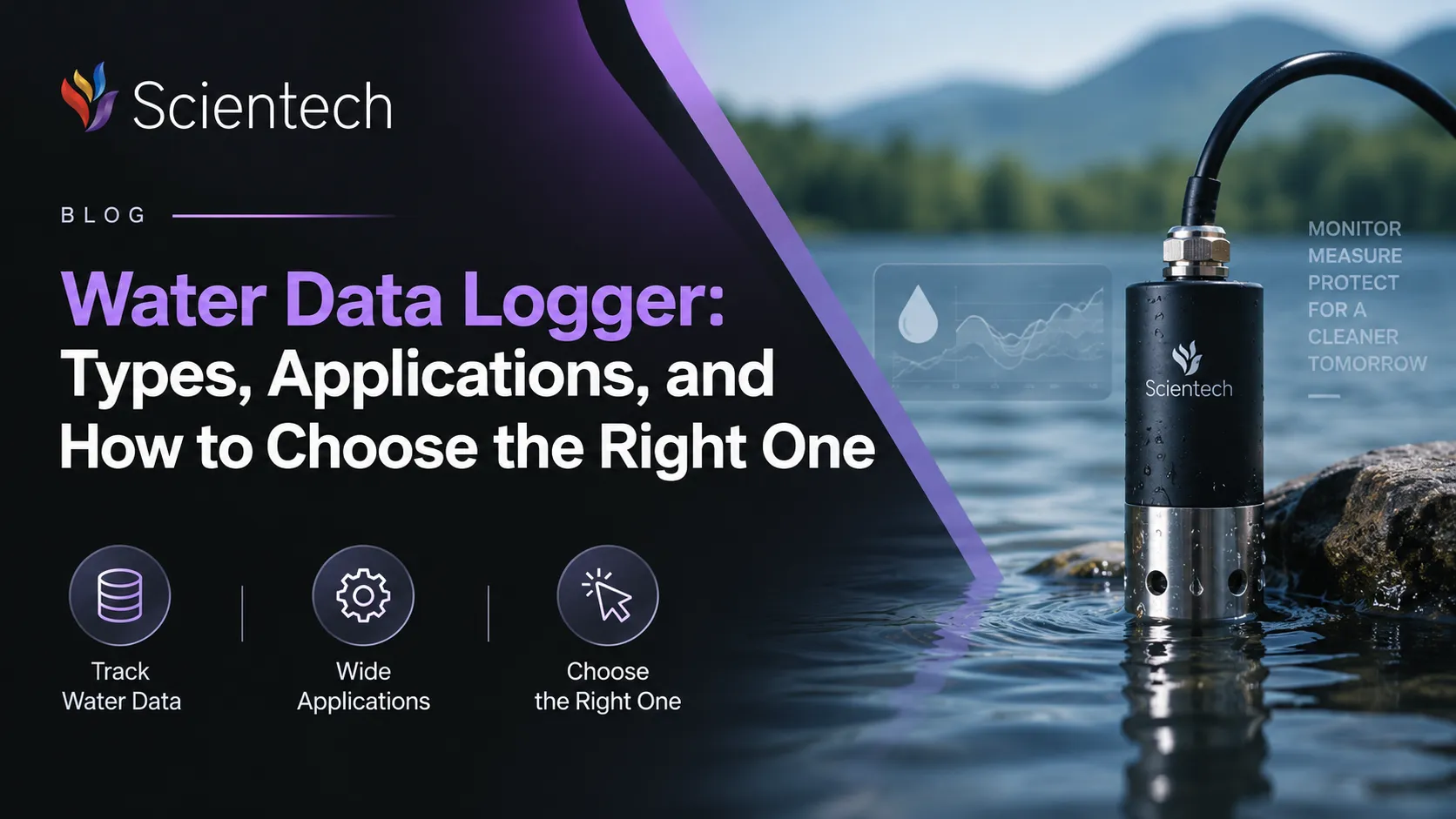
Anyone who has spent time working around rivers, wells, treatment plants, or irrigation canals knows that water rarely behaves the way a spreadsheet predicts. Levels shift overnight, temperatures swing with the seasons, and conductivity can spike after a single storm event. Trying to track these changes with manual sampling alone is a losing game. This is exactly where a water data logger earns its place in the toolkit of hydrologists, environmental engineers, municipal utilities, and researchers.
A water data logger is a compact monitoring device that records parameters like water level, temperature, conductivity, pressure, or dissolved oxygen at set intervals, without needing a person standing there with a clipboard. Over the past decade, these instruments have quietly become one of the backbones of modern water resources management, feeding continuous, reliable data into decisions that used to rely on guesswork or infrequent field visits.
In this guide, we'll walk through the different types of water data loggers available today, where each one fits best, and the practical criteria that separate a good purchase from a frustrating one. Whether you're managing a groundwater monitoring network, running an aquaculture facility, or studying water resource management in India's increasingly stressed river basins, this article should give you a clear, usable framework for making the right choice.
What Is a Water Data Logger and Why It Matters
At its core, a water data logger is an autonomous sensor and recording unit built to survive submersion or exposure in harsh field conditions while collecting data over extended periods, sometimes months or years without intervention. Most units store readings internally on non-volatile memory, and many modern models also transmit data wirelessly to a cloud dashboard or local receiver.
The value isn't just automation for its own sake. Continuous monitoring reveals patterns that spot checks simply cannot. A well might look stable during a weekly visit but actually experience daily drawdown cycles tied to nearby pumping. A stream might appear fine in the afternoon but drop below critical oxygen thresholds at 4 a.m. Without continuous data, these events go unnoticed until they cause real damage, whether that's a fish kill, a dry well, or a violation of a discharge permit.
This is why regulatory bodies, research institutions, and increasingly private companies have shifted from periodic sampling toward always-on monitoring networks built around reliable, field-tested loggers.
Types of Water Data Loggers
Not all water data loggers do the same job, and picking the wrong category is one of the most common (and expensive) mistakes people make. Here's a breakdown of the main types you'll encounter.
Water Level Data Loggers
These measure hydrostatic pressure to calculate water depth, and they're the workhorses of groundwater and surface water monitoring. Submersible pressure transducers sit below the water surface in a well or stream, while a separate barometric logger above the surface corrects for atmospheric pressure changes. Without that barometric compensation, level readings can drift and produce misleading trends, so it's worth budgeting for both units rather than the level logger alone.
Water Temperature Data Loggers
A water temperature data logger is often the simplest device in the lineup, but don't mistake simplicity for lack of importance. Temperature affects dissolved oxygen solubility, chemical reaction rates, aquatic species behavior, and even the accuracy of other sensor readings. Fisheries biologists rely heavily on these loggers to track thermal refugia for cold-water species, while wastewater operators use them to monitor process tanks where temperature swings can disrupt biological treatment.
Many of these units are small, battery-powered, and rated for long deployments (a year or more isn't unusual), which makes them popular for remote stream networks where site visits are infrequent.
Conductivity and Salinity Loggers
These track the electrical conductivity of water, which correlates with dissolved salts and total dissolved solids. They're essential in coastal aquifers dealing with saltwater intrusion, agricultural drainage studies, and estuarine research where salinity gradients shift with tides.
Dissolved Oxygen Loggers
Critical for aquaculture, wastewater treatment, and aquatic ecosystem health assessments. Optical DO sensors have largely replaced older membrane-based designs because they require less maintenance and drift less over time.
Multi-Parameter Loggers
These combine several sensors, level, temperature, conductivity, pH, turbidity, into a single housing. They cost more upfront but reduce the number of separate deployments and simplify data management, which matters a lot when you're running dozens of monitoring points across a watershed.
Rain Gauges and Flow Loggers
Technically adjacent categories, but often deployed alongside water data loggers to build a complete hydrological picture, particularly for flood forecasting and stormwater management projects.
Applications Across Industries and Research
The range of use cases for water data loggers has grown considerably as the hardware has become cheaper and more rugged.
Groundwater monitoring: Utilities and geological surveys use level loggers to track aquifer drawdown, recharge rates, and long-term sustainability of well fields.
Agriculture and irrigation: Farmers and agronomists deploy loggers in canals and reservoirs to schedule irrigation more precisely, reducing water waste while protecting crop yields.
Environmental research: Universities and conservation groups use multi-parameter loggers to study climate change impacts on lakes, rivers, and wetlands.
Aquaculture: Fish farms depend on dissolved oxygen and temperature loggers to prevent stock losses, since oxygen crashes can wipe out an entire pond in hours.
Construction and dewatering: Contractors monitor groundwater levels near excavation sites to manage dewatering systems and avoid structural risks.
Municipal infrastructure: Stormwater and wastewater departments track flow and level data to manage combined sewer overflows and plan capacity upgrades.
Coastal and tidal studies: Loggers deployed in estuaries help researchers understand saltwater intrusion patterns as sea levels change.
Each of these applications has slightly different accuracy, durability, and reporting requirements, which is part of why there's no single "best" logger for every job.
Water Data Loggers in Water Resources Management
Water resources management, at a practical level, is about knowing how much water you have, where it's going, and how it's changing over time. Continuous data logging has transformed this field from something reactive into something genuinely predictive.
Before affordable data loggers became widespread, water resource management often relied on quarterly or even annual well measurements. That kind of sparse data made it nearly impossible to detect seasonal stress on aquifers until damage had already occurred, dried wells, saltwater intrusion, or land subsidence from over-extraction. Now, networks of loggers feed near-real-time data into models that help agencies allocate water rights, forecast droughts, and plan infrastructure investment with far more confidence.
There's also a growing intersection between data logging and climate resilience planning. Basins that once saw predictable rainfall patterns are now dealing with more erratic precipitation, and the only way to catch these shifts early is through dense, continuous monitoring rather than periodic snapshots.
The Role of Water Resource Management in India
Few places illustrate the stakes of this technology better than India, where water resource management in India has become one of the country's most pressing infrastructure challenges. India supports nearly 18 percent of the world's population with roughly 4 percent of its freshwater resources, and groundwater depletion in states like Punjab, Haryana, and parts of Tamil Nadu has reached levels that researchers describe as critical.
The Central Ground Water Board and various state agencies have expanded telemetric groundwater monitoring networks over the past several years, installing level and quality loggers across thousands of observation wells. These efforts tie into national programs focused on aquifer mapping and sustainable groundwater management, aiming to replace the older system of manual dip-meter readings, which were slow, inconsistent, and difficult to scale across such a vast and hydrologically diverse country.
Beyond government initiatives, private agricultural operations and industrial water users in India are also adopting data loggers to comply with tightening environmental regulations and to manage costs in regions where water scarcity directly affects productivity. The trend suggests that continuous monitoring will only become more central to how the country balances agricultural demand, urban growth, and long-term water security.
How to Choose the Right Water Data Logger
With the landscape of available devices growing every year, choosing the right one comes down to a handful of practical questions rather than chasing the most feature-rich model on the market.
1. Define the Parameter You Actually Need
It sounds obvious, but many buyers over-invest in multi-parameter units when a simple water temperature data logger or single-channel level logger would do the job just as well, at a fraction of the cost and with far less maintenance complexity.
2. Match Accuracy and Resolution to Your Application
Regulatory reporting or scientific research often demands tighter accuracy tolerances than internal operational monitoring. Check the manufacturer's stated accuracy (for example, ±0.05% full scale for pressure transducers) and make sure it aligns with the precision your project actually requires.
3. Consider Deployment Duration and Battery Life
A logger deployed for a two-week study has very different battery and memory requirements than one meant to sit in a remote well for three years. Check both the memory capacity at your intended sampling interval and the realistic battery life under field conditions, not just the manufacturer's best-case estimate.
4. Evaluate Housing and Durability
Materials matter more than people expect. Titanium or stainless-steel housings resist corrosion in saline or contaminated environments far better than standard plastics. If the logger will sit in brackish water or a chemically active industrial discharge, this isn't an area to cut corners on.
5. Check Data Retrieval and Connectivity Options
Some projects are fine with manual retrieval, walking out, plugging in a cable, and downloading data every few months. Others, especially large monitoring networks, benefit enormously from cellular or radio telemetry that pushes data to a cloud platform automatically. Telemetry costs more upfront but saves significant labor over time and allows near-real-time alerts for critical thresholds.
6. Look at Software and Data Compatibility
A logger is only as useful as the software behind it. Look for export formats compatible with common analysis tools, clear calibration workflows, and vendor support that doesn't disappear after the sale.
7. Factor in Total Cost of Ownership
The purchase price is just the starting point. Calibration standards, replacement batteries, desiccant packs, cables, and software subscriptions all add up. A cheaper logger with expensive proprietary consumables can end up costing more over a five-year deployment than a pricier unit with open standards.
8. Verify Vendor Track Record and Local Support
Especially for large-scale water resource management projects, having a vendor with responsive technical support and spare parts availability in your region can save weeks of downtime when something goes wrong in the field.
Conclusion
Choosing the right water data logger isn't about finding the most advanced device on the shelf. It's about matching the tool to the actual problem: the parameter you need, the environment the logger will sit in, how long it needs to survive out there, and how the data will ultimately get used. A simple, well-calibrated water temperature data logger deployed correctly will outperform a sophisticated multi-parameter unit that's been poorly matched to the site conditions.
Zoom out, and the bigger picture becomes clear. Whether it's a farmer scheduling irrigation more efficiently, a municipal engineer managing stormwater capacity, or a government agency tackling the enormous scale of water resource management in India, continuous monitoring has moved from a nice-to-have to a genuine necessity. Water resources management now depends on data that's timely, granular, and trustworthy, and the humble data logger, unglamorous as it might seem, sits right at the center of making that possible.
Get the fundamentals right: define your parameters clearly, invest in durable hardware suited to your environment, and don't skimp on calibration discipline. Do that, and the data will do the heavy lifting for every decision that follows.
Learn about water data loggers, their types, applications, key features, and how to choose the right logger for accurate and reliable water monitoring.




















Sign in to leave a comment.