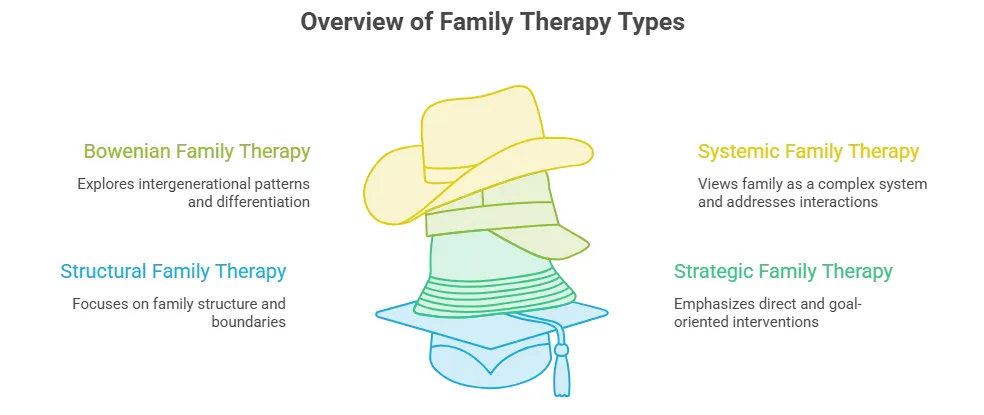


The four commonly discussed types of family therapy are Structural Family Therapy, Strategic Family Therapy, Bowenian Family Therapy, and Systemic Family Therapy. Each looks at family relationships from a different perspective, so the most appropriate approach depends on the family’s concerns, relationships, goals, and circumstances.
Family therapy is not about deciding who is responsible for a problem. Instead, it helps family members understand interaction patterns, improve communication, address conflict, and develop healthier ways of responding to one another.
Why Are There Different Types of Family Therapy?
Families do not experience problems in the same way. A parent-child conflict may involve unclear boundaries, while another family may be struggling with repeated arguments, emotional distance, or patterns that have existed across generations.
That is why family therapists may use different therapeutic models or combine techniques from several approaches. Current clinical literature describes structural, strategic, Bowenian, systemic, attachment-based, cognitive-behavioral, and other family-oriented approaches rather than treating one model as universally appropriate.
The four models below are among the most frequently discussed when people search for the main types of family therapy.
1. Structural Family Therapy
Structural Family Therapy focuses on the organization of a family. Developed by psychiatrist Salvador Minuchin, this approach looks at roles, boundaries, authority, and relationships between different parts of the family.
For example, a therapist may explore whether parents have clearly defined responsibilities or whether a child has become involved in adult conflicts. The goal is not to assign blame but to identify patterns that may be creating tension.
What does Structural Family Therapy address?
Structural Family Therapy may be considered when families experience parent-child conflict, unclear family roles, boundary difficulties, challenges adjusting to a blended family, repeated conflict around authority, or patterns of emotional closeness and disengagement that create tension within the household.
Structural work often involves observing how family members interact in real time and helping them practice healthier patterns. The approach has historically emphasized hierarchy, boundaries, roles, and family organization.
2. Strategic Family Therapy
Strategic Family Therapy is generally more focused on specific problems and patterns of behavior. Rather than spending all of the therapy examining the history of a family, the therapist may focus on what is happening now and identify practical ways to interrupt an unhelpful cycle.
A therapist might assign a communication exercise, introduce a new parenting strategy, or help family members respond differently during a recurring conflict.
This approach can be particularly relevant when a family is dealing with behavioral concerns, recurring disagreements, or difficulties involving an adolescent. Strategic models examine communication and interaction patterns and may use structured interventions to change them.
The exact techniques and length of treatment vary. There is no universal number of sessions that applies to every family.
3. Bowenian Family Therapy
Bowenian Family Therapy, associated with psychiatrist Murray Bowen, examines how emotional patterns can develop across generations.
A family may notice that similar ways of handling conflict, anxiety, closeness, or emotional distance appear repeatedly over time. Bowenian therapy can help people understand these patterns while developing greater emotional awareness and differentiation.
A tool called a genogram may be used to map family relationships and significant events across generations.
When can a Bowenian approach be useful?
Bowenian Family Therapy may be helpful for families who want to better understand repeating intergenerational patterns, family-of-origin influences, emotional reactivity, relationship triangles, emotional cutoff, or difficulty maintaining a sense of self during family conflict.
Research and clinical literature describe Bowenian therapy as focusing on intergenerational patterns, emotional reactivity, triangulation, and differentiation of self.
4. Systemic Family Therapy
Systemic Family Therapy views the family as an interconnected system. Instead of looking at one person's behavior in isolation, the therapist considers how each person's thoughts, actions, emotions, and responses influence the wider family.
For example, when a teenager is experiencing significant distress, systemic therapy may explore not only the teenager's symptoms but also communication patterns, parenting dynamics, family stress, and other relationships that may affect the situation.
The approach often uses techniques such as circular questioning, reframing, and exploration of relationship patterns. It can be useful when families feel caught in repetitive cycles and want to understand what maintains those patterns.
Which Type of Family Therapy Is Best?
There is no single family therapy approach that is best for every family.
A therapist considers the presenting concern, family structure, developmental stage, safety, cultural context, relationships, and treatment goals before deciding how to work. Different approaches may also be integrated when appropriate.
For example, a family dealing with parent-child conflict may benefit from structural techniques, while another family may need greater attention to intergenerational patterns or communication cycles.
This individualized approach is important because family therapy is not simply about choosing a category from a list. It is about finding a therapeutic strategy that fits the people involved.
What Problems Can Family Therapy Address?
Family counseling may be considered when relationship difficulties begin affecting everyday life. Common concerns include frequent family conflict, communication breakdowns, parenting challenges, behavioral concerns in children or teens, divorce or separation, blended-family adjustment, grief and loss, major life transitions, emotional distance, anxiety or depression affecting family relationships, trauma and household stress, and difficulty establishing healthy boundaries.
Family therapy can also complement individual treatment when a person's emotional or behavioral concerns affect the wider household.
For example, Lumen Health & Psychological Services provides family therapy addressing ongoing conflict, parenting challenges, emotional distance, trauma and stress, life transitions, and concerns involving children and teens.
What Happens During Family Therapy?
The first sessions generally involve understanding what brought the family to therapy, hearing different perspectives, identifying patterns, and establishing treatment goals.
Depending on the approach, sessions may involve guided family discussions, communication exercises, exploration of relationship patterns, identifying boundaries and roles, parenting strategies, emotional regulation skills, problem-solving exercises, and homework or between-session practice. Individual conversations may also take place when clinically appropriate.
Not every family member has to describe the problem in the same way. A good therapeutic process creates space for different perspectives while keeping the work focused on constructive change.
Can Family Therapy Be Done Online?
Yes. Many family therapy services are available through secure video sessions. Online family counseling can make participation easier for households dealing with work schedules, school, transportation, childcare, or geographic distance.
Lumen's family therapy service offers secure telehealth across California, with in-person sessions available at its Citrus Heights office. The service also notes that parents, children, and teens can participate together when appropriate.
For families considering this option, it's worth asking how privacy will be maintained, who needs to participate, and whether the therapist's approach translates well to virtual sessions.
How Do You Choose a Family Therapist?
Start with the therapist's license, training, experience, and approach. It can also help to ask whether they regularly work with your particular concern, such as adolescent behavioral issues, blended families, trauma, grief, or parent-child conflict.
Personal fit matters, too. Family therapy can involve difficult conversations, so family members should feel that the therapist can remain neutral, respectful, and attentive to everyone's perspective.
Before starting therapy, you can ask about the family therapy approaches the provider uses, who typically participates in sessions, how treatment goals are established, and how progress is measured. It can also be helpful to ask whether family therapy can be combined with individual or teen therapy, whether telehealth is available, and how the therapist handles situations where family members disagree about participating.
For a deeper look at the approaches, concerns addressed, and treatment process, this detailed guide to the four types of family therapy provides additional information.
When Is Family Therapy Not the Right First Step?
Family therapy is not automatically appropriate for every situation. Safety should come first when there is active domestic violence, coercive control, immediate risk of self-harm or harm to others, or another situation where joint sessions could increase risk.
In these circumstances, a mental health professional may recommend individual treatment, safety planning, crisis intervention, or another level of care before considering conjoint family work.
That does not mean family involvement can never be useful. It means the format and timing should be determined with safety and clinical needs in mind.
How Long Does Family Therapy Take?
There is no fixed treatment timeline. Some families may work on a specific problem for a relatively short period, while others need longer support for complex or longstanding relationship patterns.
Treatment length can depend on the family's goals, the severity and duration of concerns, participation, progress, and the therapeutic approach being used.
Rather than choosing a provider based on a promised number of sessions, ask how progress will be evaluated and whether the treatment plan can change as family needs change.
Conclusion
The four commonly discussed types of family therapy—Structural, Strategic, Bowenian, and Systemic—offer different ways to understand family relationships and recurring problems. Structural therapy focuses on roles and boundaries, Strategic therapy emphasizes practical problem-solving, Bowenian therapy examines intergenerational patterns, and Systemic therapy considers the family as an interconnected system.
The right approach depends on the family rather than a simple ranking of therapies. A qualified therapist can assess the concerns, relationships, developmental needs, and goals involved and determine which methods may be appropriate.
Families in California who want to explore how different family therapy approaches may fit their situation can learn more about family therapy options and the concerns they address here.
Frequently Asked Questions
What are the four main types of family therapy?
The four commonly discussed approaches are Structural, Strategic, Bowenian, and Systemic Family Therapy. Other approaches, including Narrative, Cognitive-Behavioral, Functional, and Emotion-Focused models, are also used in family-focused treatment.
Which type of family therapy is most effective?
No single approach is universally most effective. The appropriate model depends on the family's concerns, relationships, goals, safety, and the therapist's clinical expertise.
What is Structural Family Therapy used for?
It focuses on family organization, roles, boundaries, and hierarchy. It may be useful when parent-child relationships or unclear family roles contribute to ongoing conflict.
What is Strategic Family Therapy?
Strategic Family Therapy focuses on specific problems and interaction patterns. It often uses practical interventions designed to interrupt behaviors or communication cycles that maintain a problem.
What does Bowenian Family Therapy focus on?
Bowenian therapy explores emotional patterns across generations, including family-of-origin influences, emotional reactivity, triangulation, and differentiation.
What is Systemic Family Therapy?
Systemic therapy views the family as an interconnected system. It examines how each person's behavior and responses influence the wider relationship pattern.
Can family therapy help with teen behavioral problems?
It can be useful when family relationships and communication patterns are connected to a teenager's difficulties. Some family-based approaches have been studied for adolescent behavioral and mental health concerns.
Can children participate in family therapy?
Yes. Children may participate when clinically appropriate. The therapist can adapt communication and activities to the child's developmental level and coordinate family work with individual or child-focused treatment when needed.
Can family therapy be done through telehealth?
Yes. Online family therapy can be appropriate for many families. Privacy, technology, participant availability, and the nature of the presenting concern should be considered before choosing virtual care.
How long does family therapy take?
Treatment length varies. Some families may benefit from focused short-term work, while more complex or longstanding concerns can require ongoing therapy. Goals and progress should guide the treatment timeline.

































Sign in to leave a comment.