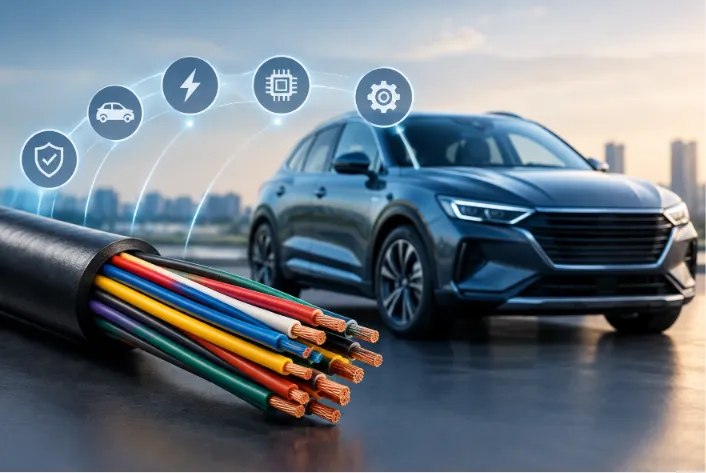

Vijay had seen a lot of failed harnesses come across his workbench, but this one made him pause. A test vehicle from the assembly line had come back with a scorched conductor tucked deep inside the dashboard wiring, and the fault report blamed a cable that had simply not been built for the heat sitting right next to it. He had been managing the harness assembly line at an auto ancillary unit near the Palsana Daman belt for close to eight years, and every quarter the wiring inside these vehicles seemed to get busier. More sensors, more control units, more places where one loose or unshielded wire could throw off an entire system.
That scorched conductor was not really about one bad cable. It was about how much a modern vehicle now depends on its wiring to behave correctly, and how little room there is for that wiring to fail. This is where multicore automotive cables quietly take on a bigger role than most buyers realise, bundling multiple conductors into a single, disciplined structure instead of leaving a vehicle's electrical system to a mess of loose wires.
Cars Are Doing More, and the Wiring Has to Keep Up
A car built fifteen years ago mostly needed wiring for the engine, lights, and a handful of dashboard indicators. Walk into a 2026 model, and you will find driver assistance cameras, parking sensors, infotainment touchscreens, battery management systems in electric variants, and a dozen small control units talking to each other constantly. Every one of these systems needs power and signal running through it, and that demand has grown far faster than most people outside the industry realise.
India's own numbers reflect this shift. Electric vehicle registrations across the country reached 1.97 million units in FY 2024-25, up from 1.68 million units the year before a growth of nearly 17%. Electric passenger vehicles alone crossed the one lakh mark that year. Each of these vehicles carries a heavier electrical load than a conventional one particularly around battery management and power distribution, and that load has to travel through cables that can handle it without adding unnecessary bulk or weight.
Vijay's plant felt this shift directly. What used to be a single production line for conventional vehicles turned into a mixed floor handling both ICE and EV models, each with different wiring demands. Suddenly the old approach of running separate single cores wherever a connection was needed started slowing everything down, and that is usually the point where a manufacturer starts asking a simple question. Why not bundle these conductors together instead of running them separately?
What Actually Sits Inside a Multicore Automotive Cable
A multicore automotive cable is exactly what it sounds like once you strip away the technical language. Instead of running several single conductors separately through a vehicle, multiple insulated cores are bundled together under one outer sheath. Depending on the application that bundle may also carry a shielding layer to block interference from nearby electrical components, something that matters a great deal in a vehicle packed with sensors.
The construction is not arbitrary. Automotive cables of this kind are built and tested against international standards and two of them matter most here. ISO 6722 governs single core cables used in road vehicles, including their temperature ratings, which range from 85 degrees Celsius up to 200 degrees Celsius depending on the class and it extends to the individual cores used inside multicore assemblies. ISO 14572 covers multicore sheathed cables specifically, laying out the test methods and performance requirements for both screened and unscreened versions. Together, these two standards decide whether a cable can survive the vibration, heat, and constant flexing that come with life inside a moving vehicle.
For Vijay, switching a dashboard harness from a bundle of loose single cores to a properly sheathed multicore assembly cut his team's assembly time noticeably. Fewer individual wires to route meant fewer connection points to inspect, and fewer places for something to go wrong later on the road. That is often the real, unglamorous benefit of good automotive wiring cables. Less time spent fighting the wiring means more time spent on the actual engineering.
Where These Cables Actually Earn Their Keep
It helps to think about where a vehicle's electrical stress actually shows up. The engine bay runs hot and is under constant stress and vibration. The dashboard and instrument cluster pack dozens of thin connections into a tight space, driver assistance systems depend on clean interference free signals from cameras and radar units electric vehicles add battery management wiring that has to move higher currents reliably for years without degrading.
A multicore automotive cable is often the quiet answer across every one of these zones, because it lets a manufacturer combine power and signal conductors into one manageable run instead of a tangle of separate ones. Vijay ran into this firsthand when a batch of test vehicles kept throwing intermittent faults on their driver assistance sensors. After days of tracing the issue his team found that a run of unshielded wiring sitting too close to a power line was picking up interference. Swapping that section for a properly shielded multicore cable solved it within a day.
That kind of fix rarely makes headlines but it is exactly the sort of problem that separates a reliable vehicle from one that develops odd electrical quirks a year into ownership. Buyers rarely think about wiring when they are choosing a car, yet it is often the difference between a system that behaves consistently and one that does not.
Choosing a Cable That Won't Let the Vehicle Down Later
This is usually where the real decision gets made, long before a vehicle ever reaches a showroom. A few factors matter more than the rest when selecting vehicle electrical cables for any application.
Temperature rating has to match where the cable sits. A run near the engine needs a far higher rating than one tucked inside the cabin. Flexibility matters just as much, since vehicles vibrate constantly and a stiff cable will crack at its joints over time. Shielding becomes non negotiable anywhere sensor or communication wiring runs near a power source. And compliance with recognised standards like ISO 6722 and ISO 14572 is not something a buyer should take on faith. It should be documented and verifiable.
Vijay learned this the hard way after his plant's earlier supplier kept quoting attractive prices without ever sharing test data. He eventually moved to a supplier who could produce compliance documentation for every batch and the difference showed up almost immediately in fewer field complaints. Choosing the right automotive cables is a decision made on paper well before installation not something to sort out after failures start appearing.
A few practical takeaways worth keeping in mind.
- Match the cable's temperature class to its exact location in the vehicle since engine bay and cabin runs demand very different ratings.
- Ask suppliers for documented compliance with ISO 6722 and ISO 14572 rather than a verbal assurance.
- Prioritise shielding wherever sensor or communication wiring runs close to power lines.
- Treat cable sourcing as part of the design process, not a last minute purchasing task.
A Cable You Never See, Doing Work You Cannot Ignore
As vehicles keep adding intelligence, cameras, sensors, battery systems, connected features the wiring holding it all together decides whether that intelligence actually works the way it should. A failure here rarely looks like a wiring problem to the person driving the car. It looks like the vehicle itself is misbehaving, a sensor acting up, a system resetting for no clear reason.
Vijay's plant runs a lot smoother now, with far fewer complaints coming back from the field. It took a scorched conductor and a few frustrating weeks of troubleshooting to get there. The next time you are evaluating a vehicle or sourcing components for one, it is worth asking what is actually running through its wiring, not just what the vehicle promises to do.
If you are looking to source dependable multicore automotive cables built to recognised standards, Balaji Cables and Wires would be glad to walk through your requirements and help you find the right fit for your application. Reach out anytime to discuss specifications or request a quote.


























Sign in to leave a comment.