

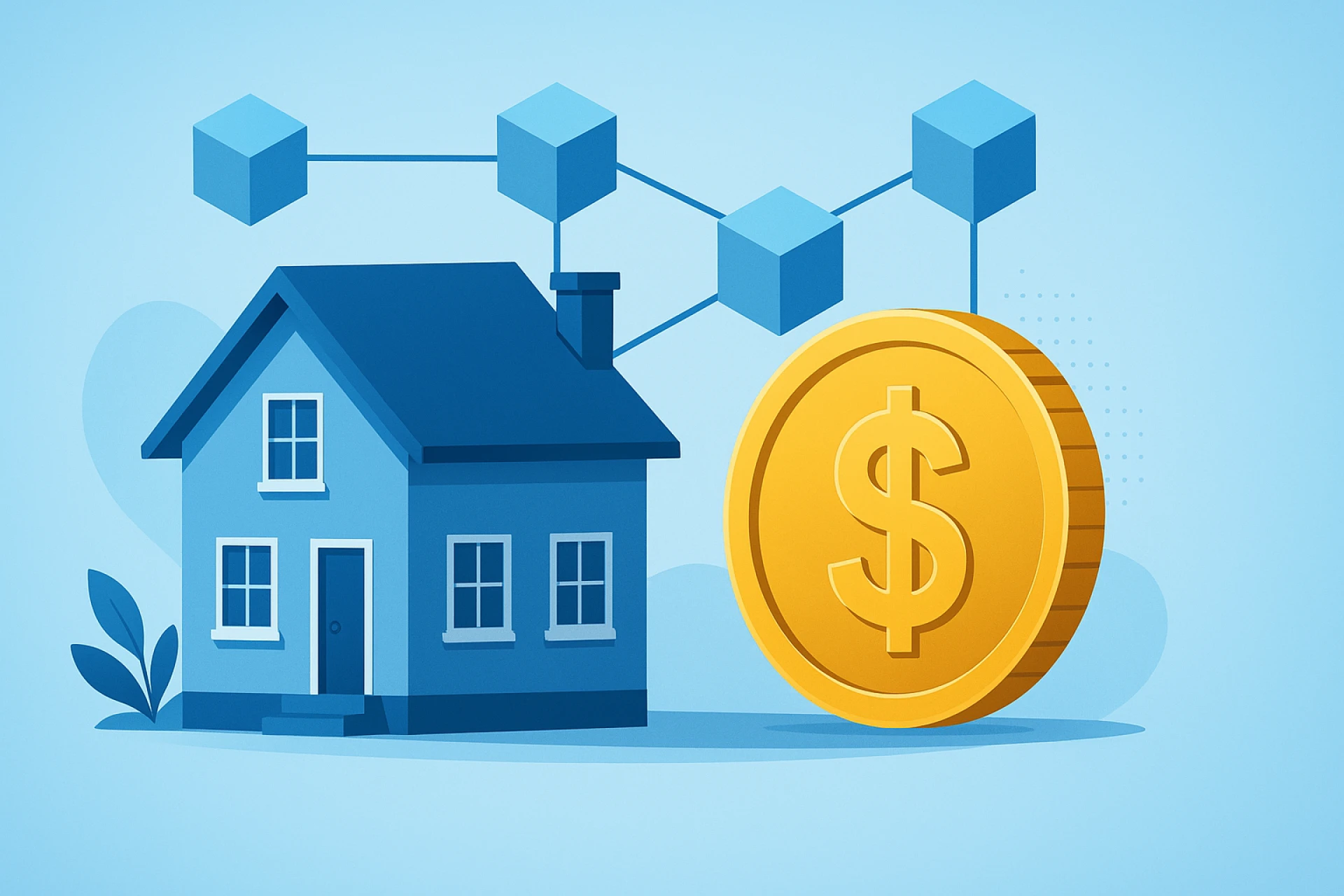
Real-world asset (RWA) tokenization is emerging as one of the most significant applications of blockchain technology beyond cryptocurrencies. At its core, tokenization involves creating a digital representation of an asset or ownership claim on a blockchain or other programmable ledger. The underlying asset could be real estate, government bonds, private credit, commodities, investment funds, artwork, or other financial and physical assets.
What makes tokenization particularly important is that it does more than simply put an asset into digital form. Blockchain-based tokens can combine ownership records with transfer rules, compliance conditions, and automated transaction logic. This creates the possibility of redesigning how assets are issued, traded, settled, and managed.
The market opportunity is substantial. McKinsey estimates that tokenized financial assets could reach approximately $2 trillion in market capitalization by 2030 in its base case, excluding cryptocurrencies and stablecoins, with a bullish scenario approaching $4 trillion. The Bank for International Settlements (BIS) similarly identifies improved efficiency, lower costs, greater transparency, fractionalization, and broader investor access as important potential benefits, while emphasizing that adoption still depends on regulation, infrastructure, and effective risk management.
The biggest benefits of RWA tokenization therefore come from its ability to address long-standing limitations in traditional asset markets.
1. Fractional Ownership Makes Expensive Assets More Accessible
One of the most visible benefits of tokenization is fractional ownership. Traditional assets such as commercial properties, private equity investments, fine art, infrastructure projects, and certain debt instruments often require substantial capital. A person may want exposure to an asset but cannot afford to purchase the entire asset or meet the minimum investment requirements.
Tokenization can divide an economic interest in an asset into smaller digital units. Instead of purchasing an entire property worth millions of dollars, for example, eligible investors could potentially acquire tokens representing fractional interests in that property, subject to the applicable legal and regulatory structure.
This changes the economics of access. Investors can construct diversified portfolios with smaller amounts of capital, while asset owners can potentially reach a broader pool of qualified investors.
The concept is particularly relevant to real estate. A property owner does not necessarily need to sell an entire building to raise capital. A properly structured tokenized offering could represent fractional interests or claims connected to the property, allowing investors to participate without purchasing the whole asset.
BIS research published in 2025 found evidence that tokenized real estate can address certain gaps in traditional property markets, particularly in areas with limited access to credit.
However, fractionalization does not automatically mean unrestricted access. Securities laws, investor eligibility requirements, custody arrangements, transfer restrictions, and ownership structures still determine who can legally purchase and trade particular tokens.
2. Tokenization Can Improve Liquidity in Traditionally Illiquid Markets
Illiquidity is one of the biggest problems associated with many real-world assets. Selling a building, private-company interest, collectible, or other alternative asset can require extensive negotiation, documentation, due diligence, and settlement procedures.
Tokenization can potentially make ownership interests easier to transfer by representing them digitally and establishing standardized transaction processes. If a compliant secondary market exists and sufficient buyers and sellers participate, tokenized interests can become easier to trade than conventional ownership interests.
Real estate offers a useful example. Traditional property transactions can take weeks or months and involve brokers, lawyers, banks, title companies, registries, and other participants. A tokenized structure can digitize parts of the ownership and transaction workflow.
Importantly, tokenization itself does not guarantee liquidity. A token can be technically transferable but still have few buyers. Liquidity ultimately depends on market depth, investor demand, legal transferability, exchange infrastructure, pricing mechanisms, and confidence in the underlying asset.
Research from the BIS on U.S. tokenized real estate found that trading activity increased significantly following natural disasters, suggesting that tokenization can provide additional liquidity during periods when conventional markets may become less liquid. The research also highlighted an important limitation: liquidity-support mechanisms such as platform buybacks can introduce additional financial risks.
3. Faster and More Efficient Transactions
Traditional asset transactions often involve multiple stages: order execution, verification, clearing, settlement, reconciliation, ownership updates, and reporting. Different institutions may maintain separate databases, creating the need to reconcile information repeatedly.
Blockchain-based tokenization can bring transaction records and asset-transfer rules onto a shared programmable infrastructure. This can reduce the number of manual processes required to complete a transaction.
The BIS describes tokenization as a technology that can integrate messaging, reconciliation, and settlement into a more seamless process. Its analysis suggests that this architecture could reduce delays, manual interventions, and operational friction in financial markets.
Consider a tokenized bond. Instead of separately coordinating the transfer of the bond, payment, ownership records, and settlement instructions through several systems, a programmable transaction could coordinate these actions according to predetermined conditions.
This is particularly valuable for institutional markets, where even small improvements in settlement efficiency can produce meaningful cost savings at scale.
4. Lower Operational Costs Through Automation
Another major advantage is the potential reduction of operational costs.
Traditional asset management frequently requires extensive administrative work. Different parties may handle investor verification, ownership records, distributions, compliance checks, reporting, settlement, and reconciliation.
Smart contracts can automate certain predefined actions. For example, a tokenized investment product could automatically calculate and distribute eligible payments according to programmed rules. A tokenized bond could potentially automate coupon-related processes, while a tokenized fund could streamline parts of investor and ownership administration.
The BIS notes that tokenization can reduce transaction costs through automation and programmable execution.
The economic impact becomes more significant when these processes are repeated thousands or millions of times. Automation can reduce dependence on manual processing and decrease the likelihood of errors caused by repetitive administrative tasks.
That does not mean intermediaries disappear. Legal advisers, custodians, asset managers, auditors, compliance providers, and other institutions can remain essential. Instead, their roles may shift toward higher-value activities while routine processes become increasingly automated.
5. Greater Transparency and Improved Auditability
Traditional asset ownership systems can involve multiple databases maintained by different organizations. Determining who owns what, when a transfer occurred, and whether records are consistent can require reconciliation between systems.
Blockchain-based systems provide a shared transaction history, depending on the network design and access permissions. Transactions can be recorded in a tamper-resistant ledger, creating a clearer audit trail.
For RWA markets, this can improve visibility into ownership transfers, token movements, and certain transaction histories.
Transparency is particularly valuable for investors and regulators. If appropriate information is made available, participants can potentially verify transaction activity without depending entirely on one institution's internal database.
However, transparency has an important limitation: blockchain transparency does not automatically verify the physical asset itself. If a token represents ownership of a building, gold, artwork, or private credit instrument, external legal and operational mechanisms are still needed to establish that the token actually corresponds to the claimed asset.
This is why reliable custody, legal documentation, asset verification, and governance are just as important as the blockchain infrastructure.
6. Programmability Creates New Financial Use Cases
Perhaps the most transformative benefit of tokenization is programmability.
Traditional financial assets generally exist separately from the systems that control transactions involving them. Tokenized assets can incorporate rules directly into the digital representation or into associated smart contracts.
This makes it possible to automate conditional transactions.
For example, a tokenized asset could be configured so that:
- Ownership transfers only after payment is confirmed.
- Investor eligibility is checked before a transfer.
- Interest payments are distributed automatically.
- Collateral requirements are monitored programmatically.
- Certain transfers are restricted by jurisdiction.
- Corporate actions follow predefined rules.
The BIS highlights delivery-versus-payment as an important example. In such a structure, asset delivery and payment can be linked so that each becomes conditional on the other, potentially reducing settlement and counterparty risks.
This ability to combine assets, money, compliance logic, and transaction conditions within programmable infrastructure could ultimately be more important than simple digitization.
7. Global Investment Opportunities Can Become More Efficient
Tokenization could also expand the geographic reach of investment markets.
A traditional investment involving international investors may require multiple intermediaries, currency conversions, legal checks, custodial arrangements, and settlement systems. Tokenized infrastructure could potentially streamline some of these processes.
For example, an appropriately regulated tokenized investment product could allow qualified investors in different jurisdictions to participate through standardized digital infrastructure.
Cross-border applications are particularly interesting because blockchain networks can operate continuously rather than according to the business hours of a particular financial institution.
The BIS has identified tokenization as having potential applications in cross-border payments and securities markets, while stressing that regulatory and infrastructure considerations remain critical.
Consequently, the benefit is not simply "24/7 trading." The larger opportunity is creating more integrated financial infrastructure in which asset transfer, payment, compliance, and settlement can interact more efficiently.
8. New Sources of Capital for Asset Owners
Tokenization can also change how asset owners raise capital.
A property developer, fund manager, infrastructure operator, or business owner may traditionally depend on banks, institutional investors, private funds, or other established financing channels.
Tokenization introduces another potential mechanism: digitally representing ownership interests, debt claims, revenue participation, or other rights and offering them to eligible investors through compliant structures.
For asset owners, this can potentially diversify funding sources. For investors, it can create access to investment opportunities that were previously difficult to reach.
The benefit becomes particularly compelling when tokenization is combined with fractionalization. Instead of finding one buyer capable of purchasing an entire asset or financing a large transaction, an issuer can potentially structure participation among multiple investors.
9. Tokenized Bonds Demonstrate the Practical Benefits
Government bonds provide a useful example of how tokenization is moving beyond experimentation.
According to a 2025 BIS assessment, tokenized government bond issuance had reached approximately $8 billion at the time of the study. The research found that tokenized bonds had lower bid-ask spreads than conventional bonds while having comparable issuance costs.
This is important because it demonstrates that tokenization is not only relevant to speculative digital assets. Traditional financial instruments can also benefit from programmable infrastructure.
Tokenized bonds can potentially support faster settlement, more efficient trading, automated lifecycle processes, and integration with tokenized forms of money.
As more regulated financial institutions experiment with these models, the focus is shifting from whether assets can be tokenized to whether tokenization produces measurable economic value.
10. The Market Opportunity Is Large, but Adoption Will Be Gradual
The growing interest in tokenization is supported by a significant projected market opportunity. McKinsey estimates approximately $2 trillion of tokenized financial assets by 2030 in its base case, excluding cryptocurrencies and stablecoins. Its analysis identifies mutual funds and ETFs, bonds and ETNs, loans and securitization, and other asset classes as important areas for adoption.
This growth is unlikely to occur uniformly.
Assets with relatively clear legal ownership, established markets, strong institutional demand, and straightforward settlement processes are likely to move faster. More complicated assets may take longer because their tokenization involves difficult legal, regulatory, valuation, custody, or governance questions.
The BIS similarly emphasizes that tokenization is still relatively small in scale and that its benefits come with trade-offs involving operational complexity, liquidity risks, and regulatory uncertainty.
Therefore, the future of tokenization will probably not be defined by putting every physical asset on a blockchain overnight. Instead, adoption is more likely to develop incrementally as institutions identify use cases where blockchain infrastructure provides measurable advantages over existing systems.
Challenges That Should Not Be Ignored
Despite its benefits, RWA tokenization is not a technological shortcut around financial regulation.
The most important challenge is establishing the legal connection between the token and the underlying asset. If a token represents a property interest, investors need enforceable rights. If it represents a bond, the legal claim must be clearly defined. If it represents physical commodities, custody and verification mechanisms must be credible.
Other challenges include regulatory fragmentation, cybersecurity, smart contract vulnerabilities, valuation, investor protection, identity verification, custody, interoperability, and secondary-market liquidity.
The BIS has repeatedly emphasized that tokenization requires sound governance and risk management, even where the underlying technology can improve efficiency.
In other words, blockchain can improve the infrastructure supporting ownership, but it cannot by itself create legal ownership, trustworthy valuation, or investor protection.
Conclusion
The biggest benefits of RWA tokenization come from combining fractional ownership, improved liquidity, faster settlement, automation, transparency, programmability, and broader access to investment opportunities. Rather than being simply another application of blockchain, tokenization has the potential to redesign important parts of the financial infrastructure used to issue, transfer, settle, and manage assets.
The strongest opportunities are likely to emerge where traditional markets have clear inefficiencies and where legal and regulatory structures can support digital ownership. As institutional adoption grows, tokenization could gradually connect previously fragmented asset markets with programmable financial infrastructure.
Businesses exploring this opportunity need more than a token contract. They need appropriate asset structures, regulatory considerations, smart contracts, investor management, custody mechanisms, security controls, and scalable blockchain infrastructure. Blockchain App Factory provides best services for businesses seeking to build and implement solutions around this emerging asset ecosystem.



















Sign in to leave a comment.