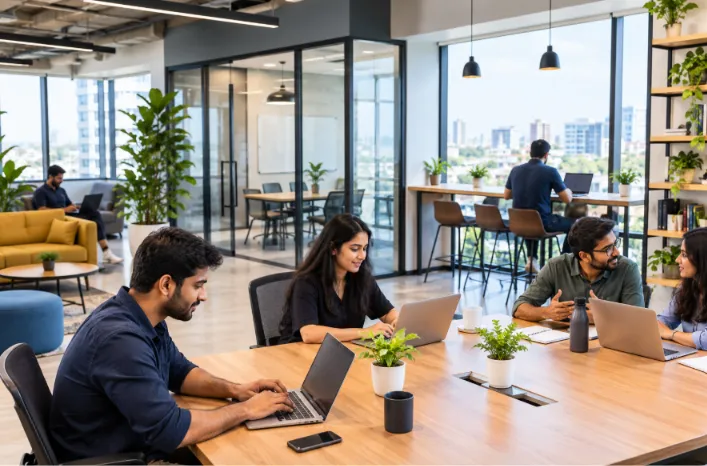
Riya started her product company the way most founders in Ahmedabad do, at her kitchen table, laptop balanced between a coffee mug and a stack of invoices. For the first eight months that setup worked fine. Then she hired her third employee, and her living room stopped feeling like an office and started feeling like a problem.
She had two choices in front of her sign a long lease on a bare shell office and spend months fitting it out or find something that could actually keep pace with a business that was still figuring out its own shape. It's a decision that plays out across the city right now because Ahmedabad's startup scene is growing faster than most founders' real estate instincts.
This isn't a niche dilemma anymore either. Flexible workspaces have moved well past their early reputation as a stopgap for broke founders. Across India, flex space now accounts for 21% of all office leasing, up from just 5% in 2017, and transaction volumes have jumped more than eightfold in that same window, according to Knight Frank India's Flex Space Occupier Intelligence report, that's not a trend confined to Bengaluru or Gurugram. It's reshaping how founders in cities like Ahmedabad think about where and how they work.
So the real question isn't whether flexible offices are popular. It's whether they actually solve the problems that keep founders like Riya up at night. Let's walk through what a flexible office space in Ahmedabad actually offers a growing startup, and where it makes a measurable difference.
The Real Cost of Choosing the Wrong Office
Every founder eventually runs the same math a conventional office in Ahmedabad means a security deposit, interior fit out furniture and a lease that locks you in whether your headcount grows or shrinks. For a startup still validating its model that's a lot of capital tied up in walls and desks instead of product and people.
The numbers back this up more clearly than most founders expect. Setting up a twenty seat traditional office can require anywhere from thirty to fifty lakh rupees in upfront capital once you count the deposit, furniture and IT setup, according to Colliers' Flex India report and the FICCI-CBRE Flex Plosion report from March 2026. Compare that to a coworking arrangement, where the only real upfront cost is the first month's membership. Ongoing costs also drop meaningfully often by 30% to 50% compared to a similar traditional lease.
Riya ran her own version of that comparison. She had been quoted a fit out cost that would have eaten nearly half her seed funding. Instead she chose a coworking space provider in Ahmedabad and moved her team in within a week, paying only for the desks she actually needed, that single decision meant she still had runway left to hire a designer three months later something the traditional lease route would have made impossible.
It's a useful gut check for any founder here. Would your business rather spend its early capital on furniture or on the people and product that actually move it forward?
Room to Grow Without Renegotiating Everything
Growth rarely happens on a tidy schedule, rather, it happens with an environment. A founder might land a new client and need two more desks by next month or lose a key hire and suddenly have an empty cabin they're still paying for, traditional leases don't bend for either scenario. Flexible arrangements do.
This is where a startup office space Ahmedabad setup earns its keep. Most flexible providers let you add seats, upgrade to a private cabin or scale down often within days rather than months of lease negotiation. That kind of elasticity matters more than it sounds like on paper because hiring plans rarely survive contact with reality.
When Riya's team doubled after closing a new client, she didn't have to think twice. She simply asked her workspace provider for an additional private cabin, and it was ready within a week. No new lease, no fresh deposit, no months of back and forth with a landlord. Her team just kept working.
That's really the underlying promise of flexibility. It's not just about saving money early on. It's about not being penalised for growing.
A Workspace That Comes With a Network
There's a quieter cost to working alone that founders don't always name directly, and that's isolation. When you're building something from scratch, the absence of other people solving similar problems around you can slow you down in ways that are hard to measure.
A shared office space in Ahmedabad changes that dynamic simply by putting you in proximity to other businesses. You're not just renting a desk, you're stepping into a working community of founders, freelancers and small teams who are often facing the exact same decisions you are. Conversations happen in hallways and over coffee that wouldn't happen if you were still working from your apartment.
Riya found this out on an ordinary afternoon. She was grabbing a coffee in the common area when another founder struck up a casual conversation nothing planned just the kind of small talk that happens naturally when people share a workspace then three weeks later that same founder introduced her to her first enterprise client. She had not gone looking for the connection. It simply showed up because she'd picked a space built around community instead of four walls and silence. This is when you realise that networking is such a simple process but leaves a big impact on your brand, because outside your cabin, you represent your brand
It raises a fair question worth sitting with. How much of your growth so far has come from a plan, and how much has come from being in the right room at the right time?
Professional Credibility From Day One
First impressions still carry weight, even in a founder friendly city like Ahmedabad. Inviting a potential investor or client to a cramped apartment or a noisy café sends a signal whether or not it's the one you intended.
A flexible workspace in Ahmedabad solves this without demanding a long-term commitment. Most providers include access to meeting rooms, conference spaces, and a professional address, giving early stage founders the same polish a much larger company would have, minus the overhead.
Riya learned this the hard way before she made the switch an investor meeting scheduled at a coffee shop got interrupted twice by the espresso machine and she could tell it affected the tone of the conversation. Her next pitch happened inside a properly equipped meeting room at her coworking space, booked for an hour with a whiteboard and a closed door. She closed that funding round two weeks later.
Credibility isn't the whole reason startups win deals, but it rarely hurts to remove the friction that gets in the way of one.
Built for Focus, Not Just for Presence
There's a difference between being at work and actually working. Cafés are noisy, home offices come with constant small interruptions, and neither one is designed for sustained, focused output. Founders often underestimate how much this quietly drags on productivity until they experience the alternative.
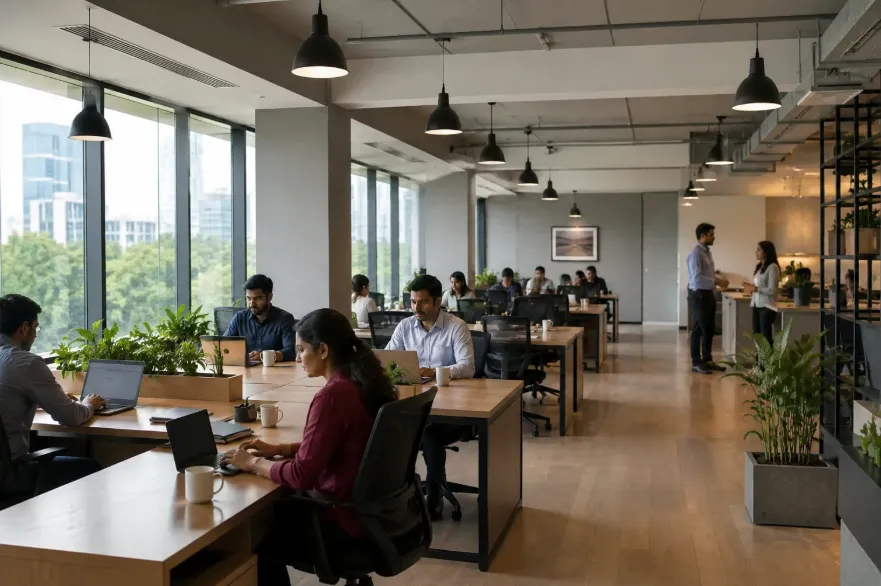
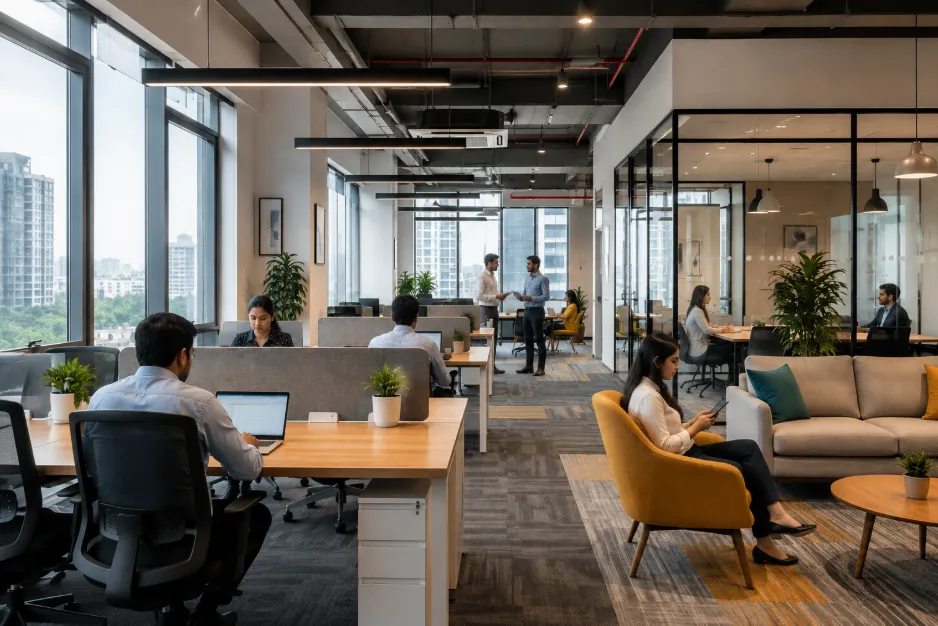
A well designed flexible office space in Ahmedabad is built specifically to remove that friction. Reliable internet, proper desks, quiet zones and a clear separation between home life and work life all add up to fewer distractions and more consistent output across a team.
Riya's team now has a routine that did not exist six months ago they arrive settle in and simply work without the background noise of a shared apartment or the awkward small talk of a café it sounds like a small shift but it's changed how much her team gets done in a given week. This made a huge impact on their productivity and work style.
Actionable Takeaways for Founders Considering a Move
- Calculate your real upfront cost for a traditional lease before assuming it is the safer option.
- Choose a provider who lets you scale seats up or down without renegotiating a long term contract
- Treat community access as a genuine growth channel not a nice to have.
- Use meeting rooms strategically for investor and client conversations that matter.
- Prioritise an environment built for focus not just a place to sit.
The Office Decision Riya Almost Got Wrong
Riya almost signed that traditional lease. She had the paperwork ready and a plan to make the fit out work somehow. What stopped her was not a spreadsheet it was a conversation with another founder who had made the opposite choice and never looked back.
The problem she was solving was not really about desks or square footage. It was about whether her business could stay light enough to adapt while it was still finding its footing. That is the same problem every early stage founder in Ahmedabad is quietly wrestling with right now, whether they've named it yet or not.
So here's the real question worth asking yourself. If your team doubled next quarter, or lost a client the month after, would your current workspace bend with you or would it be one more thing standing in your way?
If you're weighing that decision yourself, it might be worth walking through a space in person before you decide anything. Karma Workspaces would be glad to show you around and talk through what would actually fit your team's next stage.




























Sign in to leave a comment.