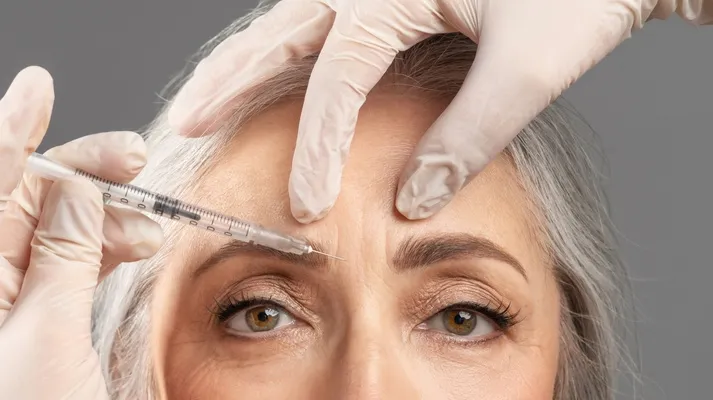

Heavy eyelids after anti-wrinkle treatment can be unsettling, particularly when the eyes feel more tired, the brows appear lower or one upper eyelid seems different from the other. In some cases, the sensation is caused by a temporary change in brow position rather than true eyelid drooping. In others, botulinum toxin can affect the muscle responsible for lifting the upper eyelid.
Understanding the difference between these effects is important when considering anti-wrinkle injections, because the treatment works by reducing muscle activity and its effects extend beyond the lines being treated. Eyelid heaviness is uncommon, but it is a recognised complication of treatment around the forehead and glabella.
Why can your eyelids feel heavy after anti-wrinkle treatment?
Anti-wrinkle injections temporarily reduce activity in selected muscles. Around the upper face, several muscles work together to control the position of the forehead, eyebrows and eyelids.
The frontalis muscle helps elevate the eyebrows and forehead. The levator palpebrae superioris is responsible for lifting the upper eyelid itself.
If treatment changes the balance between these muscles, the result can be a heavier appearance around the eyes.
There are two particularly important possibilities:
- Brow ptosis: the eyebrow sits lower, making the upper eyelid look or feel heavier.
- Eyelid ptosis (blepharoptosis): the upper eyelid itself drops because the eyelid-elevating muscle is affected.
They can look similar, but they are not the same problem.
Brow ptosis: when the eyebrow becomes lower
Brow ptosis occurs when the eyebrow descends from its usual position. This can happen after treatment of the forehead because the frontalis muscle contributes to brow elevation.
Some people naturally use their forehead muscles to help keep their eyebrows elevated, particularly when there is pre-existing upper eyelid or brow heaviness. Reducing frontalis activity can therefore reveal or increase an existing tendency towards brow descent.
The result may feel like:
- Heaviness above the eyes
- A lower-looking brow
- Reduced space between the eyebrow and upper eyelid
- A tired or hooded appearance
- Increased awareness of the upper eyelids
Importantly, this does not necessarily mean the botulinum toxin has entered the eyelid muscle itself. It can simply reflect a change in the balance of muscles supporting the brow.
True eyelid ptosis is different
True eyelid ptosis, or blepharoptosis, occurs when the upper eyelid itself sits lower than normal.
The levator palpebrae superioris is the main muscle responsible for elevating the upper eyelid. If botulinum toxin reaches this muscle unintentionally, its activity can temporarily weaken.
This is one reason injections around the glabella require careful anatomical planning. Reviews of botulinum toxin complications describe diffusion towards the levator muscle as one mechanism behind eyelid ptosis.
Someone with true eyelid ptosis may notice that the eyelid margin itself has dropped, rather than simply seeing the eyebrow sitting lower.
When does eyelid heaviness usually appear?
Heavy eyelids do not necessarily appear immediately after treatment.
Botulinum toxin takes time to produce its full muscle-relaxing effect. A review of botulinum toxin-induced blepharoptosis reports a typical onset of around 3 to 14 days after injection.
This delayed onset can sometimes make it difficult to connect the change with treatment.
The timing also matters when assessing what has happened. A mild change that develops gradually over several days may fit the known pattern of toxin-related muscle weakness, whereas symptoms that begin immediately after an injection may have a different explanation.
Why can anti-wrinkle injections cause this?
The main concern is unintended weakening of a muscle that was not intended to be treated.
The upper face contains closely positioned muscles and anatomical structures. When injections are placed around the forehead or glabella, the effect needs to remain focused on the intended muscles.
Research and clinical reviews identify several factors associated with ptosis, including injection location, technique, anatomy and the potential spread of toxin to nearby muscles.
This is why assessment before treatment matters. Existing brow position, eyelid anatomy and facial asymmetry can all influence the final appearance.
A recent review also emphasises the importance of anatomical knowledge, injection technique and individual risk assessment when preventing botulinum toxin-induced eyelid ptosis.
Does treating forehead lines increase the risk?
Forehead treatment deserves particular care because the frontalis muscle is an important brow elevator.
If too much of its activity is reduced, or treatment is placed in an unsuitable position, the brow may descend.
This can create the impression that the eyelids have become heavier even when the eyelid-lifting muscle itself has not been affected.
The issue is therefore not simply the amount of product used. The individual's anatomy, existing brow position and distribution of muscle activity also matter.
How long does heavy eyelid after Botox last?
When eyelid or brow ptosis is related to botulinum toxin, it is generally temporary because the effect of the treatment wears off.
The duration is not identical for everyone. Published reviews describe eyelid ptosis often settling within several weeks, although effects can occasionally persist for longer. One clinical review reports that eyelid ptosis often settles within around three to four weeks, while brow ptosis may take longer.
Another medical reference notes that botulinum toxin-related eyelid ptosis can last for up to around three months in some cases.
The exact recovery period therefore should not be promised in advance.
Is there anything that can be done?
The appropriate response depends on whether the problem is brow ptosis, true eyelid ptosis or another cause of eyelid heaviness.
If true eyelid ptosis is diagnosed, clinicians may consider prescription treatment such as an alpha-adrenergic eye drop. Published reviews describe agents such as apraclonidine as one treatment option because they can temporarily increase upper eyelid elevation.
These medicines are not suitable for everyone and should not be self-prescribed simply because an eyelid appears lower after treatment.
For brow ptosis, management is different. In many cases, observation while the treatment gradually wears off is appropriate. A clinical assessment can determine whether any intervention is suitable.
When should you seek medical assessment?
Mild heaviness after treatment is not automatically an emergency, but a new or worsening eyelid droop should be assessed if you are unsure what is causing it.
Seek prompt medical advice if you experience:
- Significant or rapidly worsening eyelid drooping
- Double vision
- Difficulty moving an eye normally
- Changes in vision
- Severe eye pain
- Difficulty swallowing or breathing
- Widespread muscle weakness
Botulinum toxin has a well-established safety profile when used appropriately, but rare serious effects involving spread beyond the intended treatment area have been reported.
If the problem appears to be an aesthetic complication, an assessment can establish whether the issue is true eyelid ptosis, brow ptosis or another cause.
Can heavy eyelids be prevented?
Risk reduction starts before the injection rather than after a problem develops.
A careful consultation should consider your existing facial anatomy, previous anti-wrinkle treatments, any previous complications and the position of your brows and eyelids at baseline.
The injector also needs a detailed understanding of the muscles and anatomical structures in the upper face. Reviews of upper-face botulinum toxin treatment emphasise appropriate injection positioning and technique as important measures for reducing ptosis risk.
It is also useful to have baseline photographs when appropriate. These provide an objective reference if a change in brow or eyelid position is noticed after treatment.
Heavy eyelids do not always mean something has gone wrong
A heavier sensation after anti-wrinkle treatment deserves attention, but it does not automatically mean that the eyelid itself has become paralysed.
The change could reflect:
- Temporary brow descent
- True upper eyelid ptosis
- Existing hooding becoming more noticeable
- Swelling or other temporary changes
- Natural facial asymmetry becoming more apparent
The distinction requires looking at the position of both the brow and eyelid rather than relying on the sensation alone.
This is one reason an experienced medical aesthetic clinic should assess the whole upper face before deciding what has happened.
The key takeaway
Heavy eyelids after anti-wrinkle treatment are most commonly discussed in relation to two different forms of ptosis: brow ptosis and eyelid ptosis.
Brow ptosis occurs when reduced forehead muscle activity allows the eyebrow to sit lower. True eyelid ptosis occurs when the muscle responsible for lifting the upper eyelid is affected.
Both are generally temporary when caused by botulinum toxin, but they require different assessment and management.
If a new eyelid change develops after treatment, particularly if it affects vision or is accompanied by other neurological or eye symptoms, obtaining appropriate medical assessment is more useful than assuming it is simply a normal part of recovery.
FAQs
1. Why do my eyelids feel heavy after Botox?
The sensation may result from brow ptosis, where the eyebrow has descended and creates a heavier upper-eyelid appearance. Less commonly, true eyelid ptosis can occur if the eyelid-elevating muscle is temporarily affected.
2. How soon can eyelid ptosis appear after anti-wrinkle injections?
It usually does not happen immediately. Published evidence describes onset commonly within several days, with one review reporting around 3–14 days after treatment.
3. Will heavy eyelids go back to normal after Botox wears off?
When the heaviness is caused by temporary botulinum toxin effects, it generally improves as muscle activity returns. The recovery period differs between individuals and between brow and eyelid ptosis.
4. Should I contact someone if my eyelid drops after anti-wrinkle treatment?
Yes, particularly if you are unsure whether the brow or eyelid has dropped, or if you have visual symptoms. Prompt assessment is also important if drooping is accompanied by double vision, difficulty moving the eyes, swallowing or breathing problems.
























Sign in to leave a comment.