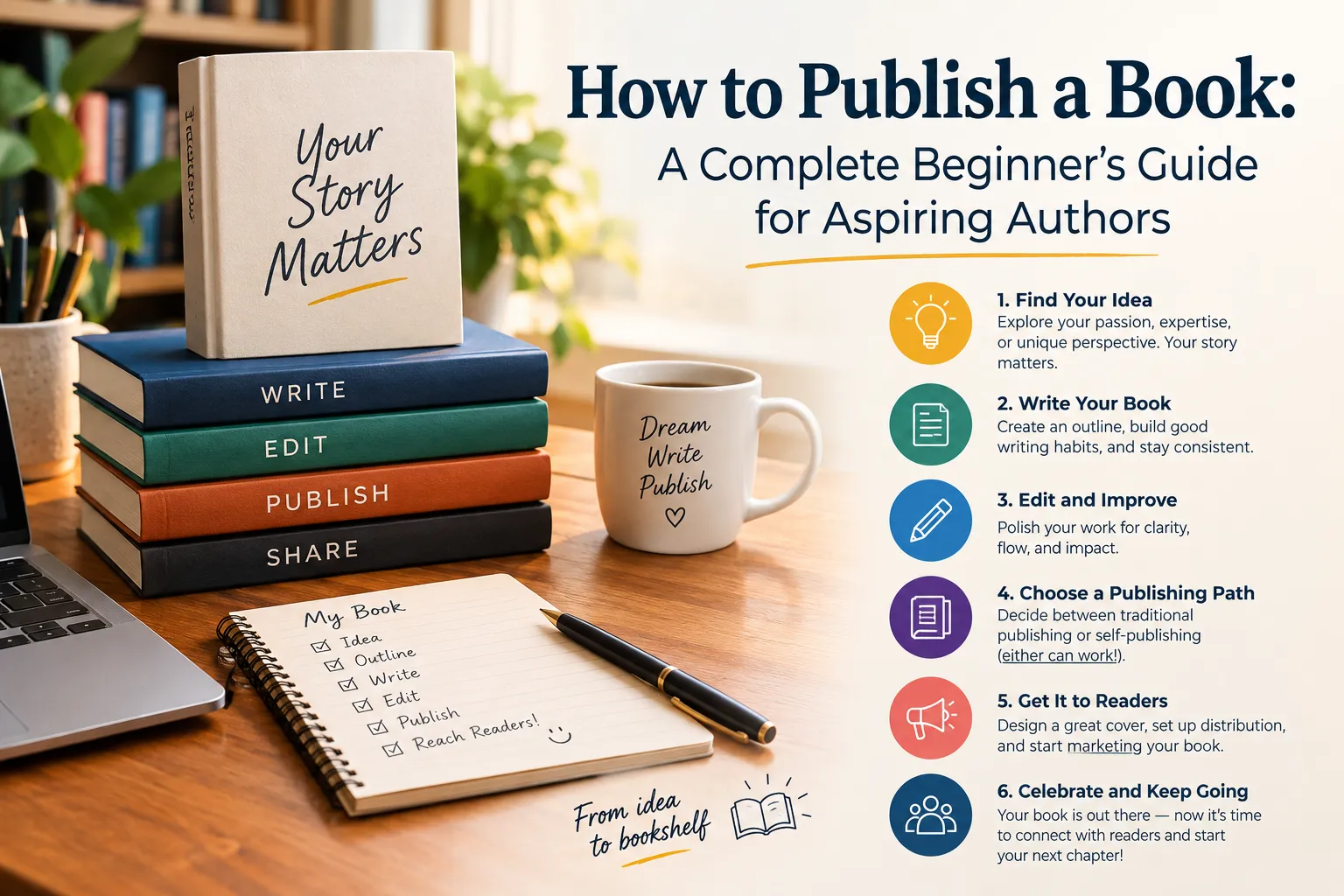

Publishing a book involves far more than writing a manuscript and uploading a file to an online store. Authors must make decisions about editing, cover design, formatting, ISBNs, printing, distribution, pricing, marketing, and the overall presentation of the finished book. For a first-time author, knowing where each responsibility belongs can be confusing.
A book publishing company can help organize these moving parts and turn a completed manuscript into a professionally prepared book. However, publishing services vary considerably, so authors should understand what publishers actually do, which services they may provide, and what responsibilities remain with the author.
This guide explains the publishing process in practical terms, compares professional assistance with a DIY approach, and outlines what authors in Miami, South Florida, and elsewhere in Florida should consider before choosing a publishing partner.
What Is a Book Publishing Company?
A book publishing company is an organization that helps transform an author's manuscript into a finished, marketable publication. Depending on the company and publishing model, its services may cover some or nearly all stages of production and distribution.
The exact role differs between traditional publishers, self-publishing service providers, and hybrid or assisted-publishing companies. That distinction is important because an author should never assume that every company offering publishing services operates in the same way.
A publishing company may assist with:
- Manuscript editing and proofreading
- Book cover design
- Interior formatting and typesetting
- ISBN and publishing information
- Print and ebook preparation
- Distribution setup
- Printing coordination
- Metadata and book listing preparation
- Marketing guidance or promotional services
Some companies provide these services as a complete package, while others allow authors to select individual services.
The author's goals should determine which services are actually necessary. A novelist preparing a paperback, for example, may need different production support from an entrepreneur publishing a business book in print and digital formats.
What Does a Book Publishing Company Actually Do?
Understanding the workflow makes it easier to evaluate publishing services. A professional publishing process generally involves several distinct stages.
1. Manuscript Assessment and Editing
A manuscript should be evaluated before it is formatted or sent to print. Editing is not simply about correcting spelling mistakes; different levels of editing address different problems.
Developmental editing looks at larger issues such as structure, pacing, organization, character development, clarity, and consistency. Copyediting focuses more closely on grammar, wording, style, factual consistency, and readability. Proofreading is normally the final quality check for typographical and formatting errors.
For example, an entrepreneur publishing a guide about starting a small business may have strong subject knowledge but repeat the same points across several chapters. An editor can identify that structural problem before it reaches the final production stage.
2. Professional Cover Design
Readers often encounter a book's cover before they read its description. A publishing company may work with the author to create a cover that reflects the book's genre, subject, and intended audience.
A professional cover should also work in multiple environments. It needs to look appropriate as a physical book while remaining recognizable when displayed as a small thumbnail on an online bookstore.
Authors should provide the designer with accurate information about the title, subtitle, author name, genre, and any required publishing elements. The designer can then develop a visual concept rather than simply placing text on a generic template.
3. Interior Formatting
Book formatting determines how the manuscript becomes a readable physical or digital publication. It includes elements such as margins, typography, chapter headings, page numbers, spacing, front matter, and other layout details.
Print books require particular attention to trim size, margins, bleed where applicable, and the relationship between the interior file and the cover dimensions. Ebook formatting has different requirements because readers may adjust font sizes and viewing settings.
This is one area where a manuscript that looks fine in a word processor can still need substantial preparation before publication.
4. ISBNs, Copyright, and Publishing Details
A publishing workflow may also involve preparing the administrative information associated with a book.
An ISBN identifies a specific edition and format of a book, while copyright concerns ownership and legal protection of original creative work. These are separate concepts, and authors should understand what each one does rather than treating them as interchangeable.
A publishing professional can help an author understand the information required for the selected publishing route. However, authors should always verify legal, registration, and ownership questions through appropriate official sources when those issues affect their particular situation.
5. Printing and Distribution
Once the book files are ready, the next question is how readers will obtain the book.
Depending on the publishing arrangement, a book publishing company may coordinate print production, prepare files for print-on-demand services, assist with distribution platforms, or help make the title available through selected retail channels.
Print-on-demand can be useful for authors who do not want to purchase and store a large inventory. Instead of producing a substantial quantity in advance, copies can be printed when orders are placed through supported channels.
The right distribution strategy depends on the book, audience, format, budget, and sales goals.
Traditional Publishing vs. Professional Self-Publishing Support
One of the most important decisions is understanding the publishing model.
Traditional Publishing
With traditional publishing, an established publisher generally acquires the rights to publish a manuscript under a contractual agreement. The publisher typically handles production and distribution and may provide editorial and marketing support.
Authors should carefully review any publishing agreement, particularly provisions concerning rights, royalties, territory, formats, contract duration, and termination.
Traditional publishing can involve a competitive acquisition process, and authors generally have less control over certain production and marketing decisions.
Self-Publishing
Self-publishing gives the author much greater control over the publishing process. The author typically makes decisions about editing, design, pricing, distribution, and marketing.
The tradeoff is responsibility. The author must either perform these tasks personally or hire qualified professionals.
For authors who want assistance while retaining control over their project, professional publishing services can provide a middle ground. For example, an author can use a book publishing company to obtain support with production while remaining involved in important decisions about the final book.
What Should Authors Expect to Pay For?
Publishing costs depend heavily on the type of book and the services required. A short ebook requires a different production process from a heavily illustrated hardcover, for example.
Rather than focusing only on a single total price, authors should identify the individual services included in a publishing package.
Ask whether the quoted service includes:
- Developmental editing or only proofreading
- Cover design and revisions
- Interior formatting
- Print and ebook versions
- ISBN assistance
- Distribution setup
- Proof copies
- Metadata preparation
- Marketing services
- Ownership of files and publishing rights
A low initial price may not represent the lowest overall cost if important services are excluded. Conversely, authors should avoid paying for services they do not need.
The goal is to understand exactly what you are purchasing before signing an agreement.
How to Evaluate a Publishing Company
Choosing a publishing partner requires more than looking at a polished website or attractive package.
Start by asking specific questions about the process. Who edits the manuscript? Who owns the final files? Which distribution channels are included? How many design revisions are provided? What happens if the author wants to end the relationship?
Authors should also read the contract carefully.
Pay particular attention to:
- Rights and ownership
- Royalties and payment terms
- Contract length
- Distribution arrangements
- Cancellation or termination terms
- Additional charges
- Marketing obligations
- Access to source files
A legitimate professional relationship should be understandable. If important terms are unclear, ask for written clarification before proceeding.
Common Mistakes Authors Make
Even experienced writers can make publishing mistakes when they focus heavily on the manuscript and overlook production details.
Treating Editing as Proofreading
A manuscript may be grammatically correct and still have structural or readability problems. Determine which type of editing your book actually needs.
Choosing a Cover Based Only on Personal Taste
Authors naturally have emotional attachments to their books. However, a cover should communicate with the intended reader, not just reflect the author's personal preferences.
Skipping the Proofing Stage
Never assume that a final digital file will print exactly as expected. Reviewing a proof can reveal spacing, page-break, image, or cover issues that are difficult to notice on a computer screen.
Signing Without Reading the Agreement
Publishing contracts can contain important provisions about rights, royalties, services, and responsibilities. Read every section and ask questions about anything you do not understand.
Expecting Publishing to Create an Audience Automatically
Producing a professional book does not guarantee sales. Authors still need to understand their audience and develop a realistic marketing strategy.
Practical Tips for First-Time Authors
If you are preparing your first book, use this checklist before moving into production:
- Finish the manuscript first. Avoid formatting chapters while the content is still changing substantially.
- Define your audience. Know who the book is intended to help, entertain, educate, or inform.
- Choose your publishing model. Understand the control, costs, responsibilities, and rights associated with each option.
- Get the right level of editing. Ask a professional to identify the type of editorial work your manuscript needs.
- Plan formats early. Decide whether you want paperback, hardcover, ebook, or multiple editions.
- Request a detailed service agreement. Make sure you understand exactly what is included.
- Review every final file. Check the cover, interior, table of contents, chapter starts, images, and page numbers.
- Create a marketing plan before launch. Identify where your readers spend time and how you will introduce the book to them.
These steps can prevent expensive revisions later.
Publishing a Book in Miami and South Florida
Authors in Miami and South Florida have access to a diverse community of entrepreneurs, professionals, creatives, educators, and independent businesses. That can create opportunities for books with strong local or professional audiences, but the same publishing fundamentals still apply.
For example, a Miami-based consultant might publish a business book aimed at local entrepreneurs, while a South Florida novelist may create a story rooted in the region. In either case, the author should define the audience before choosing the production and distribution strategy.
Local relevance can also influence marketing. Authors may consider bookstores, libraries, professional organizations, community events, speaking engagements, and regional media as part of a broader launch plan where appropriate.
The important point is not to treat geography as the entire marketing strategy. A Florida-based author can have readers well beyond the state, so distribution and promotion should reflect the book's actual audience.
Frequently Asked Questions
What is the difference between a publisher and a publishing service company?
A traditional publisher generally acquires publishing rights and takes responsibility for producing and distributing the book under an agreement with the author. A publishing service company may instead provide professional services that the author pays for, allowing the author to retain greater control. The contract should clearly explain the company's role, fees, rights, and responsibilities.
Do I need a publishing company to publish my book?
No. Authors can self-publish independently using available publishing and distribution platforms. However, independent publishing means managing or outsourcing editing, design, formatting, metadata, distribution, and other tasks. A publishing company can be useful when an author wants professional assistance without handling every production detail personally.
Does a publishing company edit the entire book?
Not necessarily. Editing services vary between companies and packages. Some may offer developmental editing, copyediting, proofreading, or a combination. Before signing an agreement, ask exactly what level of editing is included and whether the editor will review the complete manuscript.
Can I keep control of my book when working with a publishing company?
That depends on the publishing model and contract. Authors using professional self-publishing services may retain control over many decisions, while traditional publishing agreements can transfer or license specific rights to the publisher. Always review provisions covering copyright, publishing rights, formats, territory, royalties, and contract duration.
Is professional book formatting really necessary?
Professional formatting can be particularly valuable for print books, illustrated publications, and books with complex layouts. Poor formatting can create inconsistent spacing, awkward page breaks, incorrect margins, or navigation problems. Authors with simple projects may be able to format independently, but professional review can help ensure the final files are production-ready.
What should I do before contacting a publishing company?
Have your manuscript as complete as possible, identify your intended audience, and decide which formats you may want to publish. It is also helpful to prepare questions about editing, design, distribution, pricing, ownership, timelines, and fees. Comparing services based on what is actually included will make it easier to evaluate different publishing options.
Conclusion
A book publishing company can play many different roles, from editing and design to formatting, distribution, and production coordination. The exact responsibilities depend on the publishing model and the agreement between the author and the company.
For first-time authors, the most important step is understanding the process before committing to a service. Know what you need, compare publishing options carefully, read the contract, and make sure the final arrangement matches your goals for the book.
Whether you are writing a novel, business book, memoir, practical guide, or professional resource, publishing becomes much more manageable when each stage is planned deliberately. The right combination of author control and professional support can help turn a finished manuscript into a polished book that is ready to reach its intended readers.
























Sign in to leave a comment.