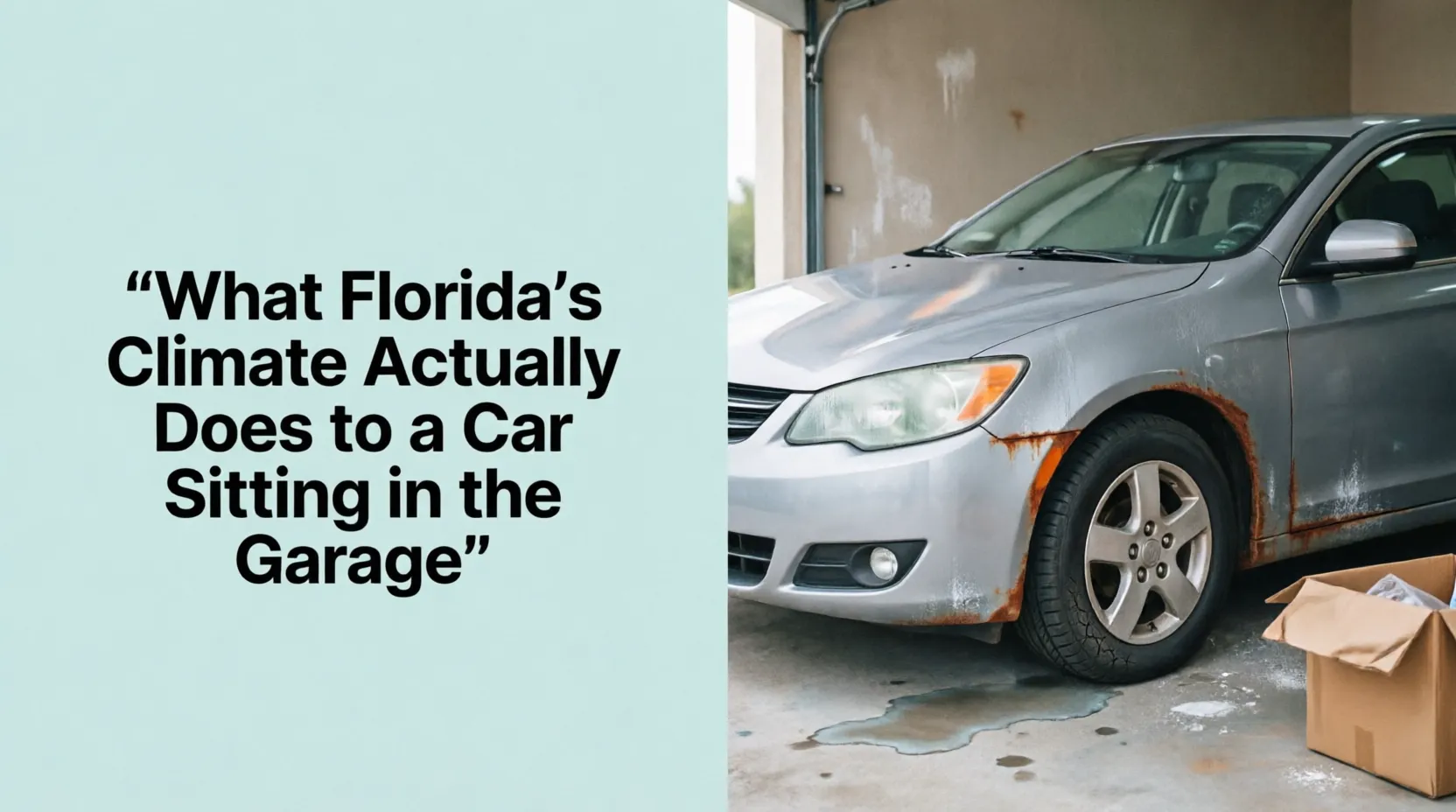

The biggest threat to an exotic car in South Florida rarely comes from the road. It comes from sitting still.
Most exotic and collector cars aren’t daily drivers. They spend the bulk of their time parked, sometimes for weeks between drives, which is exactly when Florida’s climate does the most damage. Heat, humidity, and salt air don’t pause because a car isn’t moving. If anything, a car that sits still in a closed garage is more exposed to some of these effects than one that’s driven regularly and has a chance to work moisture out of its systems.
Here’s what that exposure actually costs an owner, and what to check before it turns into a repair bill.
Humidity attacks the parts mileage doesn’t touch
Rubber seals, gaskets, and hoses don’t wear out primarily from use. They degrade from heat and humidity cycling, the daily swing between a hot, damp garage during the day and a slightly cooler one overnight. That cycle dries out rubber and breaks down seals faster than the odometer would suggest, which is why a low-mileage car that’s spent years in a Florida garage can have surprisingly tired seals compared to a higher-mileage car from a drier climate.
A climate-controlled garage helps, but temperature control alone doesn’t solve for humidity. Without active dehumidification or at minimum good airflow, a “climate-controlled” space can still sit at humidity levels that work against rubber and gasket materials year-round.
Batteries drain faster than owners expect
Heat is hard on batteries in general, and a battery that’s also sitting mostly unused compounds the problem. Self-discharge happens faster in warm conditions, and a car that only gets driven occasionally doesn’t get the regular charging cycle that keeps a battery healthy. An owner who assumes a battery will simply be fine because the car “isn’t doing much” is usually the one surprised by a dead battery before a planned drive.
A trickle charger or battery maintainer isn’t overkill for a car in this climate that isn’t driven at least weekly. It’s closer to a baseline requirement.
Tires age before they wear out
Tread depth tells only part of the story. UV exposure and ambient heat degrade tire sidewalls over time regardless of how many miles are on them, and a set of tires that looks fine visually can be well past the point where the rubber compound is still performing the way it should. This matters more in Florida than in cooler, less sun-exposed climates, where the same tires might age more slowly.
Checking the date code molded into the sidewall, not just the tread, is the only reliable way to know how old a tire actually is, which matters even more on a car that’s put on relatively few miles per year.
Salt air works on metal you can’t see
Coastal Florida’s salt air accelerates corrosion on components that aren’t always visible during a casual inspection: brake lines, exhaust hardware, and undercarriage fasteners in particular. CARFAX’s own guidance on inspecting rust notes that vehicles from humid or coastal climates are more prone to this kind of hidden corrosion than cars from drier regions, even when the visible bodywork looks clean.
Regularly rinsing the undercarriage, particularly for a car parked near the coast, is a small habit that meaningfully slows this process. It’s easy to skip precisely because the damage it prevents isn’t visible until it’s already a problem.
Interiors fade faster than owners plan for
Florida sun does to a cabin what it does to a beach umbrella: it wins, eventually. Dashboards and leather that would hold up for a decade in a milder climate can start cracking, fading, or drying out in a fraction of that time under direct sun exposure, even for a car that’s garaged most of the week and only driven occasionally.
A cover helps when a car is parked outdoors at all, and UV-blocking window treatment on a garage that gets afternoon sun through windows or a glass door does more than most owners expect. Neither is a substitute for simply minimizing how much direct sun the interior sees, which is easy to overlook precisely because the damage builds slowly, one afternoon at a time.
What a specialist catches before a private seller would
This is where buying from a dealer that reconditions cars before resale, rather than from a private seller who’s simply had the car sitting, tends to make a real difference. A specialist working through pre-sale inspection is more likely to catch dried-out seals, an aging battery, or early corrosion on undercarriage components before those issues become the new owner’s problem. Dealers such as Coast to Coast Imports, who service the cars they sell rather than simply flipping inventory, are positioned to catch exactly this kind of climate-related wear during reconditioning.
A private-sale car that’s spent years sitting in a Florida garage, by contrast, is only as well-maintained as its previous owner happened to be about these specific, easy-to-ignore details.
Staying ahead of it
Owning an exotic car in a place like South Florida is genuinely a tradeoff. The same climate that makes it a great place to actually drive one, year-round, with no winter storage season to plan around, is quietly working against the car every day it isn’t being driven. The owners who stay ahead of it treat seals, batteries, tires, and undercarriage checks as routine maintenance rather than an afterthought. The ones who don’t tend to find out the difference the expensive way, usually right around the time they finally take the car out for the drive they’d been planning for months.






























Sign in to leave a comment.